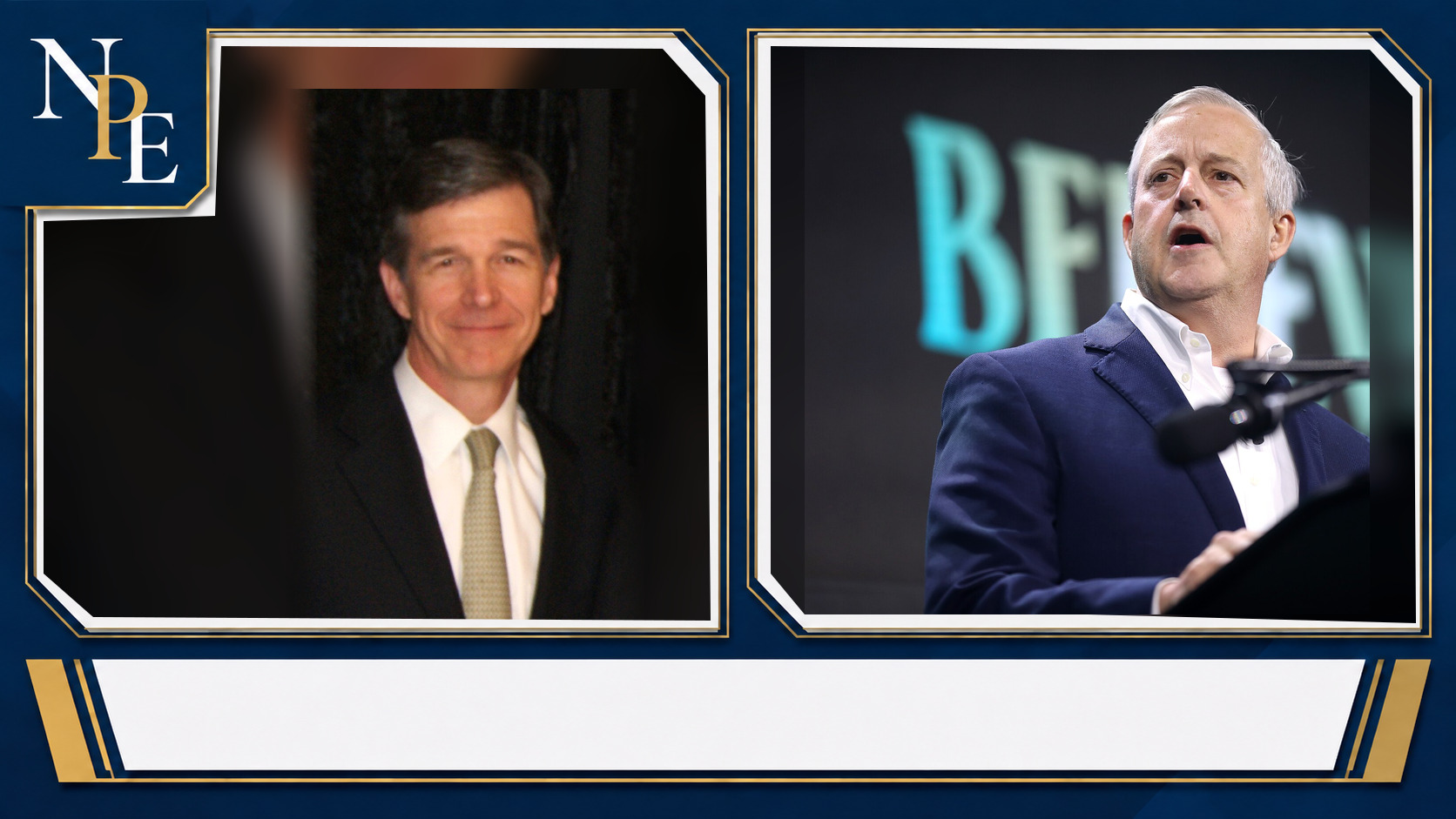
The new survey gives Democrats an encouraging early number in a pivotal open-seat race. But the result also highlights the voters and campaign dynamics that could decide whether Roy Cooper’s lead lasts through November.
Roy Cooper leads Michael Whatley by seven points in a North Carolina Senate poll, with Cooper receiving 50 percent support and Whatley receiving 43 percent. The Carolina Forward survey, conducted by Change Research, offers an early snapshot of the open race to replace retiring Republican Sen. Thom Tillis.
The seven-point margin puts the former Democratic governor in front, but it also sets up the central question for the months ahead: whether Cooper can hold his advantage once Republicans introduce Whatley more broadly and both sides spend heavily to reach undecided and independent voters.
The poll’s top-line picture
The Carolina Forward poll surveyed 915 respondents and reported a margin of error of 3.5 percentage points. Cooper’s seven-point lead is outside that stated margin, making the result more than a statistical tie within the survey’s own range.

Still, a poll is a measure of opinion at one moment, not a prediction of ballots cast in November. Its findings can be affected by the people reached, turnout assumptions, wording and the timing of the survey.
That caveat is especially relevant here because Carolina Forward is a left-leaning organization. Change Research conducted the survey for the group. The sponsorship does not make the results unusable, but it is an important part of evaluating any single campaign poll.
Seven percent of respondents said they were unsure or did not plan to vote in November. That share alone would not erase Cooper’s current lead, but it underscores that neither campaign can assume its support is locked in.
Independents give Cooper his clearest edge
Partisan voters in the survey largely backed their own side. Cooper drew support from 97 percent of Democratic respondents, while 91 percent of Republicans supported Whatley.
The more consequential split came among independents. Cooper led Whatley 48 percent to 20 percent in that group, while 32 percent were unsure or said they did not plan to vote.
Those figures give Cooper a substantial current advantage with independents, but they also leave a sizable group whose eventual choices or turnout remain uncertain. In close statewide races, those voters can become the focus of advertising, debates and efforts to define candidates before partisan preferences harden.
For Whatley, improving his standing with independents is an obvious task. For Cooper, the challenge is preserving an early advantage with a group that has not fully settled on the race.
A familiar split across the state
The survey points to a coalition divided by gender and geography. Cooper led by 15 points among women, by 35 points among urban respondents and by 20 points among suburban respondents.
Whatley held a one-point edge among men and a 20-point advantage among rural voters. The pattern reflects the broader challenge of assembling a statewide majority in North Carolina: Democrats look to build large margins in population centers and suburbs, while Republicans rely on strength in rural areas.
That means the contest may not turn only on whether Whatley protects his rural base. Limiting Cooper’s suburban advantage could be just as important, particularly if the race tightens as more voters focus on the candidates.
The survey offers a picture of current divides, not proof that they will remain fixed. Turnout and the size of each side’s margins across those groups will matter as much as the broad map itself.
Name recognition is part of the fight
Cooper begins with a long history in statewide politics. Before serving eight years as governor, he was North Carolina’s attorney general. According to the poll report cited by The Hill, he has won each of his six general-election contests in the state since 2000.
That familiarity appears to give him an asset, though the poll did not show overwhelmingly positive views. Cooper had a net favorability rating of plus 2 points.
Whatley, a former Republican National Committee chair, had a less established profile in the survey. Thirty-seven percent viewed him unfavorably, 29 percent viewed him favorably and 17 percent said they had never heard of him.
Those numbers cut two ways. Lower familiarity can make it harder for a candidate to gain support quickly, but it can also provide room for a campaign to introduce that candidate to voters. It also leaves room for an opponent to shape impressions first.
Outside groups are preparing to test it
Both parties have financial reasons to treat the current numbers as a starting point rather than an endpoint. Federal Election Commission filings showed Cooper’s campaign had about $17.2 million more cash on hand than Whatley’s at the end of June.
Republican-aligned groups are planning significant spending. The Senate Leadership Fund announced a $17 million summer advertising effort supporting Whatley and opposing Cooper, calling it the first phase of a $71 million North Carolina investment.
Democratic-aligned Senate Majority PAC has said it will spend $11 million on television advertising tied to the race, as part of a broader $42 million television investment in the state.
Those planned expenditures make the race a test of whether a polling lead can withstand repeated messaging on television, digital platforms and the ground. They also suggest that voters who currently have little familiarity with Whatley are likely to see much more of him.
An open seat with national stakes
Tillis’ retirement has created an open-seat contest, removing the usual advantage held by an incumbent senator seeking another term. Democrats view North Carolina as one of their clearest pickup opportunities.
Among six Republican-held Senate seats targeted by Democrats, North Carolina is the only one that the Cook Political Report currently rates as leaning Democratic. Republicans hold a 53-47 edge in the Senate, and Democrats would need a net gain of four seats to win the chamber outright under the current alignment.
A 50-50 Senate split would leave Vice President JD Vance with the tie-breaking vote on party-line Senate decisions. That broader math helps explain why the race is attracting major commitments from party-aligned groups.
For now, the Carolina Forward survey gives Cooper a measurable 50 percent to 43 percent advantage over Whatley. The unresolved issues are whether Whatley can become better known, whether Republicans can narrow Cooper’s edge among independents and suburban voters, and how much the coming spending campaign changes a contest that remains months from Election Day.
Leave a Reply