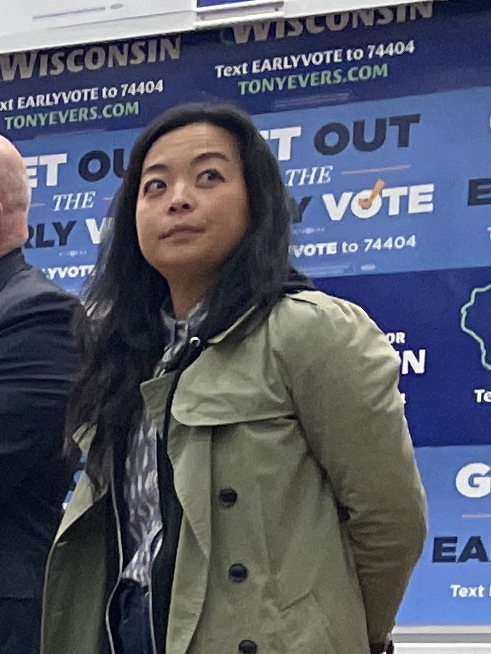
Hong’s rise has turned an open Wisconsin governor’s race into a debate over which kind of Democrat can win statewide. The immediate contest is between grassroots enthusiasm and establishment concerns about November electability.
Francesca Hong is leading Wisconsin’s Democratic primary for governor, and her lead is alarming establishment Democrats. The 37-year-old state representative, part-time bartender and Democratic Socialists of America member has led polling ahead of voting in the open race, according to The Wall Street Journal. Her standing matters because Wisconsin is a battleground state, and Democrats are weighing whether Hong’s progressive coalition can carry a general election.
Hong faces Milwaukee County Executive David Crowley, described by CBS News as the more moderate candidate after other Democrats left the race. The primary is an unusually clear test of a question facing the Democratic Party well beyond Wisconsin: when voters want change, does a candidate with a sharper ideological identity expand the electorate or narrow the path to November?
Why Hong’s lead changes the race
A primary lead does not settle an election, and polling can shift quickly in a low-turnout contest. Still, Hong’s position has placed a democratic socialist at the center of the state’s most consequential Democratic nomination fight.
That is a striking development in Wisconsin, where statewide contests are often decided by thin margins and campaigns traditionally focus intensely on persuading independents, suburban voters and ticket splitters. President Donald Trump won Wisconsin in 2024 by less than a percentage point, CBS News noted, underscoring how little room either party may have for strategic missteps.
For Hong’s supporters, her momentum can be read differently: as evidence that the standard playbook is no longer enough. A campaign that speaks directly about affordability, workers and power in state government may animate voters who do not feel represented by more conventional candidates.
The tension is not simply ideological. It is about turnout, persuasion and coalition-building—the three things that determine whether a primary message can become a statewide governing mandate.
Hong brings an explicit left identity
Hong is not being presented as a vague “progressive” candidate. The Wall Street Journal identified her as a dues-paying member of the Democratic Socialists of America, an affiliation that gives voters and party leaders a clear signal about the politics she represents.
Democratic socialism covers a broad range of views, but in U.S. electoral politics it is generally associated with a larger public role in addressing economic inequality, stronger worker protections and a willingness to challenge corporate power. Individual candidates differ sharply on the details, so the label alone does not establish a complete governing agenda.
It does, however, create a ready-made contrast. Hong’s identity can help her connect with left-leaning voters who see moderation as insufficient in the face of housing costs, health-care costs and wage pressure. It also gives opponents an easy line of attack in a general election, particularly if Republicans seek to make the race a referendum on national ideological labels.
Her biography adds another layer. A state representative who also works part time as a bartender can credibly frame her campaign around day-to-day economic realities. That story may resonate with voters who distrust political careerism, though biography by itself does not answer the larger question of how a candidate will perform across Wisconsin’s varied regions.
Establishment Democrats see November risks
The concern reported by the Journal is fundamentally about electability. Party insiders worry that Hong could face a more difficult general election than a Democrat with a more moderate profile.
That argument rests on Wisconsin’s political geography. Democrats need overwhelming support in urban areas, strong participation from younger and diverse voters, and enough appeal in suburbs and smaller communities to keep Republican margins manageable. In a race likely to attract national attention and outside money, every piece of that coalition will be scrutinized.
Critics of Hong’s path may argue that a DSA affiliation gives Republicans a simple message for persuadable voters. They may also worry that national Democratic donors and groups could hesitate if they believe the nominee is harder to position in the center of a closely divided state.
But treating those concerns as settled facts would be a mistake. “Moderate” does not automatically mean more electable, especially when voters are skeptical of familiar political formulas. A candidate who inspires volunteers, small-dollar donors and occasional voters can compensate for some weaknesses in traditional persuasion politics.
The Crowley contrast is about coalition
David Crowley offers Democratic primary voters a different theory of the race. CBS News characterized the Milwaukee County executive as the more moderate candidate, a description that places the contest in the wider Democratic debate between party pragmatists and its energized left flank.
In practical terms, the choice is less tidy than labels suggest. Both candidates would need support from Democratic base voters, while any eventual nominee would need to make a case to voters who are not ideological partisans. The difference is likely to be emphasis: whether the campaign’s most powerful argument is transformation, broad reassurance, executive experience or a combination of all three.
Hong’s supporters could argue that an explicitly progressive campaign creates contrast and enthusiasm in a way a cautious campaign cannot. Crowley’s supporters could counter that Wisconsin’s margins demand a nominee who begins with fewer questions from swing voters and general-election allies.
Neither side can know the answer until the primary electorate speaks and the fall campaign takes shape. The primary outcome will show what Democratic voters prefer; it will not, by itself, prove which strategy is best for November.
Wisconsin has national significance
The open governor’s race follows the decision by two-term Democratic Gov. Tony Evers not to seek reelection, according to CBS News. An open-seat contest removes the advantages of incumbency and makes the nomination especially valuable to both parties.
Wisconsin also remains one of the country’s most closely watched political states. It has one Republican and one Democratic senator, and its recent presidential results have repeatedly demonstrated that campaigns cannot assume any bloc of voters is safely locked in.
That makes Hong’s lead relevant to Democrats nationwide. If she wins the nomination, party leaders will be watching whether an unapologetically democratic socialist candidate can assemble a winning statewide coalition in a presidential battleground. If she falls short, the race will still shape arguments about where the party’s ideological center should sit.
What the primary can and cannot answer
The immediate question is whether Hong can turn a polling advantage into votes. The available reporting establishes that she was leading ahead of the final day of balloting; it does not establish a final result, a margin or how different voter groups ultimately broke.
After the primary, the focus will move quickly to the Republican nominee. CBS News reported that Rep. Tom Tiffany, an ally of President Trump, was all but certain to secure the GOP nomination. That prospective matchup would sharpen the contrast between Wisconsin’s competing visions of state leadership.
For now, Hong’s rise has already delivered a message to the Democratic Party: candidates once treated as outside the establishment can no longer be dismissed as protest figures. Whether that message becomes a winning statewide formula remains the central unanswered question of Wisconsin’s governor’s race.
Leave a Reply