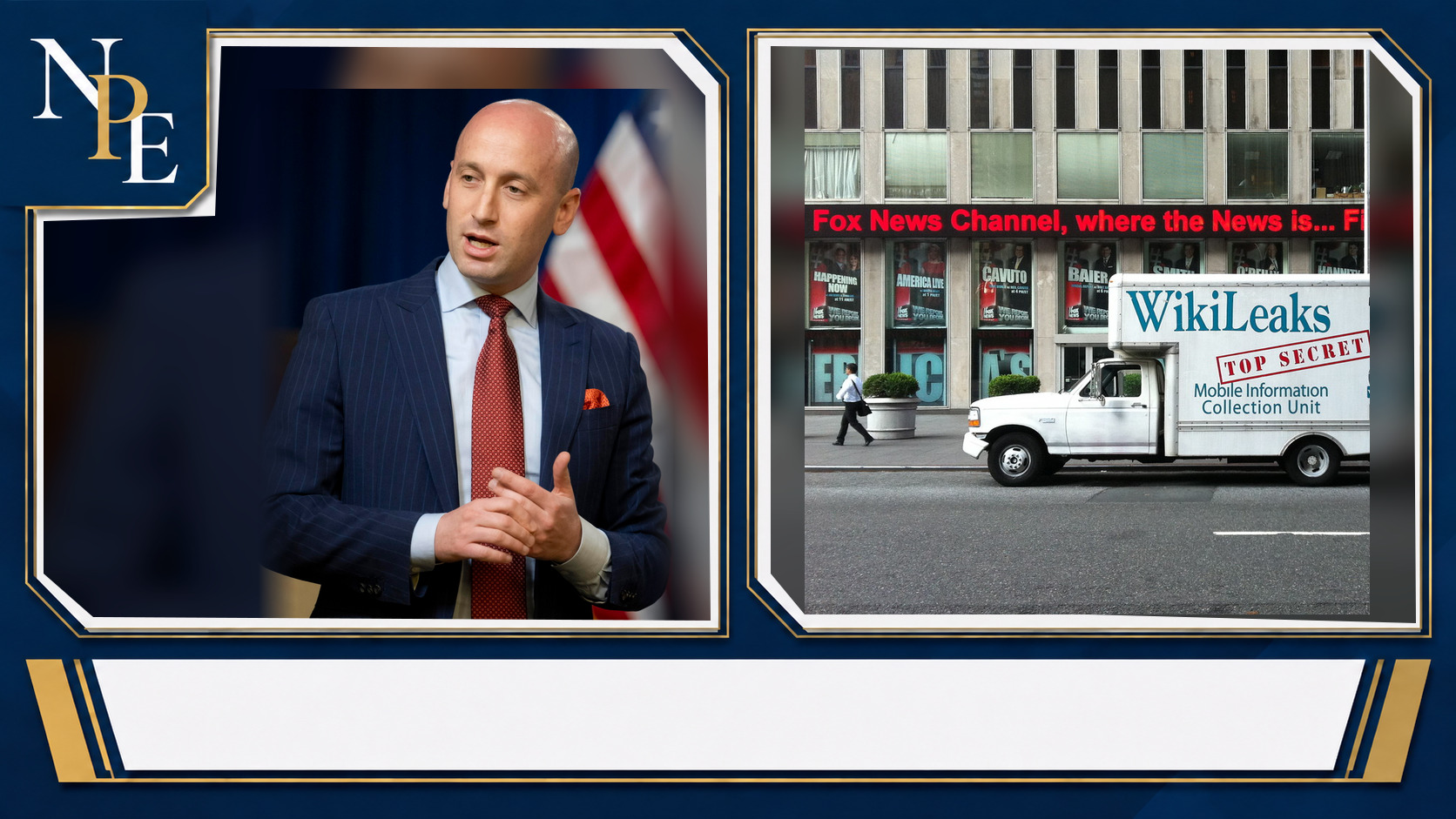
A Fox News interview about Iran put Stephen Miller’s language and assessment of U.S. leverage under fresh scrutiny. The reaction shows how quickly televised claims about an active conflict can be tested online.
Stephen Miller made comments on Fox News about Iran that prompted strong backlash across social media, according to reporting by the Irish Star. Miller said the United States had “all the cards” and could force Iran to choose between an agreement acceptable to Washington and severe military punishment.
The criticism focused less on his appearance itself than on the gap viewers saw between that confident assessment and the reported disruption around the Strait of Hormuz. The dispute matters because public claims about leverage, military power and negotiations can shape how audiences understand a volatile conflict.
Miller’s warning on Fox News
Miller, identified by the Irish Star as the White House deputy chief of staff for policy, appeared on Jesse Watters Primetime to discuss Iran and the prospects for a new agreement.

In the interview, he described what he called a “binary choice” for Iran. In his account, Iran could accept terms satisfactory to the United States or face punishment by the U.S. military “the likes of which have not been seen in modern history.”
He also argued that Iran had been weakened and stripped of its ability to wage broader war. “America can shut Iran down,” Miller said, adding that the United States had “all the cards,” “all the power” and the decisive room to act.
That language was unmistakably designed to project confidence. But it also set a high bar: if Washington has overwhelming control, critics argued, the situation on the ground should appear to reflect it.
The Strait became the rebuttal
The strongest social-media responses cited in the report centered on the Strait of Hormuz, a strategically vital waterway used for energy shipments. Critics pointed to the reported closure or disruption of the route as evidence that Iran retained meaningful leverage.
One response quoted by the Irish Star challenged Miller’s “all the cards” line by asking why the strait remained closed. Another argued that the conflict would not end until Iran decided it should end.
Those posts should not be mistaken for a scientific measure of public opinion. Social-media reactions are selective, highly partisan and often amplified by outrage. Still, they reveal the precise claim that landed badly: not simply that Miller took a tough line, but that he presented U.S. control as nearly complete.
The criticism also reflects a familiar problem in wartime messaging. A government official may want to reassure allies and deter adversaries, while skeptical audiences judge the message against fuel prices, trade disruptions, military developments and the duration of the conflict.
Why confidence can invite scrutiny
Officials often use forceful language in public discussions of foreign policy. It can signal resolve, reinforce a negotiating position and avoid publicly revealing uncertainty. Supporters of Miller’s stance may see that approach as necessary when dealing with an adversary they believe responds only to pressure.
At least one online response cited by the Irish Star backed Miller and predicted a U.S. victory under President Donald Trump. That support is important context: the reaction was not unanimous, even if the report emphasized criticism from viewers.
Critics, however, saw Miller’s phrasing as overconfident. Their argument was not necessarily that the United States lacks military strength. It was that military strength does not automatically erase Iran’s ability to disrupt shipping, influence regional conditions or make negotiations more difficult.
That distinction is central to the backlash. Holding superior military capabilities and holding every practical advantage in a conflict are not necessarily the same thing, particularly where trade routes, regional allies and political costs are involved.
Negotiations complicate the message
The Irish Star reported that Iran had presented a six-point peace proposal to the United States. The reported conditions included lifting a blockade, a pullback of U.S. forces from areas near Iran’s borders and compensation for war-related damage.
The report also said Trump had called off a planned major strike, citing what he described as serious negotiations over a new agreement. Those claims were presented in the report as part of the backdrop to Miller’s Fox News appearance.
If negotiations are actively underway, the rhetoric around power becomes especially consequential. Statements that frame one side as fully defeated can make compromise look politically harder, while statements emphasizing the other side’s leverage can be used to challenge the administration’s account of events.
None of that establishes whether a deal is close, what terms either government would accept or whether the reported proposal could produce an agreement. The available reporting leaves those questions unresolved.
What the backlash does and doesn’t show
The online reaction does show that Miller’s comments struck a nerve with viewers who believed conditions around the Strait of Hormuz contradicted his assessment. It also shows how a single phrase — “all the cards” — can become the shorthand critics use to contest a broader policy argument.
It does not, by itself, prove that Miller’s view is wrong or that the critics’ understanding of military and diplomatic conditions is complete. Social platforms reward concise, confrontational responses, while the actual balance of leverage in a conflict is shaped by intelligence, logistics, diplomacy and decisions not visible to the public.
Still, the exchange puts the administration’s public messaging under pressure. Miller’s argument was clear: Iran is weakened and Washington is in command. The backlash was equally clear: some viewers believe the reported disruption at a critical shipping route tells a more complicated story.
For now, the most significant question is not whether every online reply was fair. It is whether events and negotiations will support the certainty Miller projected on Fox News — or give his critics more evidence for their challenge.
Leave a Reply