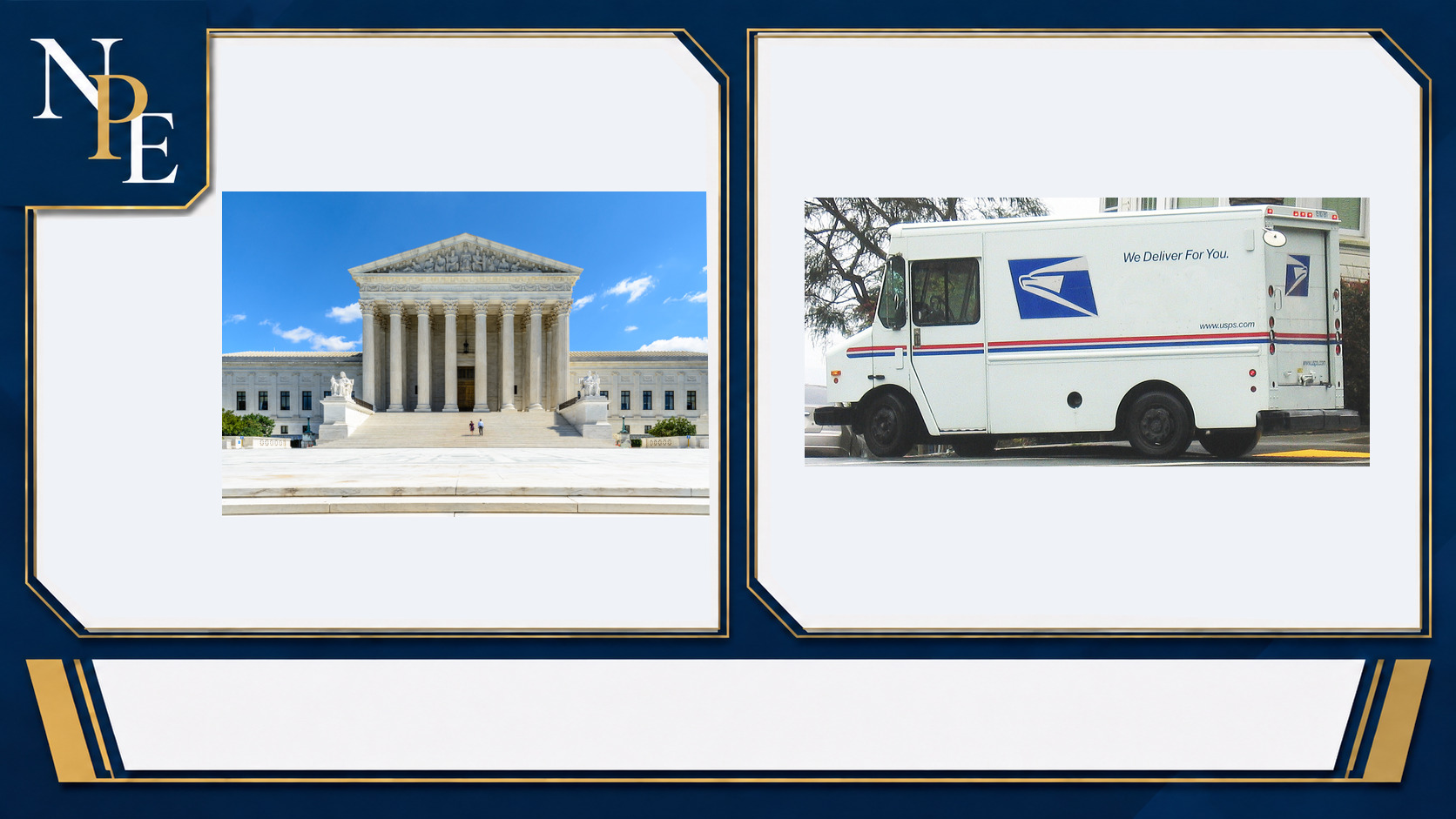
A separate nationwide order still restrains the U.S. Postal Service, even as the Supreme Court allows the Trump administration to proceed with other parts of its mail-in voting policy for now.
The Supreme Court’s action does not allow every part of President Donald Trump’s mail-in voting executive order to take effect. A separate ruling by U.S. District Judge Indira Talwani temporarily bars the U.S. Postal Service from implementing one provision anywhere in the country, and that restriction remains in place.
At the same time, the justices paused Talwani’s other injunction, which had prevented the federal government from applying challenged portions of the order in 23 states and Washington, D.C., before the November 2026 elections. The result is a divided legal landscape: parts of the policy may move ahead, while a Postal Service provision remains blocked nationwide.
The nationwide Postal Service block remains
The Postal Service injunction came in a separate case brought by different plaintiffs. It temporarily prevents USPS from carrying out one provision of Trump’s executive order across the United States, at least for now.
That means the administration’s Supreme Court win is limited. Although federal agencies can proceed with portions of the policy after the Court’s action, the administration cannot currently implement every mail-ballot measure contemplated by the order.
For election officials, the two rulings leave some federal policy moving forward while the provision most directly tied to Postal Service ballot delivery remains under a separate court restriction.
Why the Supreme Court intervened
In an unsigned, 10-page opinion, the Court concluded that the states’ challenge arrived too early because the executive order had not yet been implemented. The majority said the states had not yet suffered the kind of concrete injury required for their lawsuit to proceed as it had.
The decision gave the Trump administration temporary relief from Talwani’s Massachusetts order. It did not resolve whether the president has authority to impose the proposed voting restrictions or decide the broader constitutional arguments raised by the states.
Those questions remain for later stages of the litigation, as do questions about how agencies will carry out the order and how states will respond if implementation becomes more concrete.
What the executive order directs
Trump signed the executive order in March. The dispute before the Supreme Court focused on provisions involving federal election administration and mail ballots.
- The order directs the Department of Homeland Security to compile lists of adult U.S. citizens in each state and send them to states at least 60 days before a federal election.
- It instructs the attorney general to prioritize investigations and potential prosecutions of state and local officials who issue federal ballots to people deemed ineligible to vote in federal elections.
- It requires states to provide the Postal Service with lists of voters expected to receive mail ballots and contemplates limits on mailing ballots to people not included on Postal Service enrollment lists.
The administration has described the policy as an election-integrity measure. Critics argue that it reaches into decisions traditionally left to states and could disrupt mail-voting systems close to an election.
California and other states challenge the policy
California led the case brought by 23 states and the District of Columbia in federal court in Massachusetts. The challengers argued that the executive order conflicts with constitutional provisions giving states substantial authority over voter eligibility and the time, place and manner of congressional elections.
The states argued that the federal executive branch cannot use an order to reshape state election administration in areas where the Constitution and Congress assign important responsibilities elsewhere. They also said they could not wait for every operational detail to be finalized because election calendars and absentee-ballot deadlines were approaching.
Talwani accepted that concern for the November 2026 elections, finding that the order created a direct and immediate dilemma for the states. The Supreme Court took a different preliminary view, emphasizing that implementation had not yet created a sufficiently concrete injury.
The justices split over timing
The Court’s three Democratic appointees dissented in a 23-page opinion by Justice Ketanji Brown Jackson. She argued that the majority focused too heavily on procedural timing and did not confront what she described as the government’s real-world effort to alter election administration before the midterms.
Jackson warned that the Court’s intervention could create disorder ahead of the election. Her dissent reflected a broader disagreement over whether courts should act only after an administration takes concrete steps or earlier, when states say they must alter plans in response to an announced federal directive.
The administration had argued that the lower-court injunction improperly prevented agencies from developing and implementing the president’s proposed policies. It also maintained that delays would harm the government as mail-in and absentee voting deadlines drew nearer in some states.
For voters, mail-in voting rules have not suddenly changed nationwide. The Supreme Court has allowed parts of the executive order to proceed, but the continuing litigation and separate Postal Service injunction leave the policy unsettled heading into the 2026 midterms.
Leave a Reply