The claim has drawn attention because Melania Trump’s public schedule has been selective, making every appearance around the president a source of speculation. But the reported lookalike sighting comes with major unanswered questions.
Melania Trump remains absent from public view, according to a report that also says Donald Trump was reportedly spotted with someone described as a Melania Trump lookalike. The contrast between the first lady’s low-profile public presence and the alleged appearance has fueled online interest, but the available source material does not establish who the woman was, where the sighting occurred, or provide independently verifiable evidence for the claim.
That distinction matters. A description of someone as a “lookalike” is not confirmation that Melania Trump was replaced, impersonated or secretly represented at an event. It is a subjective label that can spread quickly when images, clips and secondhand accounts circulate without enough context.
What the report actually claims
The originating headline frames the story around two ideas: Melania Trump’s continued absence from public view and a reported Donald Trump appearance involving a woman said to resemble her. Yet the extracted material available for review contains no event details, photographs, video provenance, named witnesses or official statement establishing the identity of the person described.
That does not prove the appearance did not happen. It does mean the claim should be treated as unverified rather than as a confirmed account of the Trumps’ movements or relationship.
There is an important difference between a person being photographed near Donald Trump and a reliable report identifying that person. In a high-visibility political setting, a vague resemblance can become the entire story before the underlying circumstances are clear.
Melania Trump has appeared publicly
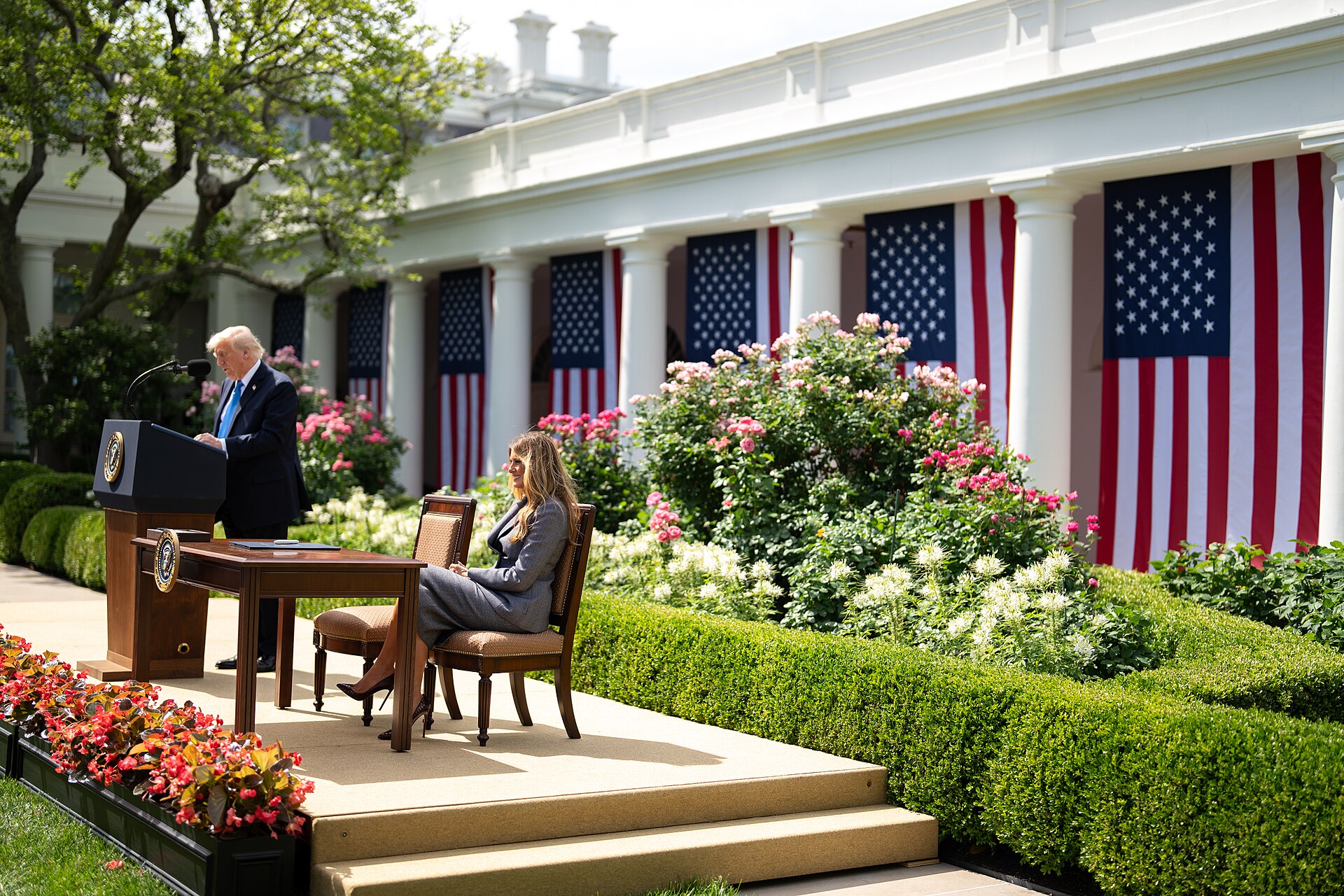
Describing Melania Trump as entirely absent would also overstate the record. The White House said she joined President Donald Trump in the Rose Garden on May 19, 2025, for the signing of the TAKE IT DOWN Act, legislation addressing the nonconsensual distribution of intimate images and certain deepfake abuse.
At that event, Melania Trump spoke about children’s well-being, online exploitation and the need for stronger protections. The White House described the measure as a priority tied to her BE BEST initiative and credited her with advocacy during the bill’s path through Congress.
That confirmed appearance does not settle whether she attended any later event referenced in the lookalike report. It does provide needed context: a selective public schedule is not the same as a total disappearance from public life.
A low-profile role invites speculation
First ladies are often expected to function as highly visible partners in a president’s public calendar. When they choose a narrower role, their absence can become a story in itself, especially when the president continues to appear frequently before cameras.
Melania Trump has long drawn attention for making fewer public appearances than some recent first ladies. That preference may reflect personal, family, political or scheduling decisions, but those motives cannot be assumed without direct confirmation from her office.
The gap between public expectation and limited information is where rumor tends to thrive. A distant image, unusual camera angle, unfamiliar aide or guest, or an edited video can be interpreted as proof of something larger than the available facts support.
Why the “lookalike” label travels
Lookalike claims have a built-in advantage online: they are easy to understand, visually provocative and difficult to disprove from a cropped photo or short clip. They also tap into a long-running internet culture of celebrity impersonation theories, including repeated false claims that public figures use doubles.
Those theories deserve special caution in an era when manipulated content can appear convincing. The TAKE IT DOWN Act itself has placed national attention on harms linked to nonconsensual intimate imagery and deepfakes, although there is no evidence in the available material that the alleged Trump appearance involved artificial intelligence or altered media.
Still, the broader lesson applies. A visual claim should be assessed through its source, date, location, full footage or photo sequence, and corroborating reporting—not just by whether one person appears to resemble another.
What remains unconfirmed
The core questions are straightforward, and the current material does not answer them: Who was the woman described as a Melania Trump lookalike? When and where was Donald Trump allegedly seen with her? Was she a staff member, attendee, acquaintance, performer, security-related personnel or someone else entirely?
There is also no documented response in the supplied research from Donald Trump, Melania Trump, the White House or representatives for either of them. Without that information, broader conclusions about Melania Trump’s whereabouts or the purpose of the alleged appearance would be speculation.
For now, the more defensible reading is narrower than the viral framing. A report has linked Melania Trump’s low public profile to an alleged Donald Trump sighting with a supposed lookalike, but the identity and circumstances behind that claim have not been independently established.
The takeaway beyond the rumor
The episode shows how quickly limited visibility can turn into a narrative about a public figure. Melania Trump’s infrequent appearances create room for curiosity, while Donald Trump’s prominence ensures that anyone beside him can become the subject of intense scrutiny.
Interest in the claim is understandable. Treating resemblance as evidence is another matter. Until reliable documentation identifies the person involved and verifies the setting, the lookalike story remains an unconfirmed report—not a verified development about the first lady.
Leave a Reply