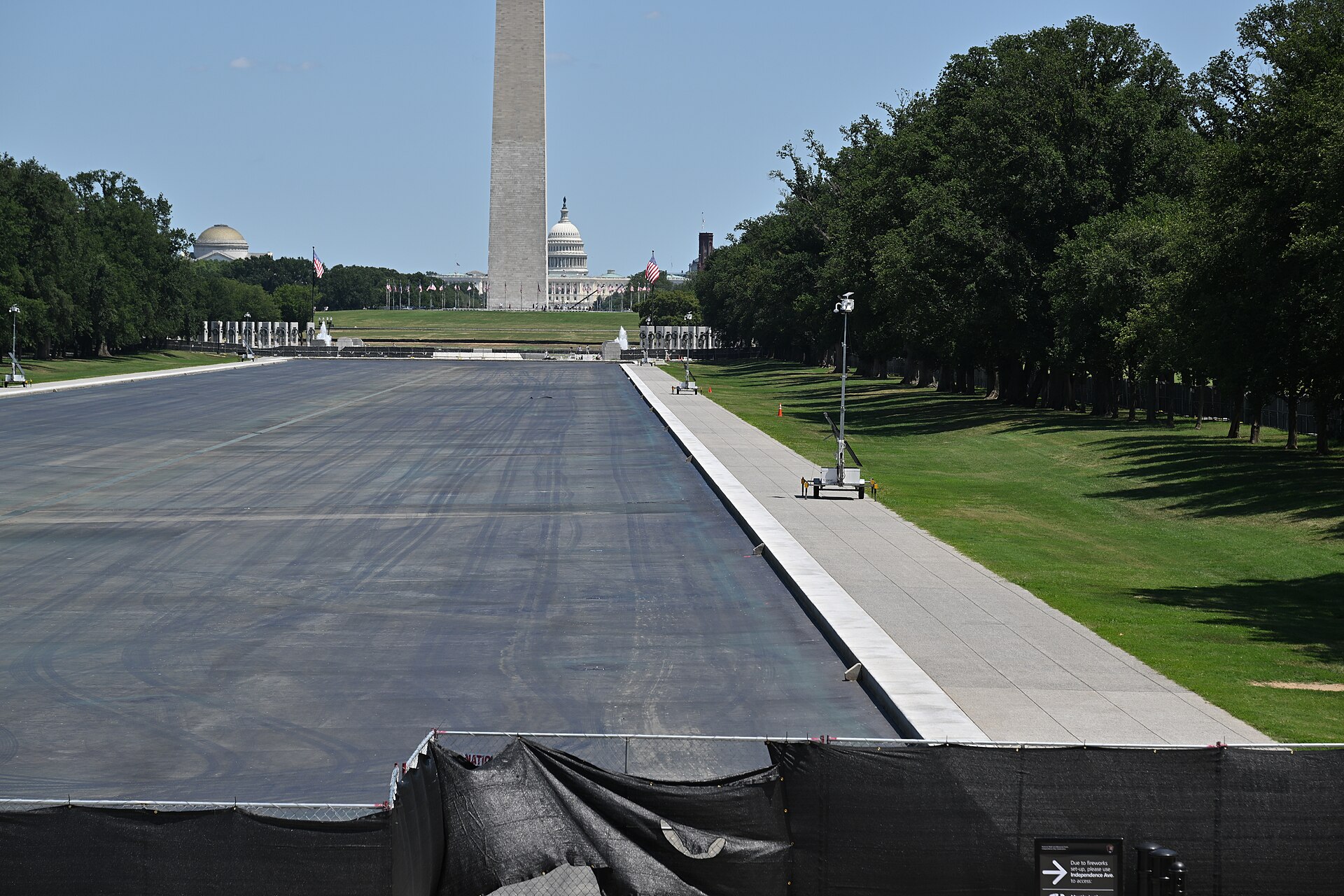
The dispute is no longer just about algae and peeling blue coating. It is now about whether a fast-tracked public renovation was oversold, then explained away with claims officials have not fully documented.
Donald Trump’s reflecting pool controversy in Washington now centers on the debate over vandalism versus a faulty renovation at the Lincoln Memorial Reflecting Pool. After a $16.4 million project tied to the nation’s 250th anniversary, including a more than $14 million blue coating contract, Trump tried to blame the problems on vandalism. On Saturday, June 20, 2026, he acknowledged more work was needed; National Park Service workers had found two cuts, while Trump later claimed multiple arrests and at least seven citations.
That matters because internal records reviewed by The New York Times suggest the pool’s visible failures include peeling coating, malfunctioning anti-algae equipment and green water problems that are not fully explained by the vandalism allegations. The dispute has turned a messy renovation into a political test of proof, competence and public trust.
The pool became the message
The Lincoln Memorial Reflecting Pool is not just another federal maintenance site. It sits between the Lincoln Memorial and the Washington Monument, where tourists, television cameras and official ceremonies turn water quality into symbolism almost instantly.
Trump had promoted the renovation as part of his broader effort to refresh Washington for the nation’s 250th anniversary. The idea was simple: make a famous civic space look cleaner, bluer and more ceremonial before a major patriotic milestone.
Instead, the pool became an unwanted exhibit. Reports described peeling blue sealant, algae blooms and sections of water that looked bright green rather than reflective. For an administration selling the project as proof of speed and competence, the visual contrast was damaging.
That is why the controversy escalated. A botched repair can be embarrassing. A botched repair followed by disputed blame claims becomes a scandal-shaped problem.
Documents undercut a simple blame story
Trump has said vandals damaged the pool with knives or razors, and he also claimed, without publicly presented evidence, that fertilizer had been dumped into the water to feed algae. According to The New York Times, he said six people had been arrested and seven others cited in connection with the damage.
The documents reviewed by the Times complicate that account. National Park Service workers did find cuts in foam near expansion joints, and a U.S. Park Police report described razor-blade slashes along a stretch of foam. But the same reporting said those cuts were not directly tied to the peeling blue coating or the algae blooms that made the pool look visibly troubled.
That distinction matters. Foam in expansion joints and blue sealant across the pool bottom are not the same thing. If vandalism affected one part of the structure, it does not automatically explain every visible problem.
The Times also reported that the White House and Interior Department did not provide charging documents, citations or names of those allegedly arrested. The incident report shared with the paper reportedly listed suspects as unknown and did not mention vandals dumping fertilizer.
Officials defended the renovation
The administration has not retreated from its broader position. Katie Martin, a spokeswoman for the Interior Department, told the Times the pool was clear and reflecting beautifully, while also saying vandals were trying to destroy, impede and delay restoration work.
That argument has political force for Trump’s supporters: a prominent civic project was underway, damage was found, and officials say malicious actors interfered. If further records show deliberate sabotage caused major damage, the vandalism explanation would gain weight.
But for critics, the available timeline points in another direction. The pool had been drained, resealed and refilled by June 5, according to the Times. Four days later, workers found holes, cracks, peeling caulking and cuts in foam. By June 16, chunks of blue sealant were reportedly peeling and floating to the surface.
The unresolved question is not whether any damage occurred. It is whether the damage explains the most visible failures, and whether public statements raced ahead of the evidence.
No-bid contracts raised expectations
The renovation also carries a contracting issue. The Trump administration awarded two no-bid contracts for the Reflecting Pool work, citing the urgency of finishing the project for 250th anniversary events, according to the Times.
One contract, worth $14.7 million, went to Virginia-based Atlantic Industrial Coatings for the blue sealant. A second, worth $1.7 million, went to Ohio-based Greenwater Services for anti-algae devices known as nanobubblers.
Emergency or urgent contracting is not automatically improper. Governments sometimes move quickly when deadlines, safety or major public events are involved. But speed narrows the margin for error, especially when a project sits on one of the most photographed civic landscapes in the country.
When a no-bid, deadline-driven project fails to look finished, taxpayers are left with basic questions: Was the rush justified? Were the contractors ready? Did officials understand the risks? And who is responsible for repairs?
Algae may have had other help
The algae dispute is especially awkward because the pool already had a long history of leaks and algae problems. The renovation was supposed to solve familiar issues, not reintroduce them days later.
The Times reported that some temporary nanobubblers were not working as intended because of generator problems. Those devices were meant to infuse the water with ozone to kill algae and bacteria.
There is also a water chemistry wrinkle. Trump claimed fertilizer was dumped into the pool, but the administration refilled it with D.C. municipal water, which is treated with phosphate to reduce lead leaching from pipes. Phosphate can also feed algae. Duck droppings can contribute nutrients too.
None of that proves vandalism did not occur. It does suggest the algae problem may not need a cinematic explanation involving saboteurs working in darkness. Ordinary engineering, chemistry and maintenance failures may be enough.
The scandal is about evidence
The political problem for Trump is not just that the Lincoln Memorial Reflecting Pool looked bad. It is that he personally tied his image as a builder to the renovation, then offered a dramatic explanation that has not been fully substantiated in public.
His June 15 comment that he is very good at building and constructing things now reads differently against reports that workers were already dealing with deterioration and equipment problems. A public boast made just before visible failure is the kind of contrast opponents will seize on.
There is also a public administration issue. Federal landmarks are maintained with public money, public labor and public credibility. When officials say vandals are responsible, the public is entitled to evidence, especially if arrests and citations are being cited as proof.
The cleanest path forward would be straightforward disclosure: charging records if arrests happened, repair reports explaining what failed, contractor assessments, warranty terms and a credible schedule for completion. Without that, the reflecting pool remains more than a maintenance problem. It becomes a mirror for how political leaders handle bad news.
Leave a Reply