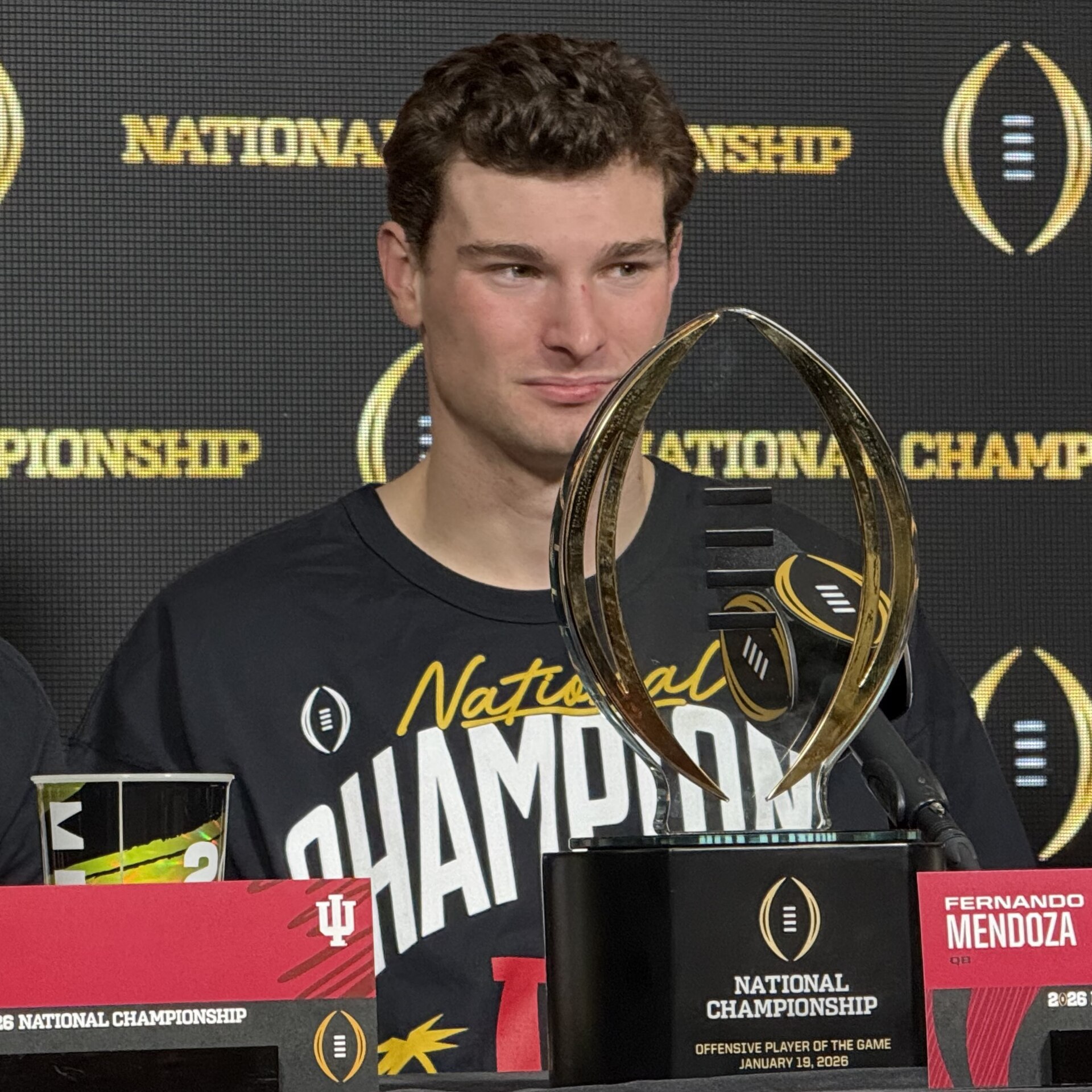
Mendoza is not just talking about a sport in transition. As a transfer quarterback, he represents the new reality coaches, fans and athletes are still trying to define.
Fernando Mendoza shares his views on the current state of college football, and the Indiana quarterback’s message is clear: the sport’s new model is not an abstract debate for players. It is the daily reality of roster movement, NIL opportunity, revenue sharing and pressure to prove you belong.
Newsweek highlighted Mendoza’s comments as another sign that college football’s biggest argument is no longer happening only in boardrooms. It is being lived by quarterbacks like Mendoza, who moved from California to Indiana and now stands inside the very system fans argue about every offseason.
A quarterback in the new system
Mendoza’s perspective carries weight because he is not speaking as a distant observer. He is a quarterback who has already navigated the modern player marketplace, where a change of school can alter a career path, a depth chart and a program’s expectations in one move.
That makes his view more practical than philosophical. The transfer portal, NIL deals and revenue-sharing era have changed the basic rhythm of the sport. Players are not simply recruited once and developed quietly for years. They are evaluated constantly, by coaches, collectives, fans, brands and other programs.
The core of Mendoza’s stance is that college football has changed into a player-driven environment with more opportunity and more responsibility. That is a balanced point. More freedom does not remove pressure. In many cases, it multiplies it.
Why his comments land now
The timing matters because college football is still adjusting to several major shifts at once. The transfer portal, launched by the NCAA in 2018, gave athletes a formal way to explore movement. The one-time transfer exception later made immediate movement more common across major sports.
NIL rights arrived in 2021 after years of legal and political pressure, allowing athletes to be compensated for their name, image and likeness. Then came the court-approved House v. NCAA settlement framework, which opened the door for schools to share revenue directly with athletes under a new compensation model.
At the same time, the College Football Playoff expanded from four teams to 12 beginning with the 2024 season. That widened the championship race but also raised the value of having the right quarterback at the right time.
Mendoza’s comments fit that larger picture. College football is not changing in one lane. It is changing in recruiting, contracts, scheduling, media money, playoff access and locker-room management all at once.
The athlete freedom argument
For players, the strongest argument for the new era is simple: athletes now have more control over careers that can be short, physically demanding and financially consequential. A quarterback stuck behind another starter can look elsewhere. A player outperforming his scholarship value can pursue NIL opportunities. A family can weigh fit, exposure and support more directly.
That is why many athletes see the modern landscape less as chaos and more as overdue leverage. Coaches have long been able to change jobs quickly. Conferences have chased media revenue. Schools have changed alignments. Players are now operating with tools that others in the industry already had.
Mendoza’s own path reflects that reality. A transfer quarterback is not necessarily a symbol of impatience. He can also be a symbol of a player making a calculated decision in a sport that asks young athletes to develop fast and compete in public.
The upside is obvious for players who land in better situations. The harder part is that freedom comes with a market’s cold edge: if movement is easier, replacement is easier too.
The stability problem for programs
Coaches and athletic departments see a different side of the same system. Roster building has become a year-round exercise. Programs must recruit high school players, re-recruit their own players and monitor the portal for immediate needs.
That can make continuity harder. A team may spend a season developing a young player, only to watch him transfer before his best years. Another program may plug a short-term hole with an older transfer, but sacrifice long-term development at the position.
Fans feel it too. The emotional contract of college football has traditionally depended on identity: the idea that players grow with a school, a town and a rivalry. The new model can still produce loyalty, but it is less automatic. The jersey may stay the same while the roster turns over faster than many fans are used to.
None of that makes Mendoza’s player-centered view wrong. It shows why the debate is so persistent. The same rules that create opportunity for one athlete can create instability for an entire depth chart.
Quarterbacks shape the debate
Quarterbacks sit at the center of this conversation because the position has outsized value. A program can change its season outlook with one transfer quarterback. A quarterback can change his professional outlook with one smart move.
That is why Mendoza’s comments are more than one player’s opinion. They speak to the most visible position in the sport at the exact moment the sport is trying to decide how much movement is healthy.
The modern quarterback has to manage more than a playbook. He has to manage a public profile, possible NIL relationships, locker-room credibility and the perception that comes with transferring into a job someone else wanted.
- For players, the new era can mean better fits and faster opportunity.
- For coaches, it can mean less patience and constant roster risk.
- For fans, it can mean excitement in December and uncertainty by spring practice.
Mendoza’s value as a voice comes from living at that intersection. He is not describing a theory. He is describing the terrain he has to compete on.
What remains unsettled
The biggest unanswered issue is whether college football can build a stable model around its new freedoms. The sport has moved from strict amateurism toward compensation and mobility, but the rules are still catching up to the behavior.
Revenue sharing may provide more structure, but it will not erase NIL differences between programs. Transfer windows can slow constant movement, but they cannot remove the incentive for players to seek better situations. Playoff expansion can keep more teams engaged, but it can also raise pressure on coaches to find instant answers.
Mendoza’s comments matter because they cut through the nostalgia around the debate. College football is not going back to the old model. The question now is whether the new one can protect athlete choice without making the sport feel disposable.
For now, players like Fernando Mendoza are the clearest evidence of where the game stands. The modern college football player has more power, more visibility and more to manage. That is the state of the sport, whether fans love it, hate it or are still trying to understand it.
Leave a Reply