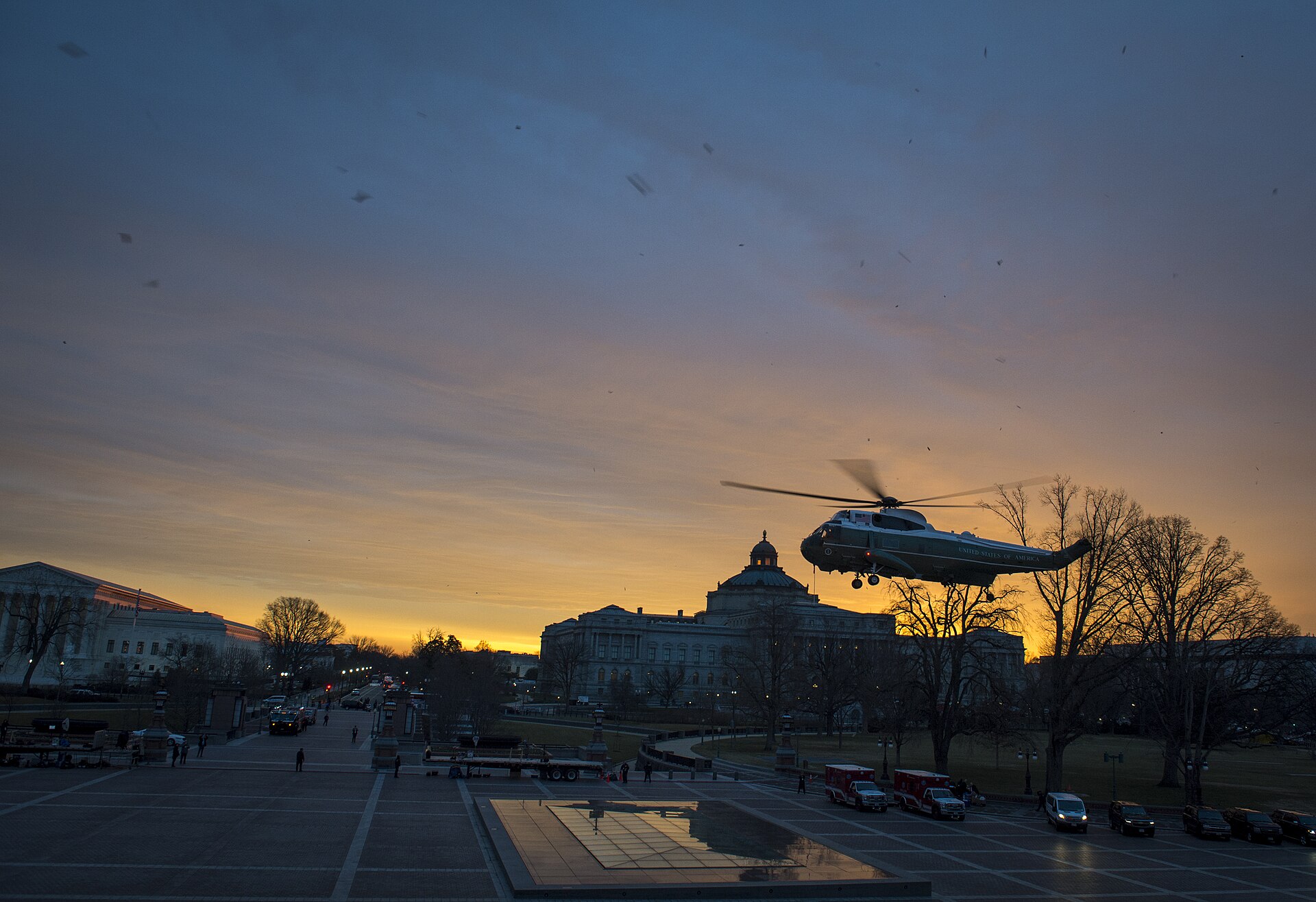
The White House said Trump was not in danger, while aviation officials examine why a passenger plane was allowed to take off as the presidential helicopter approached.
Marine One was involved in a safety incident with Donald Trump aboard Tuesday near the White House in Washington, D.C., after the presidential helicopter departed the White House area and a commercial aircraft was operating nearby. The Federal Aviation Administration is reviewing what happened in the White House safety incident, which officials described as a brief loss of separation rather than a collision threat.
The White House said Trump was not endangered. The FAA said an air-traffic controller was in contact with both Marine One and the commercial pilot during the episode, a key detail as investigators examine whether safety procedures put in place after a deadly 2025 collision near Reagan National Airport were followed.
The incident near Reagan
The episode unfolded as Marine One left the White House for Joint Base Andrews, the usual transfer point for presidential travel on Air Force One. Trump was aboard for the first leg of a West Coast trip, according to reporting from The Associated Press carried by PBS and details also reported by Reuters.

As the helicopter approached the airspace around Reagan National Airport, a passenger plane was allowed to take off. The aircraft was climbing above Marine One as the helicopter approached, meaning the two were not on a collision course, according to the AP account.
That distinction matters. A loss of separation is serious in aviation because it means aircraft were closer than prescribed safety standards allow. It does not automatically mean a crash was imminent.
The FAA’s statement used cautious language: there was a “momentary loss of separation,” and after that, the aircraft continued moving away from each other. The agency is now looking at why the takeoff was permitted at that moment.
Officials stress no danger
The White House pushed back against any suggestion that Trump was placed in harm’s way. Spokesman Kush Desai said Marine One flights are handled by “some of the best aviators in the world” and that “at no point was the President in harm’s way,” according to the AP report.
The Marine Corps also defended the helicopter crew’s actions. Capt. Jacob Sugg, a Marine Corps spokesman, said there were no “close calls” involving the routine Marine One movement and said the Washington National Tower did not delay the crew, order it to hold or alter its route.
That account puts much of the focus on air-traffic management rather than the Marine pilots. The FAA said the controller remained in contact with both aircraft during the loss of separation, which is relevant because communication can reduce risk even when spacing rules are breached.
Still, the agency’s review suggests officials believe the sequence deserves scrutiny. The central question is not whether Marine One’s pilots reacted properly, but whether the system should have prevented the passenger jet from taking off while the helicopter was passing through nearby airspace.
Why the timing stands out
The location gives the story added weight. Reagan National Airport sits in one of the most controlled and congested air corridors in the country, with commercial flights, military traffic and restricted airspace all packed around Washington, D.C.
After a Jan. 29, 2025 midair collision near the airport killed 67 people, federal officials changed procedures meant to keep helicopters and airplanes from sharing risky proximity around Reagan. The FAA decided takeoffs and landings would be halted whenever a helicopter passes by the airport, according to the AP report.
Those post-crash steps also restricted air-traffic controllers from relying on visual separation in that area and required military aircraft to broadcast their locations. The purpose was straightforward: remove judgment calls where possible in a complicated airspace where seconds matter.
That is why Tuesday’s incident is drawing attention beyond the fact that Trump was aboard Marine One. If a passenger plane departed while the presidential helicopter was approaching, investigators will want to know whether the newer rules were misunderstood, misapplied or affected by some other operational factor.
Not a near miss, but not nothing
The official descriptions leave room for two truths at once. The aircraft were not on a collision course, and Trump was not in danger, according to the White House and the reported flight geometry. At the same time, the FAA’s phrase “loss of separation” is not casual language.
In aviation, separation standards are designed to create layers of safety long before pilots reach a last-second emergency. When those buffers shrink, agencies examine the sequence because the next incident might not unfold with aircraft moving away from each other.
The Marine Corps position is that Marine One followed its approved route and received appropriate traffic information from air traffic control. The FAA’s concern appears to be broader: why a commercial aircraft was cleared to take off as the helicopter was nearby in airspace covered by heightened procedures.
That difference in emphasis is important. One side is saying the helicopter crew did not create a dangerous situation. The other is assessing whether the traffic-control system performed as designed.
What investigators may examine
The FAA review is likely to focus on the chain of decisions inside the tower and whether the controller’s clearance matched current restrictions around Reagan National. Investigators may also examine timing, aircraft altitude, route data and communications between controllers and pilots.
The National Transportation Safety Board said it was gathering information and had not yet decided whether to open a formal investigation, according to the AP report. That is a standard early posture when an incident may involve safety rules but does not immediately present the same facts as an accident.
Several practical questions remain unresolved:
- Why was the commercial aircraft cleared to take off while Marine One was approaching?
- Were Reagan National’s post-2025 helicopter procedures in effect exactly as written?
- Did the controller have all required information about Marine One’s position and route?
- Will the FAA change procedures again if it finds the rules left too much room for timing conflicts?
Families of victims from the 2025 collision have been urging more action on aviation safety reforms recommended by the NTSB. For them, Tuesday’s episode is likely to reinforce frustration that Washington’s crowded airspace remains difficult to manage even after a major tragedy.
The takeaway for travelers
For most passengers, the immediate takeaway is not that Reagan National was unsafe on Tuesday or that Marine One barely avoided disaster. The available official accounts point to a brief procedural separation problem, not an emergency maneuver or imminent crash.
But the incident is still significant because presidential travel tends to reveal how complex the Washington airspace can be. If the system can produce a momentary loss of separation involving Marine One, regulators will be under pressure to show exactly how it happened and why it will not repeat.
The FAA’s review will determine whether this was an isolated controller decision, a communication issue or a sign that the post-collision rules around Reagan National need tightening. Until then, the most careful reading is also the least dramatic: Trump was not harmed, the aircraft moved away from each other, and federal aviation officials are now checking whether the safety net worked as intended.
Leave a Reply