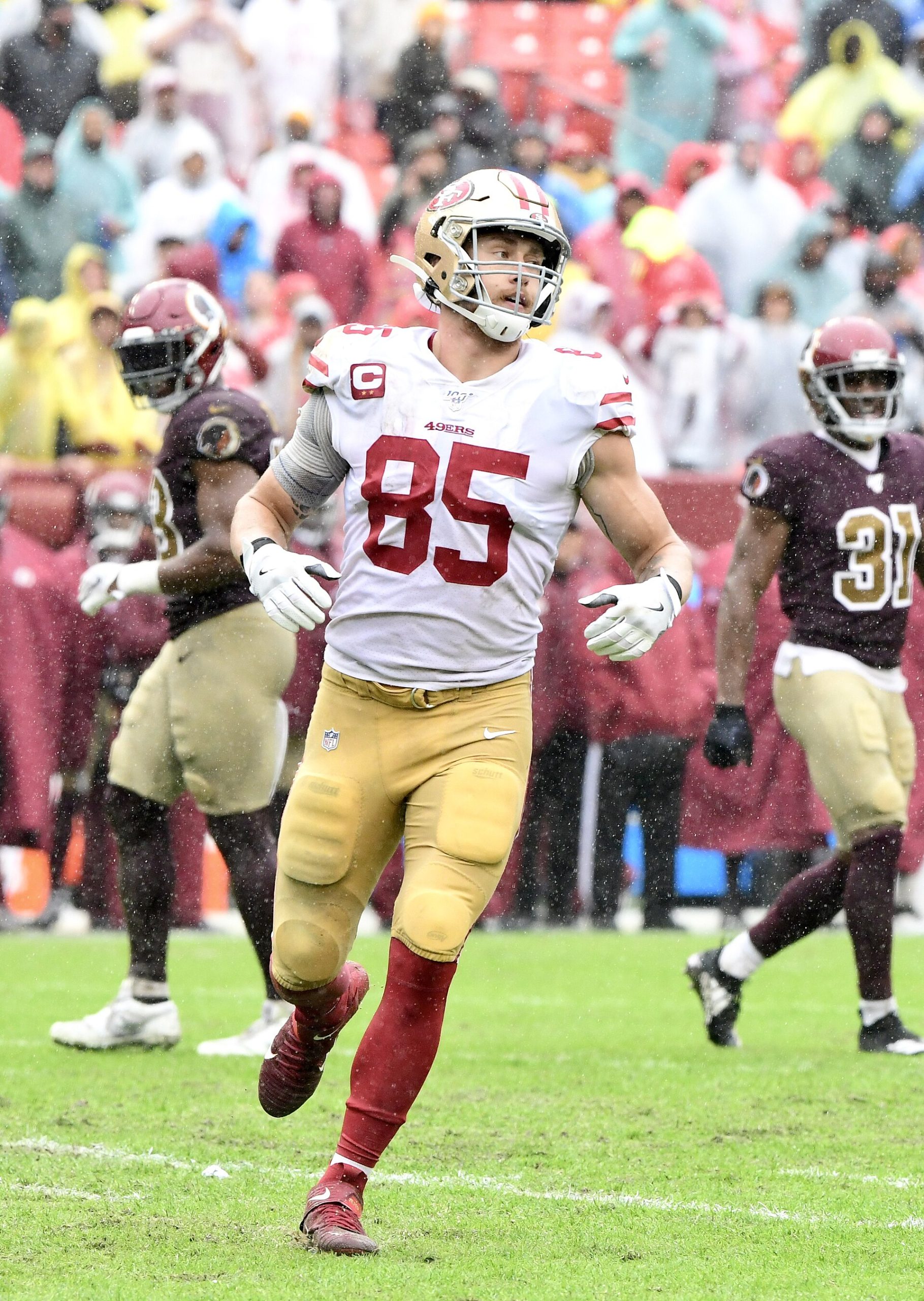
San Francisco stayed patient behind George Kittle, while Los Angeles added a proven veteran tight end. That contrast could matter if Kittle’s recovery or availability becomes a real issue.
David Njoku is the veteran tight end the Los Angeles Chargers signed in May, and he was the kind of insurance option the San Francisco 49ers passed on behind George Kittle. While the 49ers stayed patient and chose not to add another tight end for Kittle’s recovery, Los Angeles took the move that fit San Francisco’s needs and quietly undercut the backup plan. Instead of bringing in a proven veteran, the 49ers are relying on Jake Tonges and undrafted rookie Khalil Dinkins to handle depth behind Kittle. That decision leaves San Francisco betting its offense can hold up if Kittle’s availability becomes an issue.
Njoku was the obvious fit
Niner Noise framed Njoku as the kind of tight end San Francisco could have targeted if it wanted a sturdier bridge behind Kittle. The logic is not complicated: Njoku has been productive, experienced and athletic enough to function as more than a blocking placeholder.
According to the report, Njoku spent his career with the Cleveland Browns before the Chargers signed him. He made the Pro Bowl in 2023, when he posted 882 receiving yards and six touchdowns. Across nine NFL seasons, he has topped 4,000 receiving yards with 34 touchdowns.
That résumé matters because the 49ers do not use tight end as a decorative position. Kittle is a core piece of the run game, the passing game and the offense’s identity. A backup in San Francisco has to do more than stand in the formation and catch the occasional checkdown.
Njoku would not have duplicated Kittle. Almost nobody does. But he would have given the 49ers a veteran option with real receiving credibility, which is why the Chargers’ move looks like more than a routine depth signing from a San Francisco perspective.
San Francisco chose patience
The 49ers’ decision was not simply neglect. They brought back Jake Tonges and added Khalil Dinkins as an undrafted free agent, according to Niner Noise. That suggests the front office preferred a lower-cost, developmental approach rather than spending on a bigger-name tight end.
There is a reasonable argument for that strategy. If Kittle’s Achilles recovery is progressing well, San Francisco may not want to allocate meaningful money or roster priority to a player who would become a limited-use backup once Kittle is back to himself.
The other part is scheme confidence. The 49ers have often trusted their system, their offensive line combinations and their skill-position versatility to cover weak spots. If the team believes Kittle will be available early, it can justify using roster resources elsewhere.
Still, tight end depth is not a luxury when the starter is recovering from a major injury. It becomes a weekly stress test. The decision not to add a proven veteran means Tonges, Dinkins or another internal option may have to absorb snaps that carry real offensive consequences.
Kittle’s recovery changes everything
The entire debate turns on Kittle’s health. Niner Noise noted that his recovery from an Achilles tear has been described as remarkable, with even a chance he could play Week 1 in Australia. If that happens, the 49ers’ restraint will look more calculated than risky.
But Achilles injuries are not ordinary soft-tissue setbacks. Even when a player returns quickly, questions remain about workload, burst, blocking leverage and how the body responds after repeated game weeks. Kittle is also 32, and the report noted he dealt with a hamstring issue early last season.
That does not mean San Francisco should panic. Kittle is still described in the report as the best tight end in the game, and his value is not only about box-score receiving. His blocking, yards-after-catch ability and physical tone shape how opponents defend the 49ers.
The problem is that greatness can make roster planning harder. When one player does so much, the drop-off behind him becomes sharper. The better Kittle is, the more exposed San Francisco looks if he misses time.
Why Los Angeles made sense
For the Chargers, Njoku fits a different kind of need. Los Angeles can give Justin Herbert another experienced target while letting Mike McDaniel use tight ends in ways that stress defenses horizontally and vertically.
Niner Noise pointed to McDaniel’s work with Darren Waller last season in Miami, where Waller had six touchdown catches in nine games. That production is part of why Njoku’s arrival in Los Angeles carries some intrigue: the Chargers are not just adding depth, they are adding a player who could have a defined offensive role.
The reported $8 million price tag is not nothing, especially for a player with injury concerns of his own. Njoku played 12 games in 2024 and 11 games last season, per the report. That history makes the signing a bet for Los Angeles, too.
But it is a different kind of bet. The Chargers paid for upside and experience. The 49ers saved the money and trusted Kittle’s timeline. If both teams are right, nobody complains. If only Los Angeles is right, the contrast becomes uncomfortable.
The real risk for the 49ers
The risk is not that Njoku becomes a star and San Francisco looks foolish in a vacuum. The risk is that the 49ers need tight end production in September, October or during a key stretch and do not have a proven answer ready.
Kittle’s role touches too many parts of the offense for the backup plan to be ignored. If he is limited, San Francisco may have to alter formations, lean more heavily on wide receivers, change blocking assignments or reduce parts of the playbook that depend on elite tight end execution.
That can affect more than the tight ends. It can shape the run game, protection calls, red-zone spacing and how defenses treat the middle of the field. A backup tight end may not sell jerseys, but the wrong depth chart can quietly squeeze an entire offense.
That is why Njoku’s move to Los Angeles resonates. He represented a clean answer to a specific 49ers problem: veteran insurance behind Kittle with enough receiving ability to keep defenses honest.
Regret depends on September
San Francisco’s front office may end up looking disciplined. If Kittle returns near full strength and the 49ers’ young or returning tight ends handle their roles, passing on Njoku will be forgotten quickly.
If Kittle is banged up and Njoku becomes a useful piece for the Chargers, the conversation changes. The same May signing that looked expensive could start looking like the exact insurance policy San Francisco should have bought.
For now, the Chargers have the proven veteran, and the 49ers have the cleaner cap sheet and a belief in Kittle’s recovery. That is the whole roster gamble in one sentence.
The answer will not come from offseason logic. It will come when San Francisco’s offense has to function at full speed, with or without its most important tight end fully available.
Leave a Reply