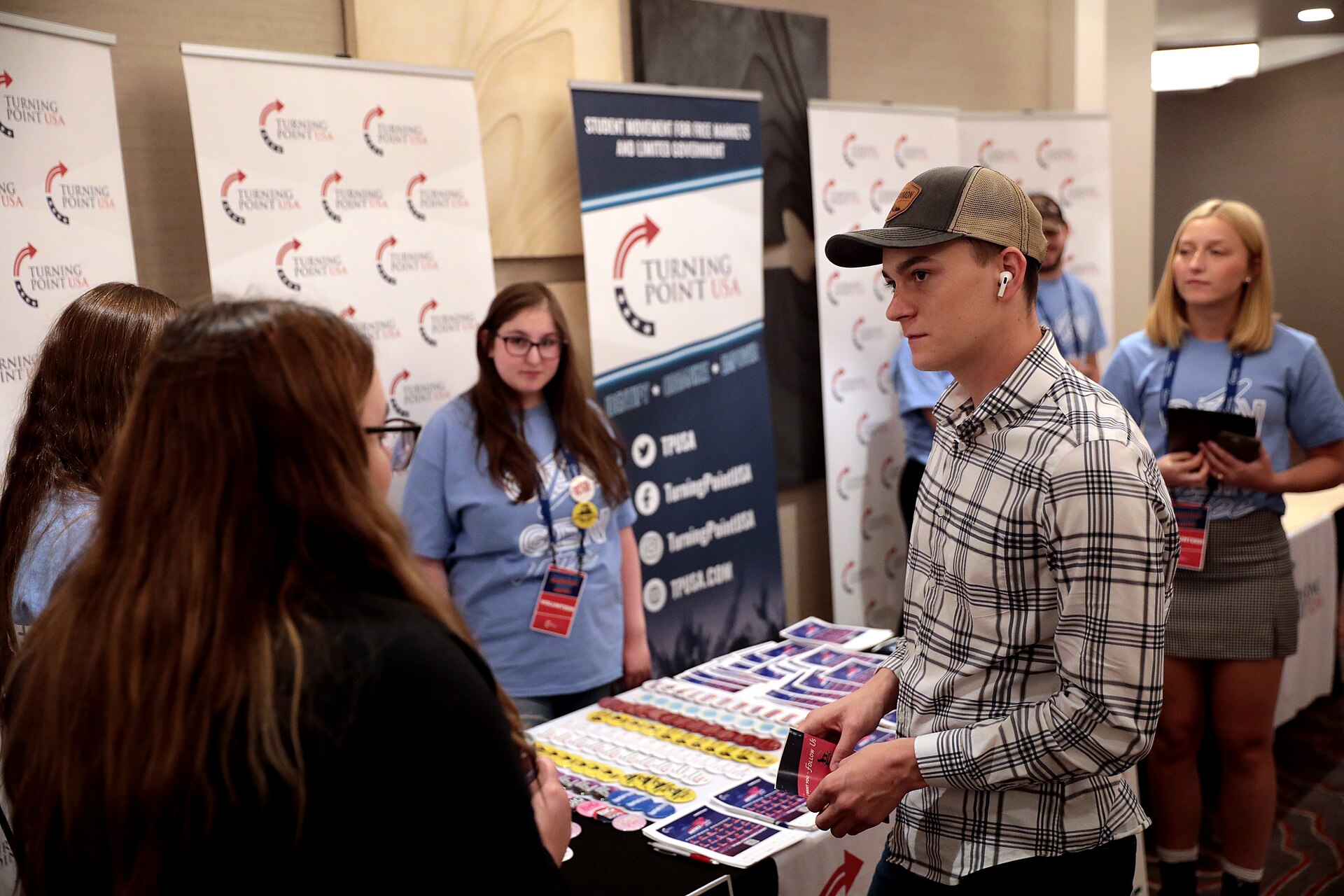
The dispute began with a bracelet at a back-to-school event but quickly moved beyond the event itself. Now, competing accounts, a police report and claims of online harassment have put a local school gathering at the center of a wider fight over TPUSA.
Sophia Hunt, the 17-year-old president of Turning Point USA’s Club America chapter at Westfield High School, says a mother confronted student volunteers at an Aug. 10 event in Westfield, Indiana, screamed at them and knocked a bracelet from Hunt’s hand. The mother, Kailly Stanich, denies touching Hunt or screaming in her face. Their TPUSA school clash has since expanded into threats, outrage, police reports and allegations of online harassment.
The confrontation occurred at Rock the Block, a back-to-school event held at a local middle school by Westfield Washington Schools and the Westfield Education Foundation. It matters because the central claims remain sharply disputed, while a conflict between adults and student activists has become a larger argument about politics in schools.
A bracelet sparked the dispute
Hunt said she and other TPUSA students were staffing a booth at Rock the Block, explaining their group’s work and handing out red, white and blue bracelets. Hunt described the bracelets as a bulk purchase without a candidate’s name, campaign slogan or explicit political message.
According to Hunt, a young boy approached the table and appeared to want a bracelet. She said his mother pulled him away, prompting Hunt to ask whether she was OK as the pair walked off.
Hunt said that question set off the exchange. She alleged that Stanich responded with profanity, criticized the students and the political figures and organization they supported, and knocked a bracelet out of Hunt’s hand when Hunt tried to offer one to her.
Hunt has described the physical aspect as minor, saying she was not hurt. Her broader concern was that, in her account, adults and young children were nearby as the argument unfolded.
Two accounts diverge sharply
Stanich disputes several of Hunt’s most consequential claims. In a statement reported by Fox News Digital, she said she did not and would not put her hands on a child or scream in Hunt’s face.
Stanich’s account is that her son had been collecting treats and giveaways at booths, and that she firmly told him no when a bracelet was offered. She said Hunt’s question and remark that she should “have a better day” came across as rude, and she said other students at the booth yelled as she left.
Stanich acknowledged using profanity and said that language was inappropriate. She also said she was upset that the TPUSA booth was present at the event, arguing that the organization did not belong in schools.
That leaves important points unresolved: whether the boy reached for a bracelet, whether the bracelet was knocked from Hunt’s hand, how close the two were during the exchange and how the students and parent spoke to one another.
Why the setting raises stakes
The disagreement did not happen at a partisan rally or a formal political debate. It happened at a community event intended for families, with student volunteers participating alongside other local groups.
That setting puts two legitimate concerns in direct tension. Hunt and her supporters frame the matter around students’ ability to organize and speak openly about their beliefs without intimidation. Stanich’s objection is rooted in the presence of a politically associated group at a school-connected event and in her view of TPUSA’s message.
Neither position settles what happened during the encounter. But the setting helps explain why a short exchange over a bracelet became a larger dispute over expression, parental authority and the boundaries of politics in spaces connected to public schools.
It also complicates the usual online version of events. The people directly involved include a minor student leader, other student volunteers, a parent and a young child—not professional political operatives debating from a distance.
Police report and footage matter
Stanich said she filed a police report and that authorities were obtaining school footage. The available reporting does not establish what any video shows, whether footage captures the full interaction or whether law enforcement has reached a conclusion.
Those details matter because the current public account is built largely on interviews and statements from people who recall the same moments very differently. Video, if it exists and is released or reviewed by relevant authorities, could clarify the sequence without necessarily answering every question about tone or intent.
School officials are also part of the wider picture because Rock the Block was connected to Westfield Washington Schools and the Westfield Education Foundation. The provided reporting identifies the institutions and event organizers, but does not provide a public finding from the school district on the competing allegations.
Until there is a documented official account, it is more accurate to describe the incident as a disputed confrontation than to present either version as established fact.
The argument moved online fast
What began locally has drawn attention well beyond Westfield. Hunt has discussed the incident publicly, including on “The Charlie Kirk Show,” while the story has circulated among conservative media figures and TPUSA supporters.
Stanich said she made her social-media presence private because she was receiving death threats from Charlie Kirk supporters. That allegation adds a serious dimension to a dispute already involving a teenager and a parent, though the available reporting does not independently detail the messages or identify who sent them.
Online attention can turn an incomplete account into a loyalty test. Supporters may see Hunt as a student targeted for her political involvement; critics may see Stanich’s reaction as a response to an organization they strongly oppose. Both interpretations risk hardening before the underlying facts are fully established.
The case is a reminder that public outrage can greatly outpace the available evidence, especially when school-age participants and nationally polarizing political brands are involved.
What remains unclear in Westfield
The clearest facts are that a TPUSA booth was present at the Aug. 10 Rock the Block event, Hunt and Stanich interacted, and both sides agree there was an argument. They also agree that Stanich used profanity, though they differ on the scale and direction of the confrontation.
The most disputed claims concern physical contact, yelling and what preceded the exchange. Hunt says a bracelet was knocked from her hand and that the mother cursed at student volunteers. Stanich denies touching Hunt or screaming at her and says the students’ conduct contributed to the conflict.
For now, the broader lesson is not that one local argument represents every school or every political group. It is that school-community events can become flashpoints when political identity enters a setting designed for families—and that accusations involving minors deserve careful attribution, restraint and evidence before public judgment becomes irreversible.
Leave a Reply