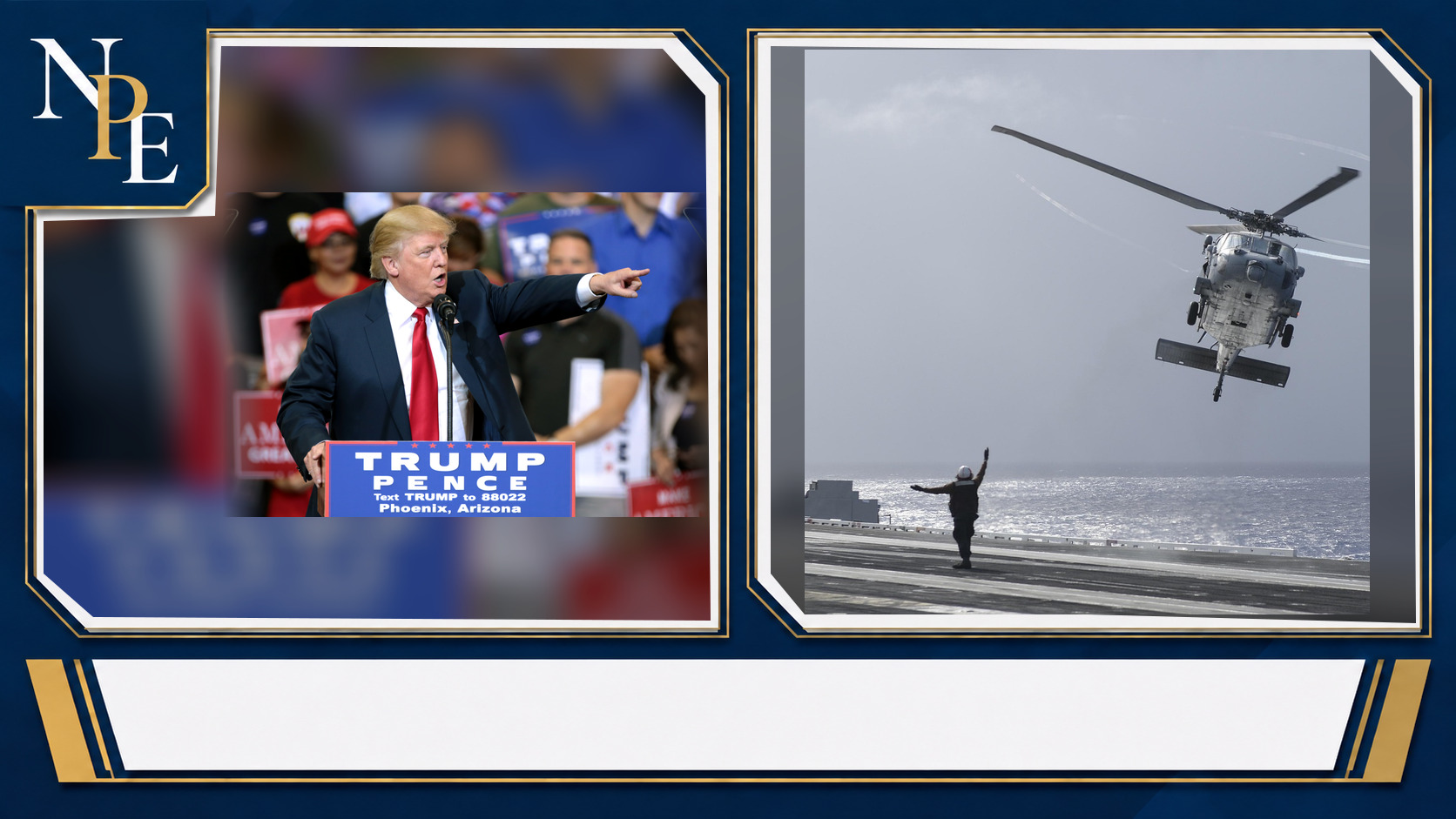
The Pentagon’s deployment of two aircraft carrier strike groups has created one of the region’s largest U.S. force concentrations in decades. Yet the report of trouble aboard a warship offers few verifiable details about the vessel, its crew or what occurred.
Donald Trump is linked to a report of an alleged crisis aboard a U.S. warship in the Middle East, while U.S. military forces carry out a major Pentagon buildup of naval and air assets toward the region. Key details of the reported warship incident remain unconfirmed, even as two aircraft carrier strike groups help form what public reporting describes as the largest force of American warships and aircraft in the Middle East in decades.
The reported shipboard problem matters because it has emerged during a tense military posture centered on Iran’s nuclear program and the prospect of U.S. military action. What is established about the deployment is far clearer than what is known about the vessel at the center of the report.
The report names no ship
A report carried by The Independent via MSN said a crisis was unfolding aboard a warship associated with Trump’s Middle East deployment decisions. But the available material does not publicly identify the ship, its crew, its location or the precise nature of the alleged crisis.
There was no official Pentagon statement, U.S. Central Command update or Navy release in the material reviewed for the originating report that identified a specific incident aboard a vessel. Nor is there a confirmed account indicating whether the matter involves an operational issue, personnel, security, combat activity or a medical emergency.
Those are not minor distinctions. A mechanical problem, an internal emergency and an encounter involving hostile forces would each have very different consequences for the people aboard, the U.S. mission and regional security.
The phrase “Trump’s warship” should also be read carefully. It is not a formal military designation and does not mean Trump owns, commands or is aboard the vessel. The connection is political: the ship is reportedly part of, or associated with, the military posture ordered under his administration.
A deployment with documented scale
The larger movement of U.S. forces is considerably more concrete. PBS NewsHour, drawing on Associated Press reporting, described the Pentagon deployment as the largest concentration of American warships and aircraft in the Middle East in decades.
The aircraft carrier USS Abraham Lincoln and three guided-missile destroyers had been operating in the Arabian Sea after being redirected from the South China Sea. That carrier strike group brought roughly 5,700 service members to a smaller U.S. naval presence already operating in the region.
Trump later ordered the USS Gerald R. Ford, described in the reporting as the world’s largest aircraft carrier, and three destroyers toward the Middle East. The combined naval presence was expected to reach 14 ships, according to PBS.
That accounting does not establish whether either carrier group includes the warship cited in the crisis report. It does explain why an unverified problem aboard any major U.S. vessel attracts attention: these ships are operating as part of a sizable military posture, not in isolation.
Iran talks drive the posture
The deployment is tied to Trump’s warnings that military action could follow if negotiations over Iran’s nuclear program fail. Trump has said he wants a meaningful agreement while warning of consequences if one cannot be reached.
Military analysts cited by PBS said the assembled force appears designed to give Washington options to strike targets in Iran and to defend U.S. forces and regional partners against retaliation. Carrier strike groups combine combat aircraft, missile-defense systems, escorts and logistical support that can sustain operations over time.
Supporters of a major deployment argue that visible military strength may discourage Iran from attacking U.S. personnel or escalating the confrontation. Critics and regional-risk analysts see another danger: heavy pressure can raise the odds of miscalculation if either side concludes it must respond forcefully to maintain credibility.
Ali Vaez of the International Crisis Group told PBS that a limited U.S. attack could be difficult to keep limited if Iran responded more broadly. Behnam Ben Taleblu of the Foundation for Defense of Democracies pointed to Iran’s remaining missile capacity as an ongoing threat to U.S. interests and allies.
Retaliation risks extend beyond ships
The recent record illustrates why force protection is central to the situation. After U.S. strikes on Iranian nuclear sites in June, Iran fired more than a dozen missiles at Al Udeid Air Base in Qatar, PBS reported. The attack caused limited damage after advance signaling and air-defense preparations.
Analysts have cautioned that a future response may not follow the same pattern. Iran has drones, cruise missiles and ballistic missiles capable of threatening military bases, shipping routes and assets around the Gulf and Arabian Sea.
The Strait of Hormuz is particularly sensitive because it is a narrow waterway used by a significant share of global oil and gas shipments. Disruption there could affect energy prices well beyond the Middle East.
That setting is why a claimed crisis aboard a deployed vessel could be viewed through more than a Navy lens. Even a contained incident can prompt questions about the safety of personnel, the resilience of the mission and the security of commercial navigation. Still, the term “crisis” alone does not establish an attack, accident, breakdown, casualties or a change in U.S. plans.
What would clarify the claim
Military authorities do not always immediately disclose operational details, especially near a potential conflict zone. Holding back information can protect personnel, avoid exposing vulnerabilities to adversaries or preserve an investigation.
But the absence of basic verified facts also leaves room for speculation. The most useful public updates would identify the vessel, confirm whether an incident occurred, describe any impact on operations and disclose whether there were injuries or damage.
Updates from the Pentagon, the Navy or U.S. Central Command would carry particular weight. Diplomatic developments matter as well: progress in nuclear talks could ease pressure around the deployment, while failed negotiations or a new exchange of fire could make movements by U.S. ships and aircraft more consequential.
For now, the evidence presents two separate layers. Trump’s substantial naval and air buildup in the Middle East is documented. The alleged crisis aboard an unnamed U.S. warship remains unresolved, with no reliable basis yet for determining its cause, scale or outcome.
Leave a Reply