Natalie Harp’s unusual proximity to President Donald Trump has put an otherwise low-profile aide under a brighter political spotlight. The available reporting describes exceptional access, while key details behind a former CIA officer’s concerns remain unclear.
Natalie Harp, a close aide to Donald Trump known as Trump’s “human printer,” is facing fresh scrutiny after a former CIA officer expressed grave concerns about her role alongside the president. Harp stays close to Trump and serves as one of his most constant aides, making the question of her influence matter well beyond White House gossip.
The warning referenced in the original report is not fully detailed in the research available here: the former CIA officer is not identified, and the precise basis for the concerns is not established. What is documented is Harp’s extraordinary access to Trump, including a role that reporting portrays as unusually personal and outside the standard White House chain of command.
Harp’s access is the central issue
Harp is a 35-year-old West Wing aide whose proximity to Trump has become increasingly visible. The New York Times reported on Aug. 18 that she works from the Oval Office, has a regular seat on Marine One and remains at Trump’s side during a wide range of official and private presidential activity.
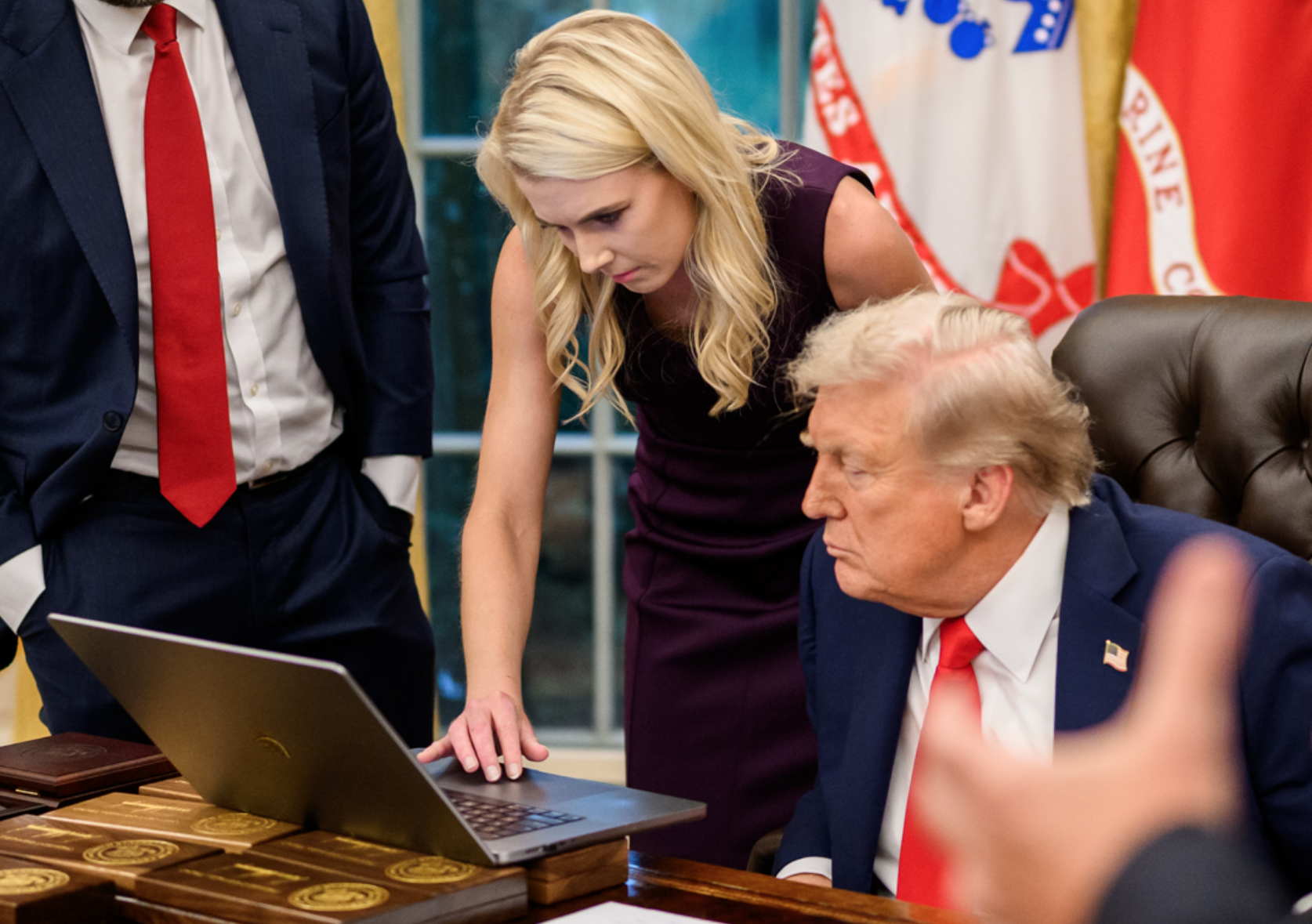
That kind of access does not automatically mean an aide directs policy or makes decisions. Presidents commonly rely on trusted staff members, and close advisers can be valuable because they understand a president’s habits, priorities and preferred way of receiving information.
Still, access is power in any White House. An aide who decides which documents, messages, calls or conversations reach a president can shape the information environment around him, even without holding a Senate-confirmed post or a high-profile policy title.
The concern around Harp, then, is not simply that she is seen frequently. It is whether her proximity gives her a gatekeeping role that is difficult for the public, Congress and even other administration officials to assess.
What “human printer” is meant to convey
The “human printer” nickname is shorthand for Harp’s reported practice of staying close to Trump with paper, information and materials he may want immediately. It captures a role built around speed, availability and personal trust rather than a traditional public-facing portfolio.
According to the Times, Harp has been described as a conduit of information to the president. The paper reported that she works late with Trump on social-media posts and communicates with world leaders on his behalf.
Those details help explain why critics are interested in the job title behind the nickname. A staffer who provides documents is performing one kind of support function. A staffer who helps manage direct communications, relays information and has constant in-person access may occupy a much more consequential place in a president’s orbit.
There is an important limit, however: the available reporting does not establish that Harp has independent authority over foreign policy, national security decisions or formal White House operations. Access and influence can overlap, but they are not identical.
The CIA concern lacks key details
The original headline says a former CIA officer raised grave concerns about Harp. But the material provided for this article does not name that former officer, quote the person or specify whether the concern involves security procedures, communications, staffing, foreign contacts or some other issue.
That gap matters. Former intelligence officials can offer informed views on risk, protocols and institutional safeguards, but their comments need context: what they know firsthand, what evidence they are relying on and whether they are describing a confirmed problem or a broader concern about how power is exercised.
Without those details, it would be inappropriate to present the concern as proof of wrongdoing by Harp or the White House. No allegation of illegal conduct by Harp is established in the available research.
The more supportable conclusion is narrower. A former CIA officer’s reported concern has added attention to a role that was already attracting questions because Harp’s access to Trump appears unusually extensive.
Her Turkey trip sharpened attention
Public interest in Harp rose after reporting that she was among a small group who traveled with Trump inside an aircraft catering container during an evacuation from Turkey amid a reported threat of attack by Iran. The Times said the episode made more people aware of an aide who had long been familiar to people around Trump but remained largely unknown to the broader public.
The trip put the usual questions about presidential entourages into sharper relief. During foreign travel or a security-sensitive situation, the number of people in close contact with a president, their roles and their communication responsibilities can take on added significance.
It does not follow from Harp’s presence that security rules were breached. The available reporting does not establish that. But the episode illustrated why aides who are normally outside public view can become subjects of public debate when they appear repeatedly in high-stakes settings.
Political criticism brought a backlash
Harp also became part of a political clash after Sen. Jon Ossoff, a Democrat from Georgia, mentioned her in criticism of Trump. The Times reported that the remark sparked a fierce defense of Harp from White House aides, Republican lawmakers, conservative influencers and at least one Cabinet member.
Supporters framed attacks on Harp as unfair and, in some cases, sexist. That argument deserves consideration: women in political workplaces can face scrutiny that is more personal than the scrutiny directed at male staffers, especially when their relationship with a powerful male principal is discussed.
Critics counter that the issue is not Harp’s gender or demeanor but her institutional role. Their question is whether an aide with limited public visibility should have such broad access and influence without a clearly defined remit.
Both points can be true. Personal attacks and insinuations are not a substitute for accountability. At the same time, a close presidential aide’s gender should not shield the structure of her role from legitimate scrutiny.
The unanswered question is accountability
White Houses have always had informal power centers: chiefs of staff, counselors, lawyers, political advisers, family members and trusted personal aides. Formal organizational charts rarely explain every route by which a president gets advice or makes decisions.
What makes Harp notable is the reported combination of functions: physical proximity, document handling, communications work, social-media involvement and a relationship of exceptional personal loyalty to Trump. The Times described her as an important gatekeeper operating outside the usual chain of command.
The White House and Harp could address some of the uncertainty by clarifying her formal title, reporting structure, security responsibilities and authority to communicate on the president’s behalf. Such clarity would not end political disagreement, but it would distinguish between a trusted aide performing a defined job and an informal power broker whose reach is hard to measure.
For now, the available evidence supports close attention, not sweeping conclusions. The former CIA officer’s reported concerns have amplified the debate, but the key facts remain Harp’s highly unusual access to Donald Trump and the unanswered question of how that access translates into influence.
Leave a Reply