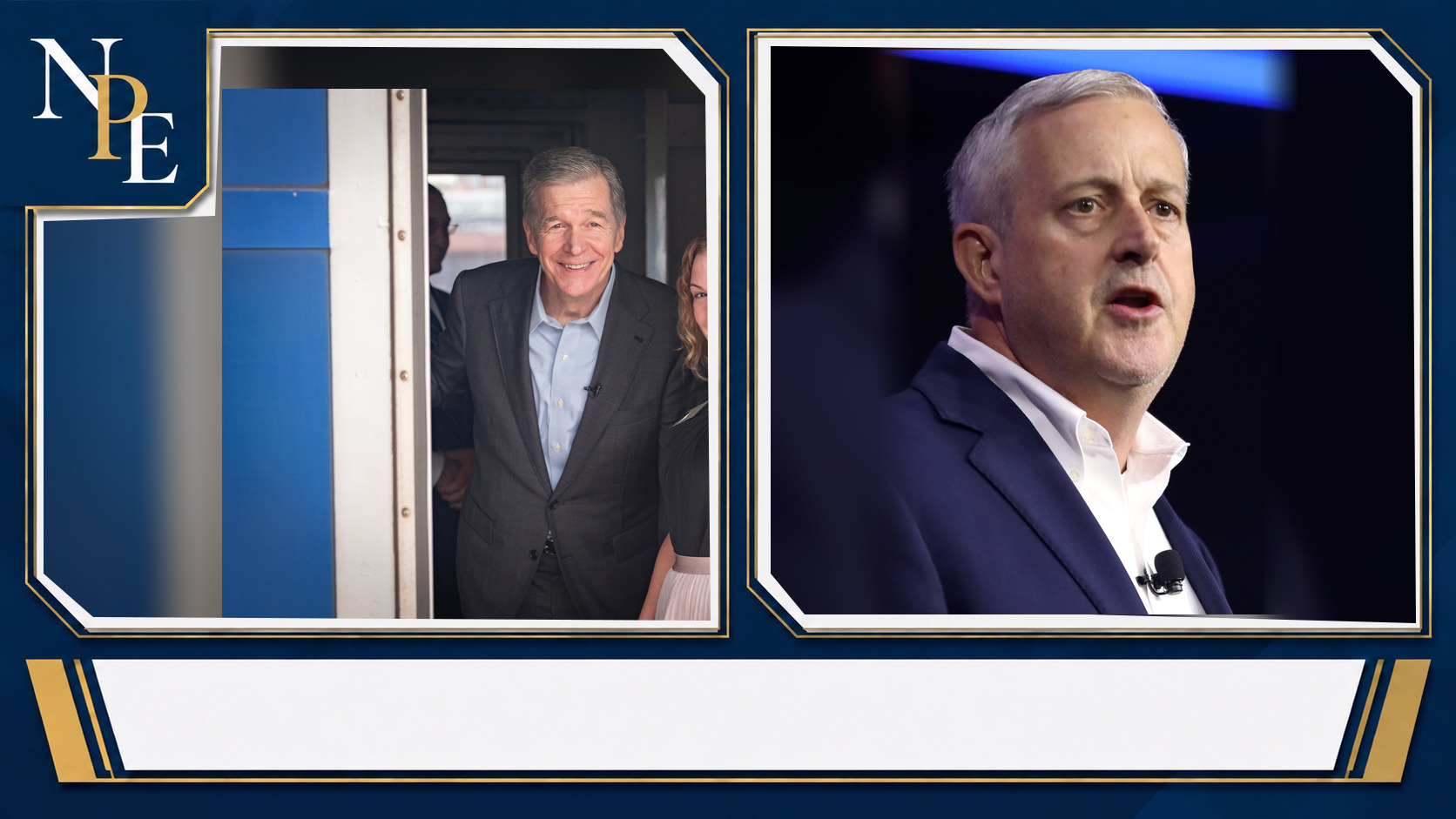
The new survey puts Roy Cooper at 50 percent and Michael Whatley at 43 percent in the race to replace retiring Sen. Thom Tillis. The margin offers Democrats an encouraging data point, but the campaign’s money and outside advertising suggest a long fight ahead.
Democrat Roy Cooper maintains a 7-point lead over Republican Michael Whatley in the North Carolina Senate race, according to a new Carolina Forward survey conducted by Change Research. The poll puts Cooper at 50 percent and Whatley at 43 percent among 915 respondents, with a 3.5-point margin of error.
The result matters because North Carolina is a Republican-held open seat and a central Democratic pickup opportunity. Cooper’s advantage is outside the survey’s stated margin of error, but it is still a snapshot taken before a costly general-election campaign reaches its final stretch.
Cooper’s lead rests on key groups
The topline gap is notable in a closely watched state, but the coalition beneath it may be just as important. The poll found an overwhelming partisan split: 97 percent of Democratic respondents backed Cooper, while 91 percent of Republicans backed Whatley.
Cooper’s clearest advantage came among independents. The survey showed 48 percent supporting Cooper and 20 percent supporting Whatley, while 32 percent said they were unsure or did not plan to vote. That large undecided-or-nonvoting group is a reminder that neither campaign can treat the current numbers as settled.
The former governor also led among women by 15 points, urban voters by 35 points and suburban voters by 20 points. Whatley held a narrow, 1-point edge among men and led rural voters by 20 points.
Those divides reflect the familiar geography of North Carolina politics: Democratic strength in major metro areas, Republican dominance in many rural communities, and a high-stakes fight for suburban and independent voters. The question for both candidates is whether those survey preferences will translate into turnout.
An open seat changes the map
Cooper and Whatley are competing to succeed retiring Republican Sen. Thom Tillis. Open-seat races can be less predictable than contests involving an incumbent, since voters are evaluating two candidates without the usual benefit or burden of a sitting senator’s record.
Cooper brings broad statewide name recognition. He served as North Carolina attorney general before spending eight years as governor, and he has won six general elections in the state since 2000, according to the report on the survey.
Whatley, a former chair of the Republican National Committee, is seeking to turn his national party experience into a statewide victory. The poll suggests he faces an immediate familiarity challenge: 37 percent of respondents viewed him unfavorably, 29 percent viewed him favorably and 17 percent said they had never heard of him.
That does not make the race a foregone conclusion. Campaigns can introduce or redefine candidates quickly, particularly when national groups are spending heavily. Whatley’s task is to consolidate Republican voters while improving his standing with voters who have not formed a firm view.
The poll deserves careful reading
The Carolina Forward survey was conducted by Change Research, which the report describes as left-leaning. That affiliation does not automatically invalidate the findings, but it is relevant context when weighing one poll against a full body of public surveys.
A sample of 915 respondents and a stated 3.5-point margin of error can provide a useful measure of the race at that moment. Still, a margin of error addresses sampling uncertainty, not every possible issue in polling, such as turnout assumptions, question wording, voter enthusiasm or whether the sample accurately reflects the eventual electorate.
Seven percent of those polled were unsure or said they did not plan to vote in November. That share is small enough that the current Cooper advantage is meaningful, yet large enough to leave room for movement as voters see more advertising, debates and campaign coverage.
The fairest takeaway is that the survey gives Cooper a real advantage at this point, not a guarantee of the final result. Other polls, their methodologies and the direction of subsequent results will be important tests of whether this lead holds.
Senate control raises the stakes
North Carolina is not simply a state-level contest with national attention. It is one of six Republican-controlled Senate seats Democrats are targeting as they try to change the chamber’s balance of power.
Democrats face a 53-47 disadvantage in the Senate. They would need a net gain of four seats to take the majority, because a 50-50 split would leave Vice President JD Vance with the tie-breaking vote on party-line decisions.
Among the GOP-held seats Democrats are pursuing, the Cook Political Report rates North Carolina as leaning Democratic, according to the report. Alaska, Maine and Ohio are rated toss-ups, highlighting how North Carolina could become especially consequential if the national Senate map remains tight.
For Democrats, Cooper’s polling edge supports the argument that a well-known former governor can compete in a state that often produces narrow statewide results. For Republicans, holding the seat is essential to protecting a path to continued Senate control.
Outside money will test the advantage
The early financial picture favors Cooper’s campaign. Federal Election Commission figures cited in the report showed Cooper had about $17.2 million more cash on hand than Whatley at the end of June.
But the race is already attracting major outside spending. The GOP-aligned Senate Leadership Fund announced a $17 million summer advertising campaign aimed at boosting Whatley and attacking Cooper, described as the opening phase of a $71 million North Carolina investment.
The Democratic-aligned Senate Majority PAC said it would spend $11 million on television advertising tied to the race, part of a broader $42 million television investment in the state. The scale of those commitments means voters are likely to see a sustained and increasingly aggressive contest.
A Supreme Court ruling in June also removed federal limits on how much political parties can spend in coordination with candidates, according to the report. That change could further amplify the role of party-backed advertising and make campaign cash only one measure of each side’s potential firepower.
The race is entering its defining phase
Cooper has the lead in this survey, and his support among independents and suburban voters gives Democrats a clear reason for optimism. Whatley has a path through Republican turnout, rural strength and the ability of national allies to reshape a race that many voters are still only beginning to follow.
The next meaningful signs will be whether subsequent polls show Cooper sustaining his advantage, whether Whatley improves his name recognition and favorability, and whether undecided voters begin to break decisively. In a state with a history of competitive statewide elections, the seven-point gap is a significant benchmark, not the final verdict.
Leave a Reply