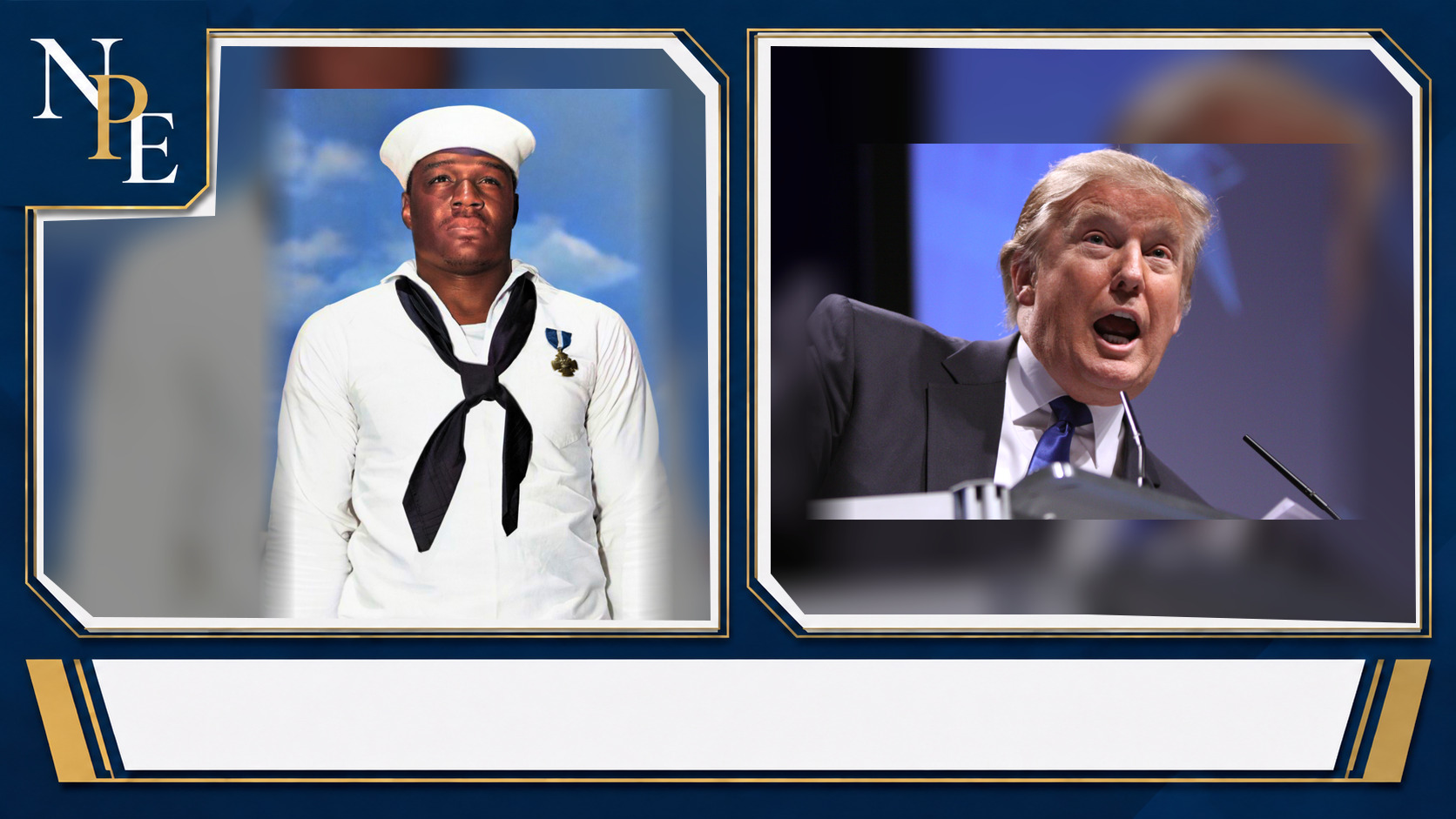
The future USS Doris Miller was intended to mark a historic first for an aircraft carrier. A reported discussion about naming the still-unfinished ship for Donald Trump raises questions about who military memorials are meant to honor — and who makes that call.
The U.S. Navy is discussing renaming an aircraft carrier after Donald Trump, according to NBC News, even though the ship had been planned as the USS Doris Miller. Doris Miller was a Black sailor who acted heroically during Japan’s attack on Pearl Harbor, Hawaii, in World War II, and the planned carrier would have been the first named for both a Black person and an enlisted sailor.
No formal change has been announced. But the reported deliberations put an unusually consequential choice of names at the center of a larger debate: whether a carrier should preserve Miller’s extraordinary military legacy or follow the recent pattern of honoring presidents, potentially including Trump.
A name with historic weight
CVN-81, the fourth planned Ford-class aircraft carrier, is still under construction. During Trump’s first term, the Navy announced that it would be named for Miller, turning a long-overlooked wartime story into one of the service’s most prominent permanent tributes.

Aircraft carriers are not routine vessels. They are among the most visible symbols of American military power, operate for decades and carry their names into deployments, diplomacy and military history. Changing a carrier’s intended name is therefore more than an administrative edit.
The future USS Doris Miller also represented a departure from a familiar convention. Many modern carriers have been named for presidents, including the USS Gerald R. Ford, USS George H.W. Bush and USS Ronald Reagan. The Miller selection showed that the Navy could make room for a different kind of national story.
Why Doris Miller is remembered
Miller served aboard the battleship USS West Virginia on Dec. 7, 1941, when Japanese forces attacked Pearl Harbor. The Navy History and Heritage Command says he distinguished himself through courageous conduct and devotion to duty during the attack.
Then a mess attendant, Miller was not trained to operate the anti-aircraft weapons he used amid the assault. Accounts cited by NBC News say he took up a gun, fired at Japanese aircraft and helped move wounded sailors to safety.
He received the Navy Cross, the Navy’s second-highest honor, becoming the first Black service member to earn it. His recognition came in a segregated military where Black sailors were often confined to service roles and faced restricted opportunities for advancement.
Miller later served on the USS Indianapolis and the escort carrier Liscome Bay. He was killed in November 1943 when the Liscome Bay was torpedoed during the Gilbert Islands campaign, according to the Navy’s historical account.
The symbolism beyond one ship
For supporters of keeping Miller’s name, the carrier has meaning precisely because it does not fit the usual presidential template. It would place an enlisted sailor — and a Black sailor who overcame the limits imposed by segregation — alongside the country’s most consequential naval assets.
The distinction matters because recognition has often arrived late for Black service members. Miller’s heroism was acknowledged during the war, but his story gained broader public attention over decades through historians, advocates and the Navy’s own efforts to better document its past.
The two U.S. officials cited by NBC News said Miller is under consideration for the Medal of Honor, although the White House had not approved it. That unresolved review adds another layer to the naming discussion: Miller’s standing in military history may still be evolving even as the Navy weighs removing his name from a carrier.
Who controls carrier names
The authority to name Navy ships rests with the secretary of the Navy. In practice, major decisions involving aircraft carriers can also draw significant involvement from the defense secretary and the White House, especially when the proposed name carries political or historical significance.
According to NBC News, the decision on this potential change would involve Defense Secretary Pete Hegseth and acting Navy Secretary Hung Cao. The Navy did not immediately respond to the outlet’s request for comment about the reported discussions.
That means an internal discussion should not be mistaken for a completed decision. There is no public announcement confirming that CVN-81 will be renamed, no stated timetable for a decision and no public explanation from the Navy for why Miller’s name might be reconsidered.
Those unknowns are important. A ship’s designation may be settled long before it enters service, but public naming controversies can sharpen pressure on officials to explain both the process and the values behind it.
Tradition points in two directions
There is a straightforward case for naming a carrier after a president: aircraft carriers have often carried presidential names, and Trump is a former president. Supporters could argue that a Trump-named carrier would be consistent with a recognizable Navy tradition rather than a break from it.
But that tradition is not an iron rule. The USS John C. Stennis honors a senator, the USS Carl Vinson honors a congressman, and the USS Enterprise carries one of the Navy’s most enduring non-personal names. The Navy’s naming history is a record of choices, not a fixed formula.
Miller’s supporters are likely to see a renaming as an especially sharp reversal because Trump’s first administration selected him for this honor. The proposed shift would not merely choose a different historical figure for an unnamed future ship; it would replace a tribute already attached to a Black enlisted war hero.
What remains unresolved
The immediate question is whether the reported discussions become an official order. Until then, CVN-81 remains the future USS Doris Miller in the Navy’s existing plan.
The broader question is what the Navy wants the ship’s name to communicate. A Trump name would reinforce the modern presidential-carrier tradition. Retaining Miller would preserve a rare, highly visible tribute to courage under fire and to a sailor whose service challenged the racial boundaries of his era.
Either outcome would carry a message far beyond the hull number. The dispute has made clear that naval names are not simply labels painted on steel; they are public decisions about which stories the country chooses to carry forward.
Leave a Reply