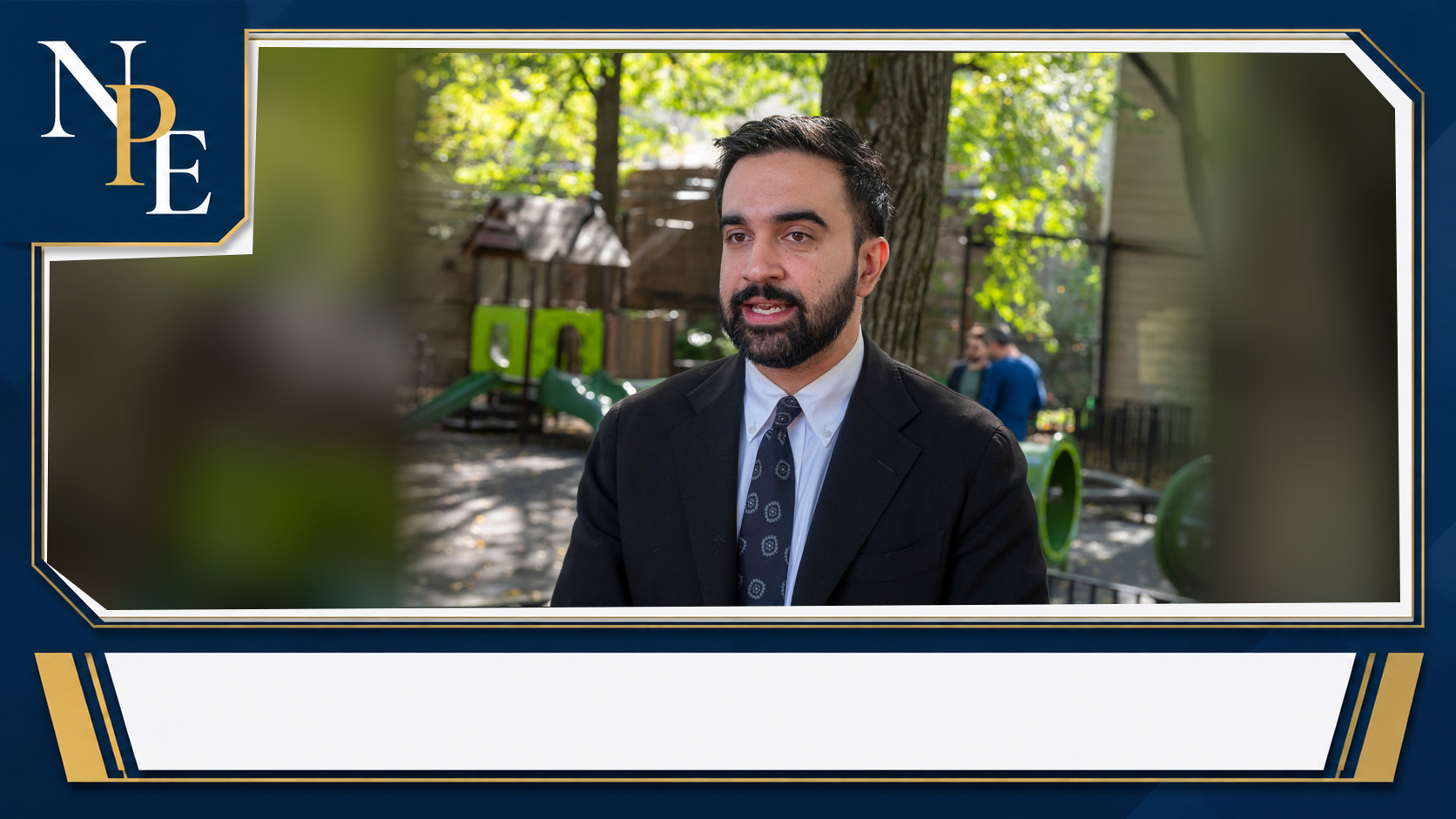
The brief exchange was less about a surprise question than a difficult test of consistency. It brought Mamdani’s comments on international arrests, Hamas and the limits of City Hall power into the same frame.
Zohran Mamdani tried to catch a reporter off guard during an exchange, but the reporter quickly turned the exchange around in seconds by asking whether he would have sought the arrest of Hamas leaders responsible for the October 7, 2023, attacks in Israel. The question put Mamdani’s earlier pledge involving an International Criminal Court warrant for Israeli Prime Minister Benjamin Netanyahu under fresh scrutiny.
The moment matters because Mamdani, New York City’s mayor, has since acknowledged that he does not have the legal authority to execute that warrant. The exchange highlights a larger issue: what political promises about international accountability can mean when the official making them lacks the power to carry them out.
The question that changed the exchange
According to CNN’s description of the roughly two-minute video, a reporter asked Mamdani whether he would have called for the arrest of Hamas leaders responsible for the October 7 attacks.
The question reframed the discussion quickly. Rather than staying focused on Mamdani’s past comments about Netanyahu, it raised whether his stated approach to international accountability would apply consistently to Hamas leaders as well.
That is the “turn the tables” element in the exchange: a question designed to test the principle behind a political position, not simply the position’s most familiar target.
The available source material does not provide a full transcript of every word said in the encounter. That makes it important not to overstate Mamdani’s precise response, tone or intent beyond what the video description establishes.
Why Netanyahu was already central
CNN said the question came after scrutiny of Mamdani’s campaign-trail pledge to execute the International Criminal Court’s arrest warrant for Netanyahu if the Israeli prime minister came to New York City.
That pledge carried obvious political force. It placed a local candidate, and later the city’s mayor, in a debate usually dominated by national governments, international courts and foreign-policy institutions.
It also created an immediate practical question: could a mayor actually make such an arrest happen? Mamdani acknowledged this week that he does not have that legal authority, according to CNN.
That clarification changes how the earlier promise should be understood. A mayor can speak forcefully about alleged war crimes, foreign leaders and international accountability, but the office does not control federal foreign policy or independently enforce international warrants.
A consistency test, not a legal ruling
The reporter’s Hamas question did not settle any legal question, nor did it create a new policy. Its significance was political and rhetorical.
Supporters of Mamdani may see the question as an attempt to force a simplified answer onto a conflict with immense human, legal and historical complexity. They may argue that concern for civilian lives and accountability should not be treated as a contest in which one atrocity cancels out another.
Critics may see it differently. They can argue that a politician who invokes international law in relation to Netanyahu should be prepared to explain whether the same standards would be applied to Hamas leaders accused of responsibility for the October 7 attacks.
Both views rest on a shared fact: international justice is politically charged, and public officials are often judged as much by the consistency of their standards as by the strength of their language.
City Hall has clear limits
Mamdani’s acknowledgement about legal authority is the most concrete part of the episode. It separates a campaign-era statement of principle from what a New York City mayor can legally direct.
Municipal government has substantial influence over city services, policing priorities, housing, transportation and local budgets. It does not run U.S. diplomacy, determine recognition of foreign governments or enforce international criminal law on its own.
That does not mean a mayor’s statements on global events are meaningless. New York is home to the United Nations, a large immigrant population and communities with direct ties to conflicts abroad. Mayoral comments can shape public debate and local political alliances.
But symbolism and authority are different things. The exchange underscored the gap between them in unusually direct fashion.
The risks of a viral political clip
Short video exchanges travel faster than the context surrounding them. A few seconds can make one participant appear evasive, triumphant or trapped, even when a fuller discussion would reveal qualifications that do not fit neatly into a headline.
That is especially true when the subject is Israel, Hamas, the October 7 attacks and the war in Gaza. These topics carry deep grief, sharply opposed political interpretations and legal claims that remain heavily contested in public debate.
The most useful way to view the clip is not as a final verdict on Mamdani or the reporter. It is a snapshot of the pressure political figures face when an earlier pledge is tested against a parallel, emotionally fraught scenario.
For Mamdani, the unresolved challenge is straightforward: explain where moral condemnation, support for international legal mechanisms and the limited powers of his office meet. For reporters, the challenge is to press that point without reducing a complex conflict to a gotcha exchange.
What remains unclear after the moment
The available reporting establishes the subject of the reporter’s question and the context of Mamdani’s Netanyahu warrant comments. It does not, on its own, provide a complete record of Mamdani’s full answer or whether he laid out a broader policy position on Hamas leaders.
That distinction matters. Political clips can generate strong reactions before viewers have seen the entire interaction, checked the underlying legal claims or considered the officeholder’s actual authority.
The lasting takeaway is less about who won a few seconds of sparring. It is about the hard standard created when public officials make sweeping statements about international justice: they will be asked whether the principle applies broadly, and whether they have any power to act on it.
Leave a Reply