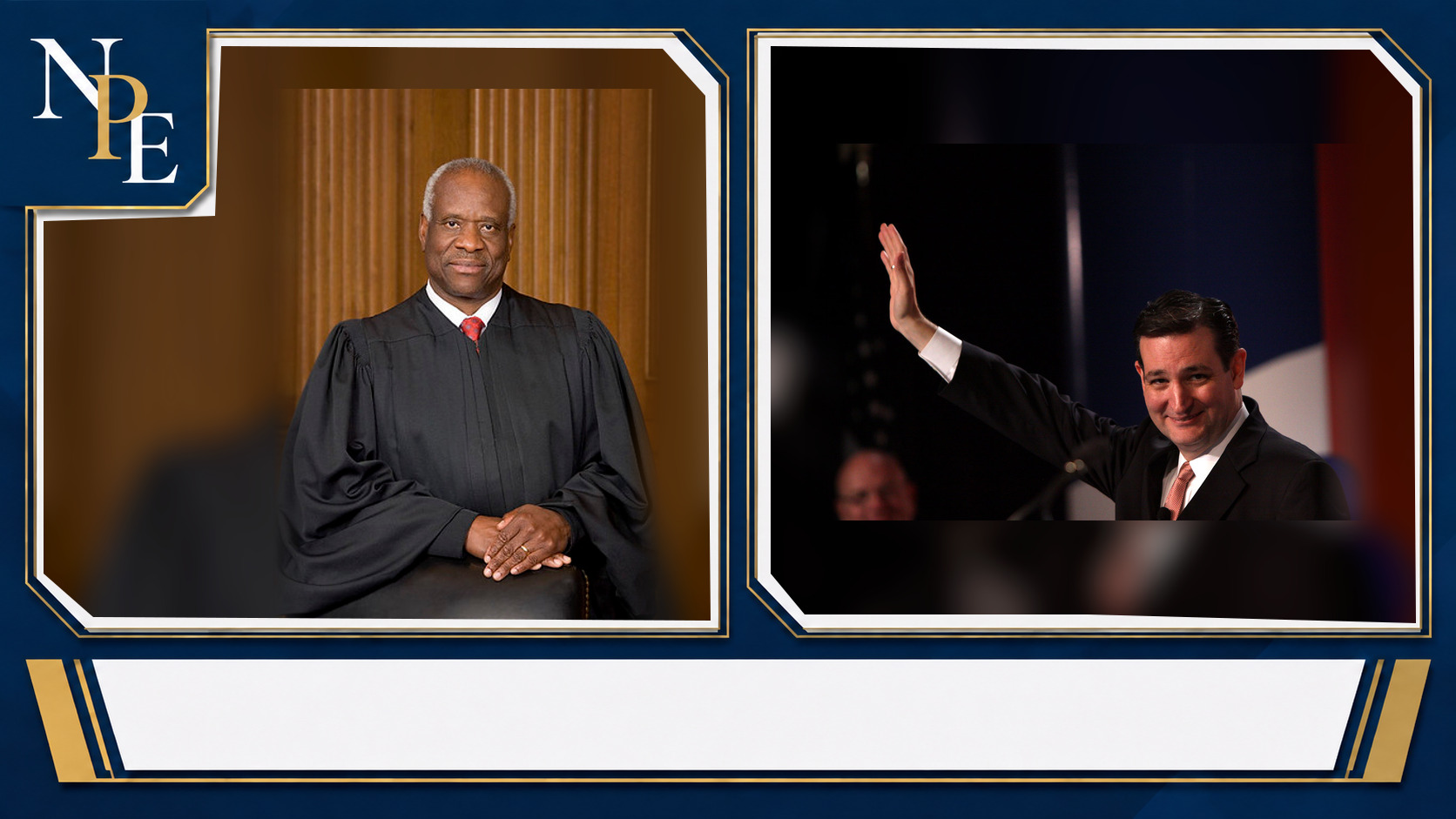
Thomas’s remarks on Cruz’s podcast put a personal face on a long-running fight over financial disclosures, judicial independence and public confidence in the Supreme Court.
Clarence Thomas thanked Ted Cruz for defending him against ethics complaints and praised the Texas senator for publicly standing up for him during an appearance on Cruz’s podcast. The comments, made on an episode of Verdict with Ted Cruz, renewed attention on the allegations involving Thomas’s financial disclosures and the wider argument over how Supreme Court justices should be held accountable.
Thomas described Cruz, Utah Sen. Mike Lee and other allies as people who supported him and his wife, Ginni Thomas, when they were under public criticism. The exchange matters because the ethics debate around Thomas has never been only about disclosure forms; it has also become a partisan conflict over the Court’s credibility and independence.
Thomas thanked a prominent ally
In the opening portion of the podcast conversation, Thomas told Cruz that he appreciated people who continued to speak up when others did not. He linked that support both to criticism directed at him personally and to attacks he said had affected his wife.

Cruz responded warmly, saying Thomas understood what it meant to withstand criticism. Their exchange was notable for its directness: a sitting justice publicly thanking an elected senator who has been among his most vocal defenders.
That does not itself establish an ethical violation. Justices routinely have public appearances and relationships with political figures. But the conversation arrives against a backdrop in which the public’s perception of political proximity has become central to arguments about Supreme Court ethics.
The complaints centered on disclosures
Scrutiny of Thomas intensified in 2023 after reports raised questions about gifts, luxury travel and property transactions connected to billionaire Harlan Crow, a Republican donor. Critics argued that some benefits should have appeared on Thomas’s financial disclosure forms.
Thomas later disclosed several private jet trips and denied wrongdoing. According to reporting summarized by The Hill, he pointed to security concerns after the leak of the draft opinion in Dobbs v. Jackson Women’s Health Organization, the case that overturned Roe v. Wade.
The dispute has involved more than travel. Thomas has also faced criticism over potential conflicts tied to Ginni Thomas’s conservative political activity, including her reported efforts related to overturning the 2020 election result.
Those are separate issues, but together they have fueled calls from lawmakers and ethics advocates for more binding oversight of the Court. Thomas and his supporters have broadly rejected the premise that the allegations show improper conduct.
Cruz called criticism political
Cruz has long treated the controversy as an ideological fight rather than a neutral ethics inquiry. In a 2023 Fox News appearance, he called the scrutiny of Thomas’s disclosures a political smear directed at a justice he views as an important constitutional conservative.
His defense reflects a broader Republican argument: that Thomas receives unusually intense scrutiny because of his judicial philosophy and his role in a conservative Court majority. Under that view, critics are using disclosure disputes to weaken a justice whose votes they oppose.
Critics see the matter differently. They argue that the issue is not whether Thomas is conservative, but whether a justice disclosed gifts and relationships in a way that lets the public assess possible conflicts. For them, appearances of favoritism can damage confidence even when no official action is proven to have been influenced.
The competing arguments rarely meet in the middle. One side emphasizes selective political targeting; the other emphasizes that the nation’s highest court needs tougher safeguards precisely because its decisions carry enormous consequences.
The Court adopted an ethics code
Amid mounting pressure, the Supreme Court adopted its first formal code of conduct for justices. The code instructs justices to avoid both impropriety and the appearance of impropriety.
That language addressed a key public concern, but it did not settle the debate. The code has been criticized by some reform advocates because it does not create an outside enforcement mechanism comparable to the disciplinary structures used in other parts of the federal judiciary.
Supporters of the Court’s approach have argued that the justices are already governed by laws, disclosure requirements and longstanding ethical traditions. They also warn that giving Congress a larger role in policing the Court could threaten judicial independence.
Thomas’s podcast remarks underline why the issue remains difficult. The public is not only evaluating paperwork and rules; it is also judging whether justices appear sufficiently distant from partisan political battles.
A book gives the moment context
The podcast appearance also came as Cruz prepared to release a biography of Thomas, Going Further: The Incomparable Clarence Thomas. The book traces Thomas’s path from poverty in segregated Georgia to his decades on the Supreme Court.
That project helps explain the tone of the conversation. Cruz is not simply a senator who defended Thomas in a television interview; he is also an admirer who has written extensively about the justice’s life and jurisprudence.
For Thomas’s supporters, the book and podcast offer a corrective to what they regard as unfair portrayals of the justice. For critics, the close public alliance between a justice and a politically active senator makes the need for transparent ethical boundaries feel more pressing.
What remains unsettled
Thomas’s appreciation for Cruz does not resolve the underlying complaints, and Cruz’s defense does not erase the questions raised by critics. The core disagreement remains whether existing disclosure rules and the Supreme Court’s ethics code provide enough reassurance to the public.
No new ethics finding or Court action was announced in the podcast exchange. What it did provide was a clear illustration of the political landscape around Thomas: he has committed allies, determined critics and a continuing role at the center of the national debate over trust in the Supreme Court.
For readers, the important distinction is between allegations, which prompted scrutiny and calls for reform, and proven misconduct, which Thomas has denied. The lasting test for the Court will be whether its ethics standards can persuade people across ideological lines that its decisions are made independently.
Leave a Reply