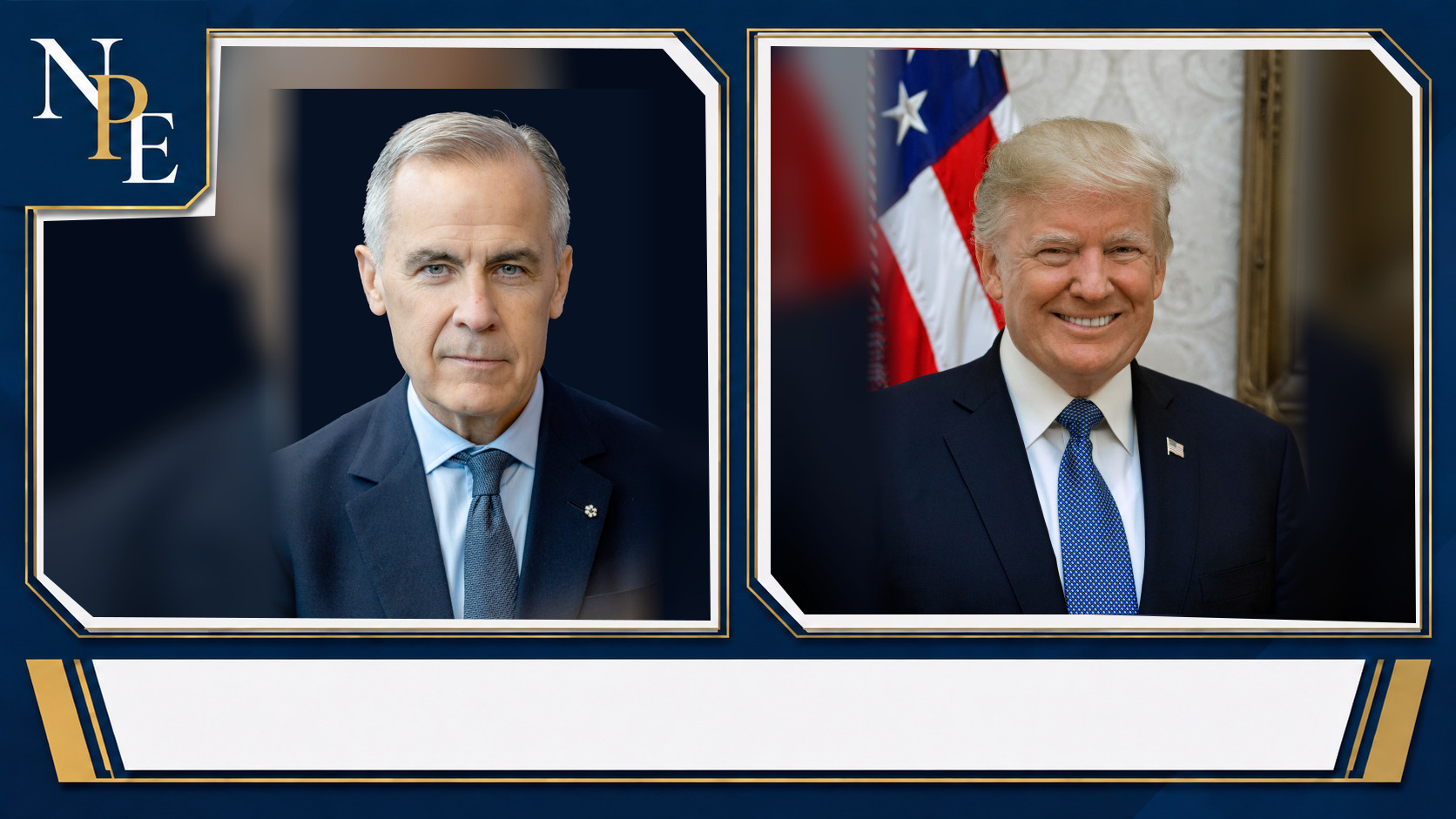
Mark Carney’s refusal to accept a U.S. trade deal has turned a hard negotiation into a test of Canada’s economic resilience. The immediate question is whether a tougher line on Donald Trump can protect Canada without deepening the damage from a trade war.
Canada may suffer economic and political costs from Mark Carney’s tougher stance toward Donald Trump, even as the Canadian prime minister argues that resisting the United States is necessary. Carney is confronting Trump in a Canada-United States trade conflict after walking away from negotiations and promising dollar-for-dollar retaliation if 50% U.S. tariffs take effect on $20 billion in Canadian goods.
The move puts a clear choice before Canada: accept pressure from its largest trading partner or absorb the disruption that comes with fighting back. Carney’s approach may strengthen his hand politically, but it cannot erase the unequal weight of the economic relationship.
Carney chose confrontation over a deal
According to reporting by The New York Times, Carney instructed Canadian negotiators to leave talks shortly before a deadline for a new round of Trump administration tariffs. He concluded that the proposed agreement was a bad deal for Canada.
That decision was followed by a public pledge to answer U.S. tariffs “dollar for dollar.” It is a deliberately forceful posture: Canada will not simply accept penalties imposed by Washington and hope diplomacy improves later.
In a televised address, Carney said the United States was trying to “break” Canada so it could “own” it, and said Canada was becoming less dependent on America. The language signals that this is being framed as more than a dispute over tariff schedules. It is being presented as a question of national independence.
That framing has an obvious political appeal. A prime minister seen as yielding to Trump could face a backlash, particularly when the U.S. president is using tariffs as leverage in negotiations.
The trade relationship is not balanced
The problem is that resolve does not make the two countries equally exposed. Canada and the United States are close neighbors with heavily integrated supply chains, but Canada relies much more on access to the U.S. market than the United States relies on access to Canada.
Tariffs can raise costs on both sides of the border. Yet Canadian exporters, manufacturers and communities tied to cross-border trade may have less room to absorb lost sales, delayed shipments or the need to find new customers.
That is the central risk in trying to out-tough Trump. Retaliation can impose a political and economic cost on the United States, but it also means Canada is accepting a share of the pain by choice.
The BBC described the situation as uncharted territory for two longtime allies and economic partners that have enjoyed free trade for decades. That history makes the current rupture more consequential than an ordinary dispute between distant trading partners.
Retaliation can protect leverage
There is a strong argument for Carney’s stance. A country that never responds to economic coercion can invite more of it. By matching tariffs, Canada may be trying to show that pressure from Washington will carry consequences rather than produce quick concessions.
Carney’s defenders can also argue that a weak agreement would have costs of its own. A deal that left Canada vulnerable to repeated tariff threats could create uncertainty for businesses and undermine confidence that Ottawa can defend Canadian interests.
A tougher response may therefore be less about winning a short-term contest of personalities than setting a limit on how the United States conducts negotiations. It gives Carney a message that is easy to understand: Canada will negotiate, but it will not be dictated to.
Many Canadians are reportedly behind him, according to the Times. Public support matters because retaliation can be difficult to sustain if households begin to feel the impact in prices, jobs or investment decisions.
The costs will not land evenly
Trade conflicts are often discussed in national terms, but their effects arrive business by business and region by region. An exporter facing a tariff may lose a contract quickly. A manufacturer that uses components moving back and forth across the border can see costs accumulate at several stages of production.
Consumers may also feel consequences if Canadian countermeasures make imported U.S. products more expensive. Some shoppers may accept that as the price of a firm response; others may see it as a self-inflicted squeeze during an already uncertain period.
There is also a timing problem. Building new trade links and reducing dependence on the United States can be a long-term strategy. Companies need customers, transport capacity, regulatory approvals and reliable investment before they can shift major volumes elsewhere.
Trump’s tariffs, by contrast, can alter decisions immediately. That gap between a fast shock and a slow adjustment is why Carney’s promise of greater independence is politically potent but economically difficult to deliver.
Trump’s leverage has limits too
Canada is not without tools. It is a major U.S. trading partner, and its role in cross-border supply networks means disruption can affect American businesses as well. Targeted retaliation may be designed to make that reality visible to politically important industries and regions in the United States.
But tariff battles are rarely cleanly targeted in practice. Companies often pass on some costs, change suppliers, delay expansion or reduce orders. The result can be a broad cloud of uncertainty that reaches beyond the products formally covered by a tariff list.
That uncertainty is one reason negotiations remain important even after a public rupture. A hard line can create leverage, but it can also narrow the room for either side to compromise without appearing to retreat.
For Trump, tariffs offer a way to force attention and test political resolve. For Carney, refusing what he considered a bad deal is a test of whether Canada can withstand that pressure without conceding its bargaining position.
Canada now needs a durable plan
The next phase will show whether Carney’s strategy is a negotiating tactic, the beginning of a longer trade realignment, or both. His government will need to explain not only why it rejected the U.S. offer, but how it intends to help sectors hit by the fallout.
Key details remain unclear, including how long the tariff escalation could last, whether Washington and Ottawa can return to talks, and which Canadian industries would face the sharpest impact. Those answers matter more than the rhetoric because they will determine how much of the dispute becomes embedded in the economy.
Carney’s challenge is not merely to sound tougher than Trump. It is to show that Canada can turn defiance into a workable economic strategy—one that protects sovereignty while limiting the burden on the people and businesses asked to carry it.
Leave a Reply