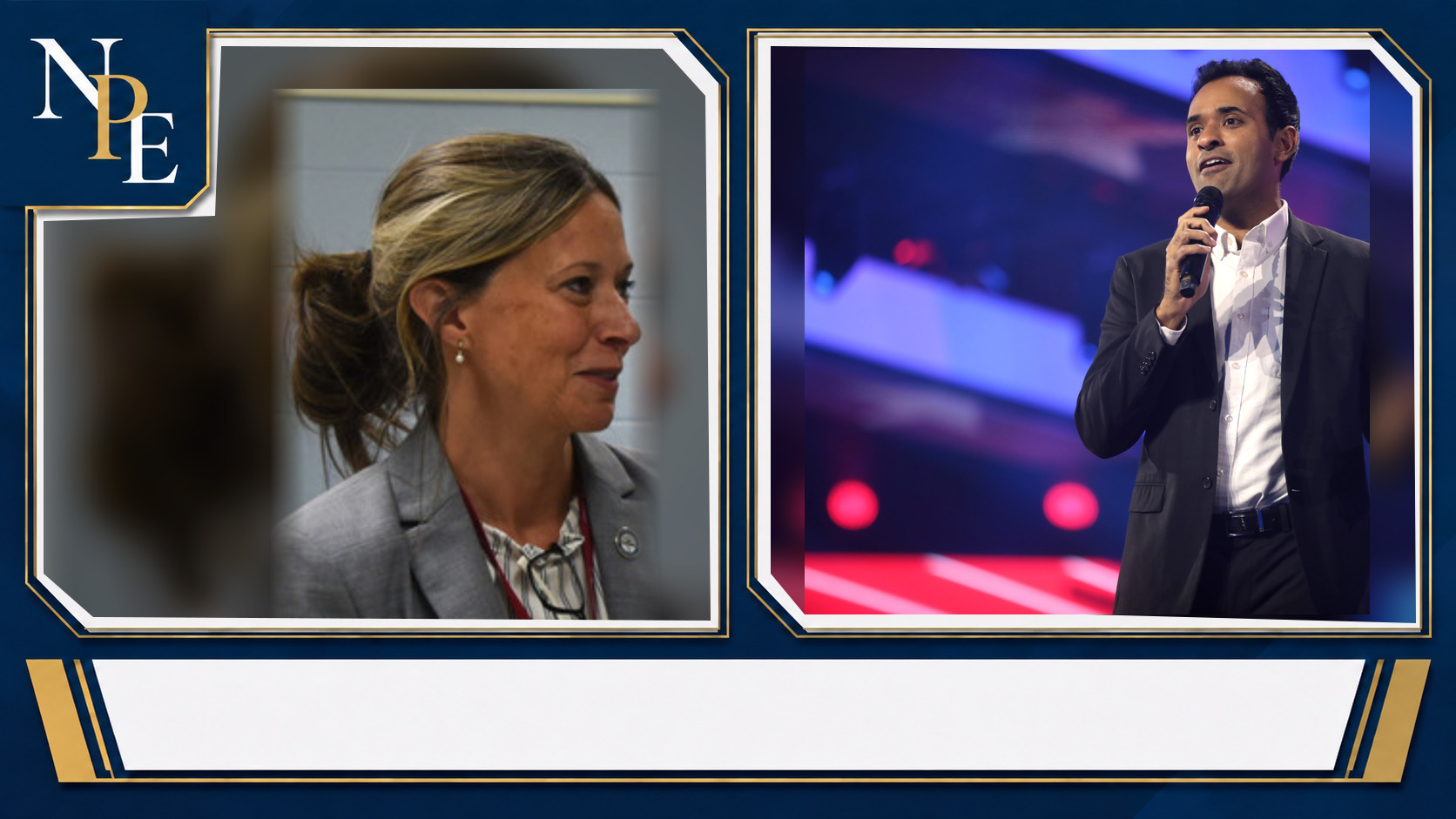
Amy Acton’s small lead over Vivek Ramaswamy is notable in a state that has moved sharply toward Republicans. Yet the available polling offers less of a clear favorite than a warning that Ohio’s open governor race may stay unsettled.
A new poll shows Vivek Ramaswamy trailing Amy Acton in the Ohio governor’s race, with the Democrat leading the Republican 46% to 44%. The Tulchin Research survey is a fresh sign that Ramaswamy’s chances of losing to Acton cannot be dismissed in a state Republicans have carried comfortably in recent presidential contests.
But the two-point result is within the poll’s stated margin of error, and other recent Ohio surveys have ranged from a tie to a slim advantage for either candidate. The more important finding may be that neither side has created meaningful separation in the race to replace term-limited Republican Governor Mike DeWine.
A two-point edge, not a verdict
Tulchin Research surveyed voters from July 29 through August 4 and found Acton at 46% and Ramaswamy at 44%. Five percent backed another candidate, while 6% said they were undecided.
The survey’s margin of error was plus or minus 4 percentage points. That means the poll should not be read as proof that Acton is definitively ahead statewide; the candidates’ measured support is close enough that a small difference in sampling could change the apparent leader.
There is another reason to treat the result with care. The poll was sponsored by Democratic attorney general candidate John Kulewicz. A sponsor does not automatically invalidate a survey, but readers should know who commissioned it and weigh that alongside the pollster’s methods, sample and uncertainty range.
Still, a Democratic candidate polling competitively in Ohio is politically meaningful. Acton does not need a commanding August lead to make the race consequential; she needs to remain viable long enough for undecided voters, turnout and the national midterm climate to matter.
Other surveys show a tight field
The Tulchin poll is part of a broader pattern rather than an outlier pointing in one direction. Recent public polling has shown an exceptionally narrow contest.
- A Times/Siena University poll of 601 likely voters, conducted June 15-28, had both candidates at 47%.
- An AARP survey of 800 likely voters, conducted June 14-16, put Acton ahead 47% to 44%.
- A Fox News poll of 1,015 registered voters, conducted May 28-June 1, showed Acton leading 50% to 49%.
- An earlier YouGov and Bowling Green State University poll of 1,000 registered voters, conducted April 7-14, gave Ramaswamy a 48% to 47% edge.
Each poll used a different sample, timing and methodology. The common thread is the narrowness: Acton has posted small leads in several surveys, Ramaswamy has led in another, and one respected poll found a dead heat.
That is a more reliable takeaway than any single percentage-point spread. The campaign appears to be a contest in which movement among a relatively small group of voters could decide who wins.
Ohio’s partisan history raises the stakes
Ohio was once a premier presidential swing state, supporting Barack Obama in 2008 and 2012. Its politics have shifted substantially since then, particularly as Donald Trump improved Republican performance among many white working-class voters and in rural parts of the state.
Trump won Ohio by about 11 percentage points in 2024, after carrying it by roughly 8 points in both 2016 and 2020. Those results help explain why a close governor’s race is drawing attention: a Democrat running even with a prominent Republican is not the recent statewide norm.
Ohio has not elected a Democratic governor since Ted Strickland won in 2006. Republican John Kasich defeated Strickland in 2010, and Republicans have retained the office since. DeWine cannot seek a third consecutive term, leaving an open-seat race without an incumbent on the ballot.
Open contests can behave differently from presidential races. Candidate image, state economic concerns and local issues can carry more weight when voters are choosing a governor rather than a president. That does not erase Ohio’s Republican lean, but it helps explain why party labels alone are not settling this matchup.
Two very different political profiles
Acton became widely known as director of the Ohio Department of Health during the COVID-19 pandemic. Her campaign is seeking to make affordability, trust in government and Ohio-focused outreach central themes.
Ramaswamy is an entrepreneur who gained national visibility during his 2024 presidential campaign. His high profile gives him built-in recognition and a clear connection to the national Republican coalition, advantages that can matter in a midterm election.
The campaigns are also working to define each other before the general-election message hardens. Acton campaign manager Philip Stein told Newsweek that Acton is speaking directly with voters around the state and criticized Ramaswamy’s campaign. Newsweek said it contacted Ramaswamy’s campaign for comment by email.
Both candidates face political complications. Ramaswamy was booed and heckled during a late-July speech at a Young Americans for Liberty event in Cincinnati, while Acton has drawn criticism from some LGBTQ+ activists over comments on transgender sports. Such episodes may not determine the race, but they show each candidate has constituencies to hold together.
Markets mirror the uncertainty
Prediction markets have also reflected a contest too close to call. As cited by Newsweek, Kalshi put Ramaswamy’s chance of victory at 51%, while Polymarket put Acton’s at 52%.
Those figures are not election forecasts in the same sense as a survey. They reflect prices set by traders buying and selling contracts tied to possible outcomes, and they can shift rapidly after polls, fundraising reports, debates or national political developments.
Markets can be useful as a snapshot of elite and trader expectations, but they should not be treated as a substitute for votes. Their near-even prices reinforce the polling picture: neither candidate has a credible claim to a runaway advantage.
What could move Ohio next
The remaining undecided voters are one obvious prize. In the Tulchin survey, 11% either chose someone else or had not yet made up their minds. In a race separated by two points, even a modest shift among that group could matter.
Turnout is another major unknown. Republicans’ statewide strength has been driven in part by strong rural and working-class support, while Democrats will need robust participation in cities and suburban areas, including the Columbus and Cincinnati regions where they have made gains.
The national environment may also shape the contest. Midterms often punish the party holding the White House when the president’s approval is weak, but Ohio’s recent Republican tilt means Democrats still have to convert a favorable climate into an unusually strong state-level performance.
For now, the new poll offers a clear but limited message: Acton is competitive and narrowly ahead in one survey, while Ramaswamy remains fully within striking distance. Ohio’s governor race is no longer easy to categorize as safely predictable, but it is far too early to call it for either candidate.
Leave a Reply