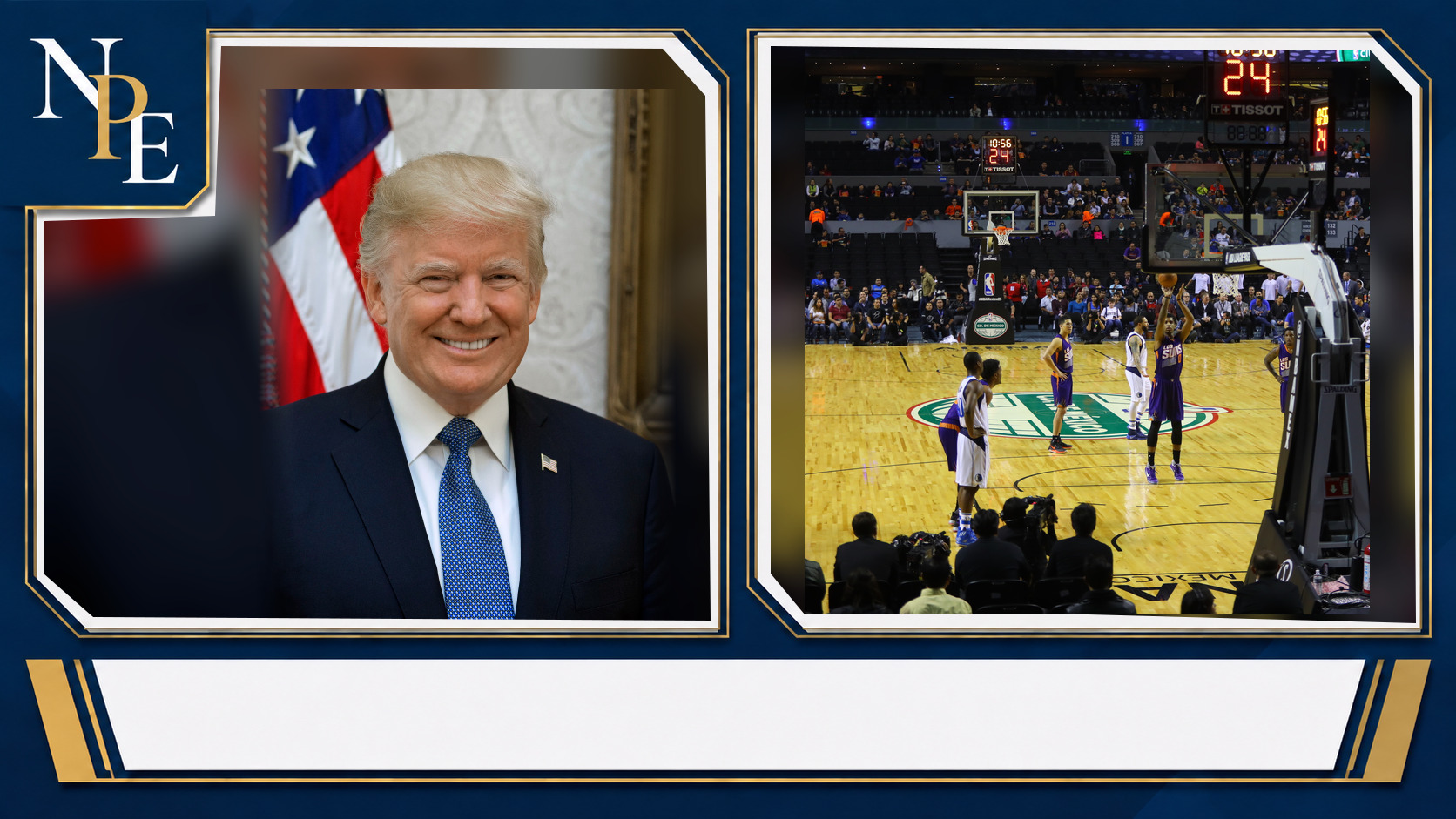
A Daily Express headline links Donald Trump’s reported reception at IndyCar to boos at the FIFA World Cup and NBA Finals. Available reporting firmly documents the NBA moment, but offers far less to establish a single view among IndyCar fans.
Donald Trump’s reception among IndyCar fans is being discussed alongside reported boos at the FIFA World Cup and NBA Finals. The clearest available account concerns the NBA Finals, where Trump was booed at Madison Square Garden; a broader claim about what IndyCar fans think of him remains difficult to verify from the reporting provided.
That distinction matters because a loud reaction in one arena can become a sweeping political storyline within hours. Sports crowds are large, emotional and varied, and a few seconds of applause or jeering rarely amount to a reliable measure of an entire fan base.
The documented NBA Finals moment
Associated Press reported that Trump was booed loudly when he appeared on Madison Square Garden’s video screens during the national anthem before Game 3 of the NBA Finals. The report described chants of “U-S-A! U-S-A!” during the anthem before boos began as Trump appeared giving a military salute.

The arena reaction was not uniform. AP said the jeers stopped when the U.S. flag appeared on the screens, while the crowd cheered New York Knicks players. It also reported loud boos for the visiting San Antonio Spurs, a reminder that spectators were responding to the game as well as to the president.
Trump gave a different assessment afterward, telling reporters that he believed there were “mostly cheers” and describing the reception as loud and enthusiastic. Reuters also reported that basketball fans greeted him with a chorus of loud boos.
Both accounts support a narrow conclusion: audible boos were directed at Trump inside the arena. They do not establish that every person in the building shared the same view, or that the reaction represents sports fans nationally.
What the IndyCar claim lacks
The Daily Express headline suggests Trump then learned what IndyCar fans think of him. But the source material supplied for this story does not include a reported IndyCar appearance, a venue, a race, video evidence, crowd accounts or a direct statement from INDYCAR.
Without those details, it is not possible to responsibly describe a verified IndyCar crowd reaction as supportive, hostile or mixed. A headline can connect separate sports events, but the evidence for each event still needs to stand on its own.
That does not mean IndyCar fans have no views about Trump. Like any large audience, they almost certainly hold a range of political opinions. It means there is no basis in the available reporting to turn that range into a single, definitive verdict.
Why sporting crowds become political
A sitting president at a championship event changes the atmosphere well beyond the action on the court, track or field. The appearance brings security restrictions, television cutaways and a political figure into a setting where many people came for sport rather than a public statement.
AP reported that Trump’s NBA Finals visit led to an extensive security perimeter around Madison Square Garden. Fans faced checkpoints and restrictions, while an outdoor watch party was canceled. Those disruptions can shape the mood around a visit independently of anyone’s politics.
At high-profile events, cheers and boos are also unusually easy to capture and circulate. A short clip can be real while still failing to explain the full crowd, the surrounding context or what happened before and after it was recorded.
That is especially relevant when the person involved is Trump, whose public appearances often draw strong reactions from both supporters and opponents. A crowd’s volume may show intensity, but it is a poor substitute for a representative survey.
World Cup reports need specifics
The FIFA World Cup is included in the claim, but the supplied research does not provide independently reported details of the alleged boos: no match, host city, date, broadcast footage or account from FIFA is included.
Calling a reaction “reported” is appropriate when it is attributed to the underlying headline. Treating it as established fact requires more: a clear description of where it occurred, who observed it and whether multiple credible outlets corroborated the account.
The difference may sound technical, but it protects readers from a common online shortcut. A claim repeated across social media posts can look confirmed even when each post traces back to the same unsourced or thinly sourced assertion.
For events as visible as a World Cup match, documentation should be possible to examine. Until it is, the reported World Cup episode should be treated with caution rather than used as proof of a wider trend.
No fan base is one audience
IndyCar, the NBA and international soccer draw audiences with different traditions, regions and demographics. They also contain supporters and critics of Trump, people indifferent to politics, and fans who may object mainly to the disruption caused by a presidential visit.
Even the NBA Finals example shows why simple labels can mislead. The same crowd heard patriotic chants, booed Trump’s image, cheered its home team and booed the opponent. Those reactions can coexist without resolving what the audience thinks on a political question.
There is also a practical difference between a spontaneous crowd response and organized protest. Reporting should identify whether a reaction came from a broad section of a venue, a concentrated group, signs outside an event, or a small clip amplified online.
None of this erases the NBA Finals boos. It puts them in proportion: they were a notable public moment, not a scientific reading of American sports culture.
The evidence-based takeaway
The available reporting supports that Trump encountered loud boos when shown during the national anthem at the NBA Finals in Madison Square Garden, while Trump himself characterized the overall reception differently. Reuters and AP each described the boos, and AP detailed the unusually heavy security around the visit.
The available material does not establish a comparable, verified reaction from IndyCar fans, nor does it supply enough detail to independently confirm the reported FIFA World Cup boos. Those gaps are central to the story, not a footnote.
For now, the most accurate reading is narrower than the viral framing: one major sporting event produced a clearly reported hostile reaction, while claims about other fan bases and events need fuller sourcing before they can carry the same weight.
Leave a Reply