A giant brain is striking, but it does not explain what makes killer whales so unusual. The stronger clue is how pods pass on distinct calls, diets and hunting skills across generations.
Orcas have brains up to five times heavier than human brains, but the article explains the orca trait that is more impressive than brain size: their ability to build and pass down pod cultures. Killer whales do not merely live in groups; many populations learn specialized calls, diets and hunting methods that can persist across generations.
That matters because a heavier brain is not a simple scoreboard for intelligence. The more compelling evidence of orca cognition is visible in the water: coordinated hunts, close family structures and traditions that distinguish one community of orcas from another.
A huge brain is only a clue
An adult human brain weighs roughly three pounds. Orca brains are commonly described as weighing several times more, with the largest estimates reaching around five times the mass of a human brain.

That figure is memorable, but mass alone cannot tell scientists what an animal thinks, feels or understands. Brain size is shaped by body size, sensory demands, movement and evolutionary history, not just by the kinds of mental skills humans tend to value.
A 2017 neuroanatomy study of a killer whale described the animal’s cerebral volume as 81.51% of its total brain volume, calling it one of the most corticalized mammalian brains studied. Earlier research reviewing cetacean brains and behavior argued that their large brains evolved alongside complex cognition and social lives.
Those findings make orcas scientifically fascinating. They do not, by themselves, prove that an orca is “smarter” than a person, a chimpanzee or another dolphin. Comparing intelligence across species is far messier than comparing weights on a scale.
Pod culture changes the question
The standout trait is culture: behavior learned socially and shared within a group. For orcas, culture can include vocal patterns, food preferences, travel habits and precise techniques for catching prey.
NOAA Fisheries notes that killer whale populations around the world include distinct ecotypes, or forms, and that populations are usually specialized in their foraging behavior and diet. In other words, “orca” does not describe one uniform way of life.
Some groups target fish, while others hunt marine mammals. These differences are not just dictated by geography or opportunity. Research on killer whales has repeatedly found that young animals learn essential behavior from close relatives, especially their mothers and older pod members.
That makes an orca pod more than a temporary hunting party. It can function as a long-running repository of local knowledge: where to travel, what to pursue, which sounds to make and how to coordinate with others.
Hunting skills are learned traditions
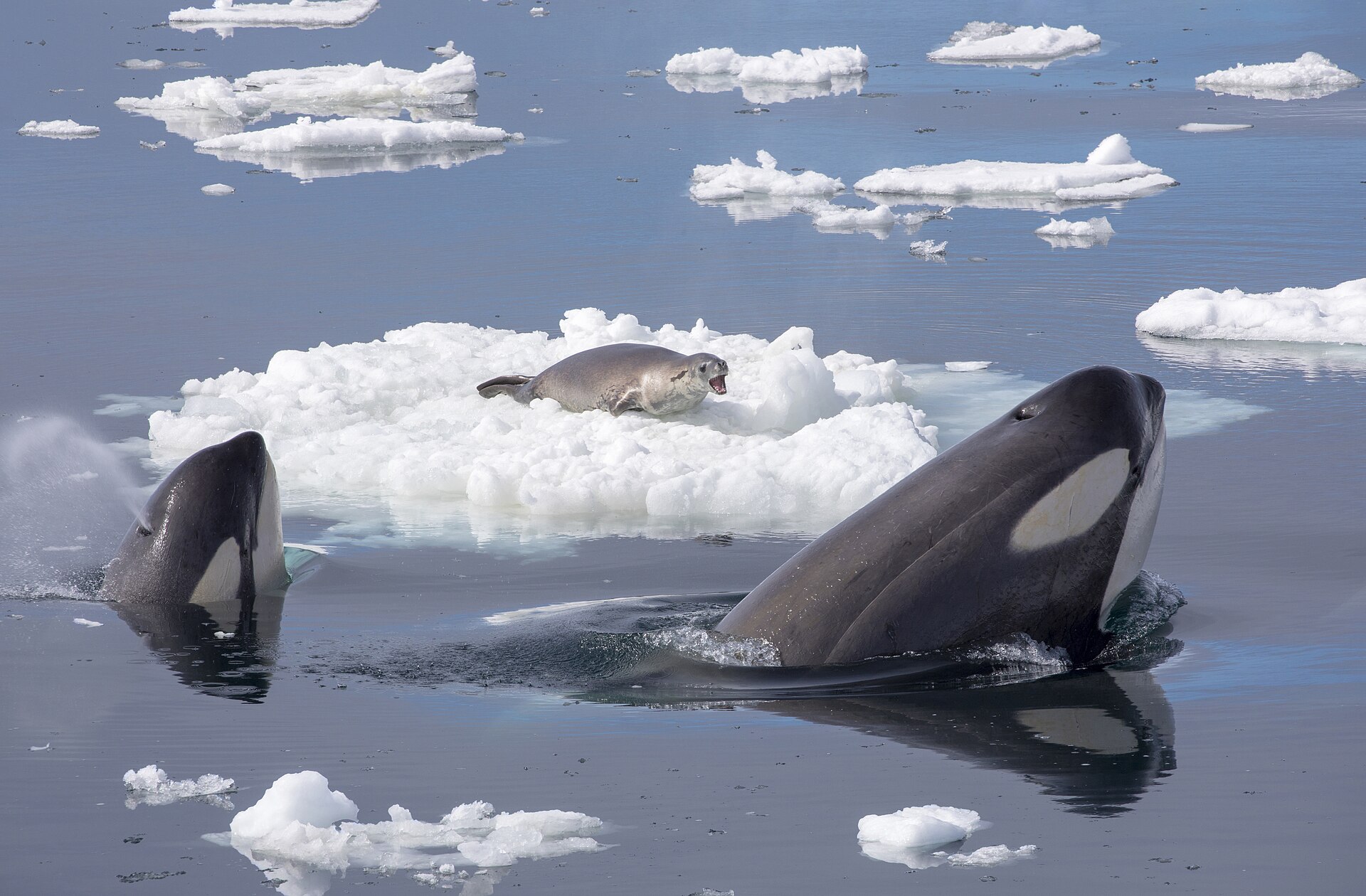
Orcas are apex predators found in every ocean, but their methods can be astonishingly specific. NOAA says they often use coordinated hunting strategies, working as a team in a way often compared with wolves.
For a pod, success may depend on mastering a technique that would be difficult for one animal to invent or execute alone. The animals must anticipate one another’s movement, recognize the behavior of their prey and adjust when conditions change.
Scientists have documented striking examples in different regions: orcas that work together to herd fish, groups that use waves to dislodge seals from ice and populations that pursue particular prey while ignoring others nearby. The critical point is not that every orca uses every tactic. It is that different communities can maintain different playbooks.
That specialization offers a more meaningful window into cognition than brain mass. It involves memory, social learning, communication and cooperation, all playing out in a real-world survival task.
Calls can mark community identity
Orcas are also known for distinctive vocal behavior. Pods may use characteristic call patterns that help maintain contact and may help signal group membership.
These calls are often discussed as dialects, though the term should not be treated as a claim that whales use language exactly as humans do. Human language has its own defining features, including open-ended grammar. Still, learned, group-specific vocal traditions are a powerful sign that communication is socially shaped rather than purely hard-wired.
The comparison is useful when kept in bounds. Orcas are not miniature humans in black-and-white bodies. Their intelligence developed under entirely different pressures: navigating vast oceans, coordinating with family and locating prey in a world where sound travels farther than sight.
That difference is part of the appeal. A cognitive system does not have to resemble ours to be sophisticated.
Social bonds may preserve knowledge
Orca societies are notably family-centered. NOAA says pods typically contain two to 15 animals, though social arrangements vary among populations. Long associations give young whales time to learn behavior that cannot be downloaded instantly from instinct.
Older animals may be especially important because they carry experience accumulated over years. In a changing ocean, knowledge of productive feeding areas, prey behavior and seasonal movement can be valuable well beyond a single hunt.
This is also why culture complicates conservation. Protecting an animal is not always enough if its food sources, habitat or opportunities to pass knowledge to younger relatives are damaged. A declining population can lose traditions along with individuals.
NOAA identifies food limitations, chemical contaminants, vessel disturbance and ocean noise among threats faced by some killer whale populations. Southern Resident killer whales, which range from central California to southeast Alaska, are the only endangered killer whale population in the United States.
Brain size should not steal the story
The claim that orcas have brains up to five times heavier than ours is a useful starting fact, not a final verdict on their minds. It invites curiosity, but it can also encourage the misleading idea that intelligence is a one-number contest.
What makes orcas exceptional is the combination of neurological complexity and a social world rich enough for knowledge to be shared. Their pod cultures turn individual capabilities into collective survival strategies.
Many questions remain unresolved. Scientists are still working out how much behavior is inherited versus learned, how traditions emerge and change, and how different ecotypes should be classified. Several populations may even represent separate species or subspecies, according to NOAA.
The clearest takeaway is also the least flashy: an orca’s biggest advantage may not be the extraordinary size of its brain, but what generations of whales do with it together.
Leave a Reply