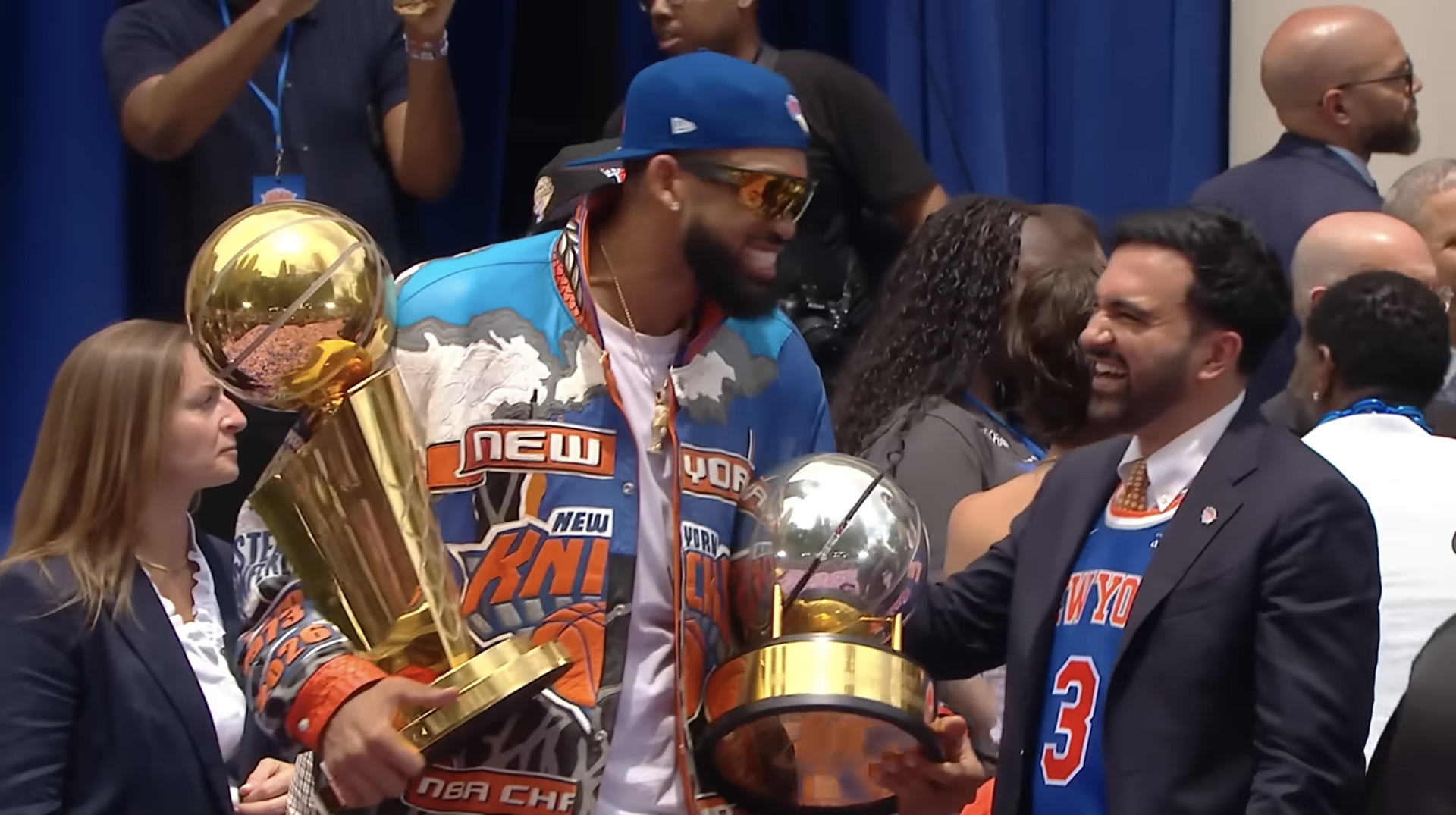
The reported decision says as much about New York’s confidence as it does about James’ star power. It also shows how a franchise can treat even a LeBron opportunity as a chemistry question, not just a talent grab.
The New York Knicks reportedly passed on the chance to sign LeBron James after LeBron James’ camp reportedly contacted the Knicks during free agency. According to reporting attributed to Hoops Wire’s Sam Amico and carried by Larry Brown Sports and Yardbarker, New York did not pursue James because the Knicks valued roster continuity and believed in the group already in place.
That makes the reported LeBron pass less about whether James can still swing games and more about the price they wouldn’t pay: the disruption, attention and role reshuffling that can come with adding one of NBA history’s defining players.
The headline is the hesitation
On name value alone, almost any LeBron James free-agency link still sounds enormous. The unusual part of this report is that the Knicks were not described as racing to make room for him.
The available reporting says James’ side reached out and the Knicks had no interest in pursuing him. It does not establish a formal offer, a detailed contract structure or the specific roster moves that would have been needed.
That distinction matters. Free agency often includes exploratory contact that never becomes negotiation. A player’s camp can test a market, and a front office can decide the fit is not worth chasing before anything close to a deal exists.
Still, the identity of the player changes the weight of the choice. Teams routinely remake plans around a James-level possibility. New York reportedly chose not to begin that process.
Continuity beat star gravity
Amico’s reporting, as cited by Larry Brown Sports and Yardbarker, pointed to a simple explanation: the Knicks believed they were good enough as constructed and did not want to disrupt their current roster.
That is the core basketball question inside the rumor. The Knicks were not only weighing LeBron James’ ability. They were weighing what his presence would do to a team that, in the framing of the reports, already saw itself in title-winning terms.
Adding James is rarely just an addition. It changes touches, roles, media attention, leadership dynamics and the way every decision is judged. For one team, that can be the whole point. For another, it can look like a reset disguised as an upgrade.
New York’s reported stance suggests the front office trusted the existing chemistry more than the theoretical upside of a superstar pivot. That is a notable posture in a league where star chasing often doubles as strategy.
Rich Paul’s comment gains context
The report also interacts with earlier comments attributed to Rich Paul, James’ longtime agent. Paul reportedly said earlier in the offseason that James would have gone to the Knicks if they had not just won an NBA title.
At first glance, that comment could be read mainly as an optics issue for James: the idea that joining a team already framed as a champion would invite criticism or look too easy.
The newer reporting shifts part of the emphasis back toward New York. If James’ camp made contact and the Knicks did not want to pursue him, then the team may have had more agency in closing the door than the earlier comment alone suggested.
That does not prove how close anything came. It supports a narrower point: there was reported interest from James’ side, and the Knicks were reportedly reluctant to alter course.
The Sixers line raises stakes
The same reporting also said the Knicks believe they are better than the Philadelphia 76ers. That detail gives the decision a sharper Eastern Conference edge.
Without adding unsupported certainty about James’ exact Philadelphia situation from the available material, the comparison still matters. It presents New York as a team evaluating itself from a position of confidence rather than fear.
If the Knicks truly believe they are ahead of Philadelphia, then chasing the biggest available name becomes less necessary. The reported message is not panic. It is conviction.
That conviction can be remembered in very different ways. If the Knicks keep winning with the roster they protected, the decision will look disciplined. If they fall short, the reported pass on James will become an easy point of second-guessing.
The backlash New York avoided
Larry Brown Sports noted that James has drawn criticism from some corners for what is perceived as “team stacking.” That backdrop would have followed any serious Knicks pursuit, especially if the move involved James taking a major discount to join a team already described in championship terms.
The public reaction, though, should not be treated as the stated reason for New York’s decision. The available reporting does not say the Knicks backed away because of backlash or leaguewide optics.
The supported reasoning is more direct: New York reportedly believed in its roster and did not want to disrupt it. The possible noise around James only helps explain why the move would have been larger than a normal free-agent signing.
For the Knicks, staying out of the chase may have protected more than a rotation. It may also have kept the franchise from turning every possession, substitution and loss into a referendum on whether adding James had changed too much.
What remains unproven
The clearest supported sequence is limited but compelling: James’ camp reportedly contacted the Knicks during free agency, the Knicks reportedly had no interest in pursuing him, and Amico’s reporting centered New York’s confidence in its current roster.
The gaps are just as important. The available material does not include a detailed Knicks explanation, a confirmed financial structure or a clear account of how close any move could have become.
That means this should not be framed as the Knicks rejecting a completed deal. It is more precise to say they reportedly declined to pursue the possibility after contact from James’ side.
The significance is in that restraint. In a league built around the belief that elite talent should always be collected when available, New York reportedly treated LeBron James as a fit question. The answer, at least according to the reports, was that the team it already had was worth protecting.
Leave a Reply