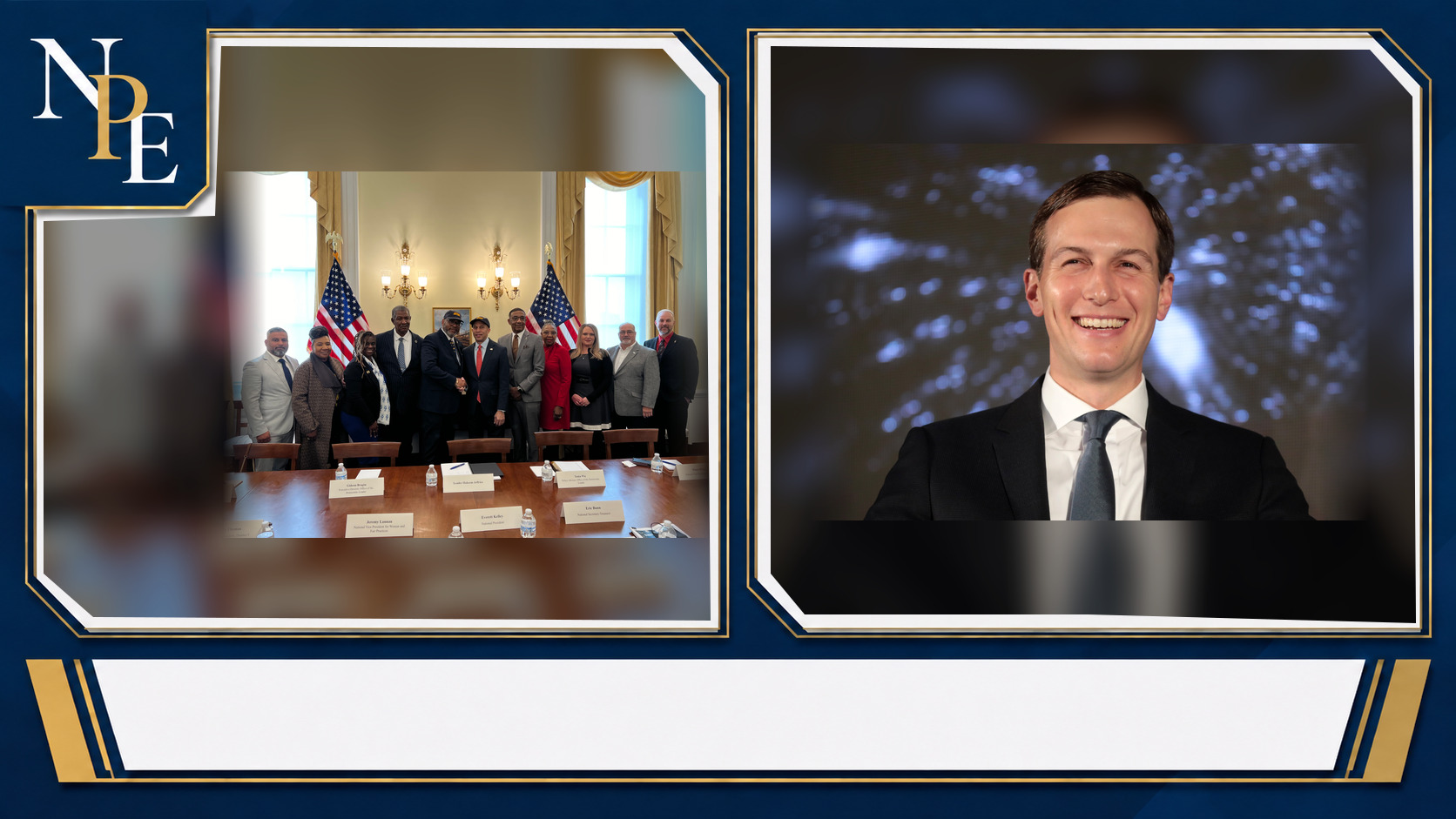
The unusual conversation brought a leading Democratic critic of President Donald Trump together with Trump’s son-in-law and informal adviser. It offers a glimpse of where both sides may see room for dialogue — and where their public positions remain far apart.
Hakeem Jeffries and Jared Kushner held a private meeting in New York City, reportedly gathering in Manhattan to discuss possible areas of cooperation and common ground between Democrats and President Donald Trump’s orbit. The conversation reportedly touched on immigration, housing and the high cost of living — issues that could shape the political fight over affordability.
The meeting was unusual because Jeffries is the House Democratic leader and one of Trump’s most prominent congressional critics, while Kushner is Trump’s son-in-law and an informal adviser. Reports from The New York Times, later confirmed to NBC News by a source familiar with the meeting, leave important details unresolved, including exactly when it occurred and what, if anything, came of it.
A rare private political channel
Private meetings between political rivals are not inherently unusual in Washington and New York, where lawmakers, business figures and former officials often maintain informal lines of communication. But the Jeffries-Kushner conversation stands out because it joined two figures associated with sharply different political camps.
Jeffries represents a Brooklyn-based New York district and leads House Democrats. Kushner, who served as a senior adviser during Trump’s first administration, remains a close family member and trusted figure around the president.
NBC News described the meeting as an effort to discuss potential cooperation between Democrats and Trump. The existence of the meeting is notable on its own: public exchanges between congressional Democrats and the Trump administration are often defined by confrontation, particularly over immigration, spending and the direction of the economy.
That does not mean either side has abandoned those disputes. It suggests that behind-the-scenes contact can coexist with an openly adversarial political environment.
The reported focus was affordability
According to The New York Times, the discussion included housing, immigration and the high cost of living. Those topics place kitchen-table pressures at the center of a conversation that might otherwise be viewed simply as political optics.
Housing costs and everyday expenses are closely linked in many voters’ minds. Rent, home prices, insurance, food and utility bills can make broad economic claims feel distant, even when national indicators point in a favorable direction.
Jeffries emphasized that point in a statement after the meeting. He said Republicans had embraced a “my-way-or-the-highway approach” to governing and argued that Democrats would continue telling the Trump administration that “the affordability crisis is not a hoax.”
His statement was not a declaration of agreement with Kushner or the White House. Rather, it framed any talks as an opportunity to press Democratic demands for what Jeffries called transformational policy change.
Manhattan was a practical choice
The meeting took place at a private Manhattan space offered by a mutual acquaintance, according to reporting cited by USA Today and NBC News. The identity of that person and the precise venue have not been made public.
New York City was a natural setting in one sense. Jeffries lives in Brooklyn and represents New Yorkers in Congress. Kushner also has deep ties to the city: he attended New York University for graduate study, and his family has long-standing real-estate interests in the state.
Still, there is no public explanation for why Manhattan was selected beyond the availability of the private space. It would be a mistake to read a larger strategy into the location when the reporting does not establish one.
The limited information is part of why the meeting has drawn attention. In a polarized era, even a quiet meeting between figures with ties to opposing camps can become a political signal.
Common ground has clear limits
There are plausible areas where Democrats and Trump allies might identify overlapping concerns. Increasing housing supply, addressing high consumer costs and finding workable administrative approaches to certain immigration questions can attract interest across ideological lines.
Agreement on the diagnosis, however, is not the same as agreement on policy. Democrats and Republicans have deep disagreements over immigration enforcement, federal spending, taxes, regulation, health care and the role of government in making housing more affordable.
Jeffries’ statement underscored those limits. His argument was that Republican governing has failed ordinary Americans, not that the parties had reached a shared program.
Kushner’s role also adds complexity. He is not a member of Congress, and the available reporting did not indicate that he was negotiating legislation or speaking on behalf of a formal White House process. He is, nonetheless, a consequential Trump confidant whose access makes the conversation politically meaningful.
No deal has been announced
Neither the reporting nor Jeffries’ public statement identified a specific agreement, legislative package or follow-up plan. The source who confirmed the meeting to NBC News did not provide details on when it happened or the full substance of the discussion.
That lack of detail leaves two competing readings. Supporters of cross-party engagement can see value in keeping a channel open on problems that affect voters regardless of party. Skeptics can reasonably note that meetings without public commitments may produce little beyond speculation.
For now, the clearest takeaway is narrower: a top House Democrat and a close Trump adviser met privately in Manhattan and discussed areas where cooperation might be possible. The reported agenda focused on issues with immediate public resonance, but any concrete outcome remains unknown.
What to watch after the meeting
The next test is whether any of the reported subjects surfaces in public policy. A serious sign of progress would be a defined proposal, a bipartisan congressional discussion, administrative action or direct acknowledgment from participants that talks are continuing.
Absent that, the meeting may remain chiefly a reminder of political reality: public combat and private conversation often happen at the same time. For Jeffries, it creates a chance to argue that affordability requires a different governing approach. For Kushner and Trump allies, it offers an avenue to hear directly from a leading Democratic opponent.
Neither outcome guarantees compromise. But on housing, immigration and the cost of living, the issues raised in a private Manhattan room are unlikely to disappear from the public debate.
Leave a Reply