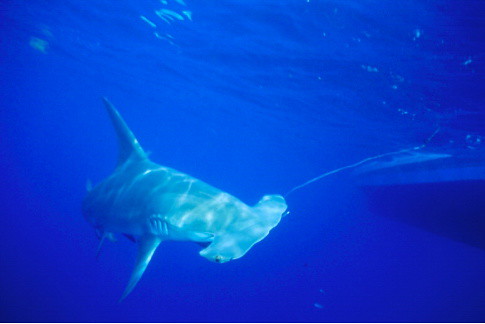
The Florida sighting was dramatic because of how close the shark appeared to shore, not because shallow water is outside its range. The encounter also puts a spotlight on how to respond safely when a large shark is nearby.
A giant hammerhead shark appeared in Florida’s shallow waters and created a major spectacle after it was spotted just yards from a beach. The shark was identified in a USA Today/For The Win report as a great hammerhead, a species that can grow to 18 to 20 feet and is built for warm coastal water.
The sighting is a startling image for anyone at the shoreline, but it is not proof that a shark is behaving unusually or that Florida beaches have suddenly become unsafe. It is a useful reminder that the nearshore zone belongs to wildlife as well as swimmers—and that a close encounter calls for caution rather than panic.
Why the shark looked so startling
Great hammerheads are the largest members of the hammerhead family. Their broad, squared-off head, exceptionally tall first dorsal fin and heavy body make even a brief view near the surface look enormous.
According to the Florida Museum of Natural History, great hammerheads can reach a maximum length of 18 to 20 feet. An animal does not need to approach that upper limit, though, to create a spectacle in clear, shallow water where its outline can be seen from shore.
The report did not provide a verified measurement, precise beach location or details that would allow outsiders to independently determine the shark’s size. “Giant” captures the public reaction, but viewers should be wary of estimating length from shore or from a video without a reliable object for scale.
That distinction matters. A large shark close to land is visually unforgettable, yet a dramatic clip can make it difficult to judge distance, depth and the animal’s actual behavior.
Shallow water is not a contradiction
A great hammerhead in Florida’s shallows may feel out of place to beachgoers, but coastal habitat is part of the species’ known range. The Florida Museum describes the great hammerhead as a warm-water, coastal and semi-oceanic shark found from offshore waters to areas much closer to land.
Its range in the western Atlantic includes North Carolina, the Gulf of Mexico, the Caribbean and waters south to Uruguay. Florida sits squarely within that broader warm-water distribution.
Nearshore water can offer feeding opportunities. Great hammerheads eat bony fish and invertebrates, as well as other sharks and rays; their unusual heads carry sensitive electrical receptors that help them detect prey, including animals concealed under sand.
That does not reveal what this particular shark was doing. It could have been passing through, following prey or using a familiar coastal corridor. Without observations over time, assigning a motive would be speculation.
Close sightings demand calm distance
The immediate takeaway for people on a beach is simple: give a large shark room. Do not enter the water to get a closer look, try to follow it from a paddleboard, throw bait or attempt to touch it.
The Florida Museum says great hammerheads should be treated with caution because of their size and unpredictable nature. That is a sensible standard even though documented unprovoked attacks involving all hammerhead species combined are uncommon; the museum cites the International Shark Attack File’s record of 17 unprovoked attacks and no fatalities across the genus Sphyrna.
Rare is not the same as impossible, especially when a powerful wild animal is within swimming depth. Beach conditions can also change quickly, and a crowd moving toward the water for a better view can create its own risks.
- Leave the water promptly and calmly if a large shark is seen nearby.
- Keep children, pets and fishing activity away from the shoreline until the animal has moved on.
- Follow local lifeguard, beach patrol or wildlife-agency directions rather than relying on social-media speculation.
- Do not assume a shark’s route or intentions from a single sighting.
A vulnerable predator beneath the spectacle
The fascination around a great hammerhead can obscure a harder fact: the species is listed as Endangered on the IUCN Red List, according to the Florida Museum. Great hammerheads are vulnerable to fishing pressure and accidental capture in gear such as longlines, nets and trawls.
The museum notes that the species is valued in the fin trade and can suffer high mortality after capture. It also describes great hammerheads as physiologically fragile animals that tire quickly when caught by recreational anglers.
That conservation reality changes the frame around a viral-style sighting. The shark is not merely a beachside attraction; it is a large, declining marine predator moving through habitat people use every day.
There is also a practical limit to what one close-shore appearance can tell us about the population. A single individual cannot establish whether numbers are rising, falling or shifting locally. It does, however, show why coastal stewardship and responsible viewing matter.
What remains unknown about this encounter
The available report establishes the central event: a great hammerhead was spotted just yards from a Florida beach, producing a major spectacle in shallow water. It does not establish the animal’s exact size, sex, age, travel route or the reason it was close to shore.
Those unknowns should temper both extremes of the conversation. There is no basis to portray every shark sighting as an emergency, and no reason to treat a giant shark near swimmers as a harmless photo opportunity.
Florida’s coast is one of the places where people, fish, rays and sharks overlap. The most grounded response to this hammerhead sighting is to respect the distance between observer and animal—and to recognize that seeing an endangered coastal predator alive in its habitat is remarkable in its own right.
Leave a Reply