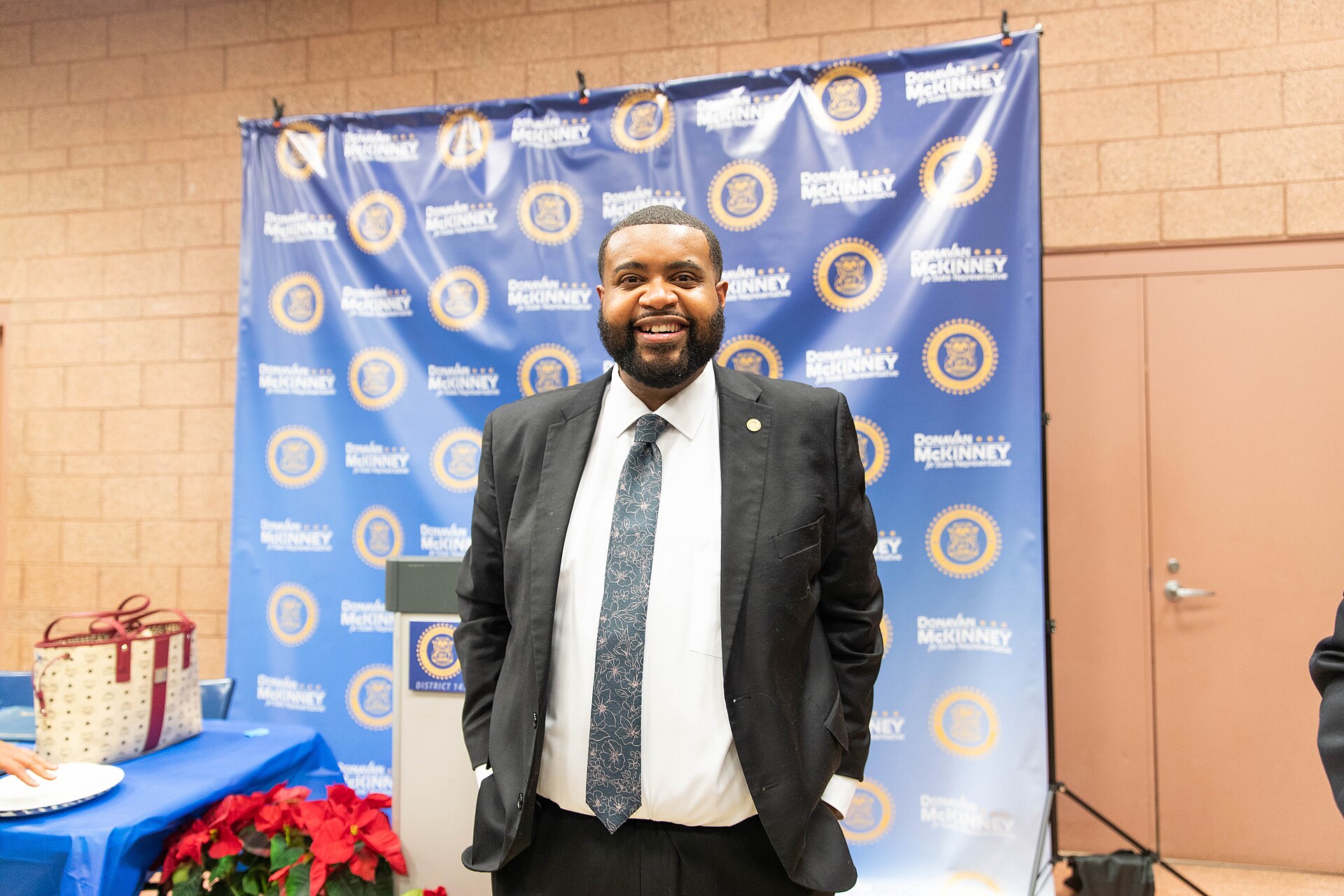
Donavan McKinney’s win gives progressives another incumbent defeat to point to. But the Detroit-area race was shaped by more than ideology alone.
Democratic Rep. Shri Thanedar lost his Democratic primary in Michigan, and Donavan McKinney defeated him, NBC News projected on Aug. 5, 2026, handing a win to the Democratic Party’s progressive wing. The result matters now because it shows progressive challengers are still finding openings against Democratic incumbents, even in races shaped by local complications rather than a simple left-versus-center storyline.
The Detroit-area contest did more than remove an incumbent. It exposed a party argument over ideology, Israel, campaign spending, and whether establishment endorsements can still protect vulnerable members.
McKinney turns a challenge into an upset
McKinney, a Michigan state representative, beat Thanedar after launching his congressional bid about 16 months before the primary. NBC News described the outcome as the latest victory for progressives pushing against the Democratic establishment this cycle.

At 34, McKinney ran as a democratic socialist with support from prominent progressive figures and organizations. His platform included Medicare for All, new restrictions on military aid to Israel, and major federal investment in clean energy and housing.
That message gave progressive activists a clear contrast with Thanedar, who entered Congress with his own history of progressive branding but later moved into a more complicated lane inside the Democratic caucus.
McKinney’s win also shows the value of early organizing. A challenger who enters late often has to rely on a single controversy or outside spending. McKinney had time to build a case that Thanedar was beatable.
Why progressives are celebrating
For the Democratic Party’s left flank, the race offers a clean headline: a progressive challenger defeated a sitting Democratic member of Congress. That matters because incumbent House members usually begin primaries with money, name recognition and institutional support.
McKinney was backed by Sen. Bernie Sanders of Vermont, Rep. Rashida Tlaib of Michigan, Michigan Senate candidate Abdul El-Sayed, Justice Democrats and Leaders We Deserve, according to NBC News. Those endorsements placed the race inside a broader national effort to elevate younger, more confrontational progressive candidates.
The victory gives that network another proof point. Progressive groups have argued that Democratic voters are frustrated not only with Republicans, but with their own party’s caution, hierarchy and distance from working-class concerns.
Still, the outcome should not be flattened into a single national lesson. Thanedar had vulnerabilities that made this contest different from a routine ideological primary. Progressives won, but they also benefited from a race in which the incumbent had accumulated unusually visible baggage.
Thanedar’s liabilities piled up
Thanedar narrowly won the Detroit-area seat in 2022 after self-funding his campaign. Since then, his political identity has shifted in ways that gave opponents room to attack him from multiple directions.
He initially ran as a progressive, then broke with the Democratic Socialists of America in 2023. Thanedar has said he quit the organization; the local chapter has said he was expelled. Either way, the break gave critics a shorthand for arguing that he had moved away from the movement that once helped define his brand.
His position on Israel also became part of that shift. NBC News reported that Thanedar rebranded more around supporting Israel, while McKinney campaigned on adding restrictions to military aid to Israel. In a district and party where the issue has become a sharp dividing line, that contrast mattered.
Thanedar also drew Democratic criticism for an attempt to impeach President Donald Trump that was not backed by party leadership. Yet he later received support from House Minority Leader Hakeem Jeffries and other top House Democrats, creating an unusual split: party leaders were willing to stand by him even as some voters and activists were ready to move on.
Money questions added pressure
Campaign finance became another problem for Thanedar. NBC News reported that his campaign disclosed losing more than $2 million this year tied to cryptocurrency investments, an uncommon use of campaign money.
That detail is politically damaging because it is easy to understand. Voters do not need to be campaign-finance experts to question why a congressional campaign would take such a hit on crypto holdings.
Thanedar also spent hundreds of thousands of dollars in taxpayer money on television ads from his congressional office that looked similar to campaign ads, NBC News reported. Members of Congress can use official resources to communicate with constituents, but the line between public information and political promotion often draws scrutiny.
For a challenger, those controversies created a practical argument. McKinney did not have to campaign only on ideology. He could argue that voters deserved a representative more focused, more accountable and less encumbered by questions about judgment.
Establishment support was not enough
One of the most revealing pieces of the race is that Thanedar did not lose as an isolated incumbent abandoned by Washington. He had support from major Democratic figures, including Jeffries, according to NBC News.
That makes the result more uncomfortable for party leaders. Endorsements from leadership can help raise money, reassure donors and signal legitimacy. They cannot automatically settle a primary if the local electorate has already turned skeptical.
For progressives, that is the strategic opening. Their argument is not just that left-wing policy is popular; it is that Democratic leaders sometimes protect incumbents who are out of step with their districts or vulnerable because of their own records.
For establishment Democrats, the counterargument is also clear. They often prioritize unity, seniority and keeping seats in Democratic hands. From that view, primary challenges can drain resources and sharpen intraparty divisions before general elections.
The lesson is not simple
McKinney’s victory will be read nationally because it fits a larger pattern of progressive challengers testing Democratic incumbents. But the Michigan race also warns against easy interpretation.
This was not only a referendum on Medicare for All, Israel policy or democratic socialism. It was also a referendum on Thanedar’s personal political arc, his campaign’s financial choices and the credibility of his local connection.
What remains unclear is how far McKinney’s model travels. A challenger with national progressive backing, a long runway and a weakened incumbent can win. That does not mean every incumbent is equally exposed, or that every district will respond the same way.
For now, the takeaway is direct: Thanedar’s primary loss gives the Democratic Party’s progressive wing momentum and gives party leaders another reminder that incumbency is not armor. In some races, it can become the thing challengers run against.
Leave a Reply