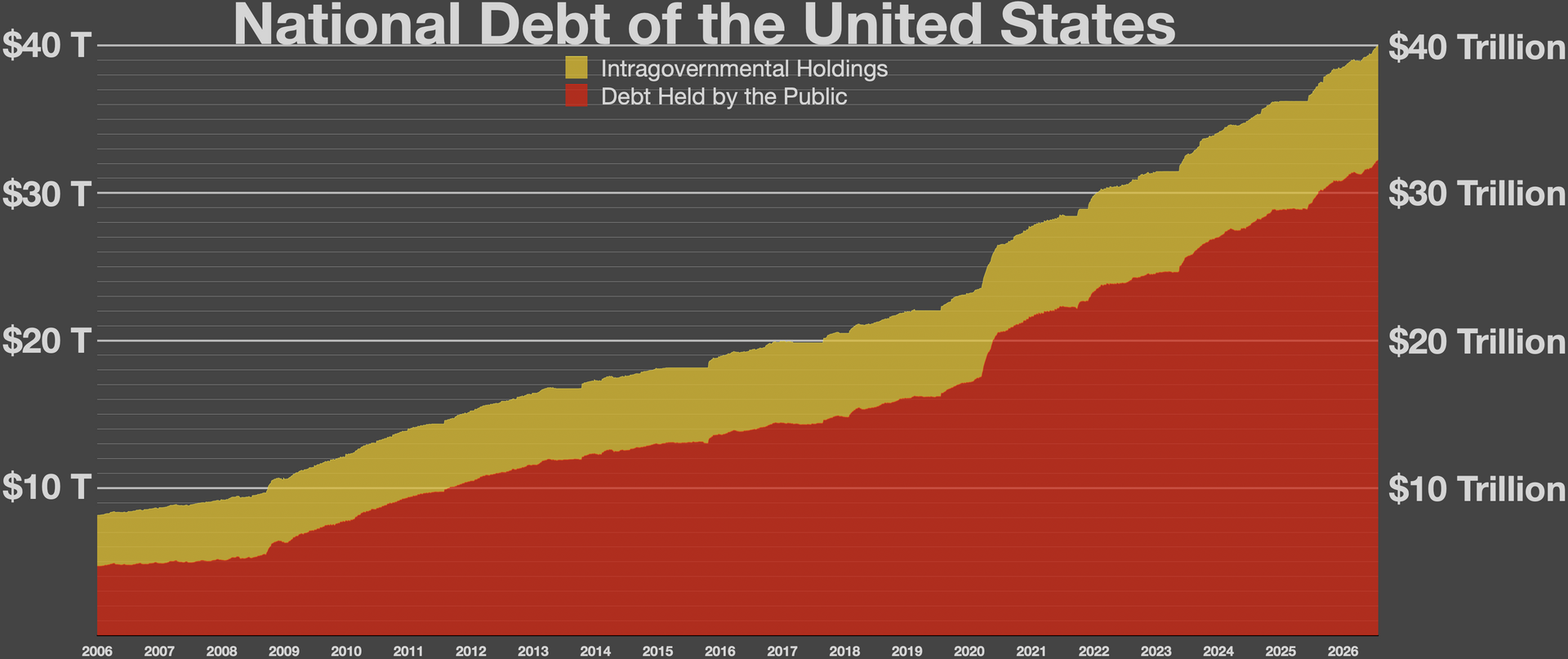
The national-debt debate is often reduced to the debt ceiling, but the harder issue is the gap between what Washington spends and what it collects. New Congressional Budget Office projections show why delay can make the eventual choices more difficult.
U.S. Congress faces a last chance to address the national debt before the choices become more disruptive, according to the fiscal path outlined by the Congressional Budget Office. Taking the U.S. national debt seriously means more than avoiding a debt-limit crisis: Congress must confront persistent annual deficits, rising borrowing costs and the mismatch between federal spending and revenue in the United States.
The urgency is not based on a single deadline. It comes from compounding projections. CBO expects debt held by the public to rise from 101% of gross domestic product in 2026 to 120% in 2036, while annual deficits grow from $1.9 trillion to $3.1 trillion.
The problem goes beyond the debt limit
The debt limit is often the most visible part of Washington’s borrowing debate, but it is not the same thing as a plan to reduce debt. The Treasury Department defines it as the total amount the federal government is authorized to borrow to meet legal obligations already approved by Congress and presidents.
Those obligations include Social Security and Medicare benefits, military pay, interest on Treasury securities, tax refunds and other payments. Raising or suspending the limit allows payment of bills already on the books; it does not authorize a new spending program by itself.
That distinction matters because debt-limit confrontations can create a false sense that lawmakers have addressed the broader fiscal problem. A vote to avert default may be necessary, but it leaves the underlying deficit untouched unless it is paired with changes to spending, taxes or both.
Treasury says Congress has acted 78 times since 1960 to permanently raise, temporarily extend or revise the debt limit. That record reflects a recurring reality: the ceiling is a constraint on financing prior commitments, while fiscal policy determines the commitments that require financing.
CBO sees larger deficits ahead
CBO’s February 2026 budget outlook describes deficits as large by historical standards. The agency projects a $1.9 trillion deficit in fiscal 2026, equal to 5.8% of GDP, rising to $3.1 trillion, or 6.7% of GDP, by 2036.
For comparison, deficits averaged 3.8% of GDP over the past 50 years, according to CBO. A single year of heavy borrowing can be explained by recession, war or emergency relief. A decade of deficits far above that long-run average creates a more structural challenge.
In CBO’s baseline, federal outlays total 23.3% of GDP in 2026 and rise to 24.4% by 2036. Revenue is projected at 17.5% of GDP in 2026 and 17.8% in 2036. The central issue is the gap between those two lines.
That gap cannot be closed by rhetoric about waste alone. Any durable change would require lawmakers to weigh some mix of restraint in spending, changes to tax policy, reforms to major programs, faster economic growth or measures that affect all of those areas.
Interest costs narrow the options
Debt becomes harder to manage when interest consumes a growing share of the budget. CBO says outlays will rise in part because of increasing net interest costs, alongside growth in mandatory programs.
Higher debt does not automatically produce a fiscal crisis. The United States retains substantial economic capacity, a large tax base and Treasury securities that play a central role in global finance. Those strengths are reasons analysts differ over how quickly Congress should tighten fiscal policy.
Still, interest payments are less flexible than many other budget items. They are the cost of honoring past borrowing. As more resources go to interest, Congress has less room to respond to recessions, disasters, security needs or new domestic priorities without further borrowing or new revenue.
This is why the debate is not merely about a large headline debt number. The practical question is whether federal policy is on a stable enough path that borrowing remains affordable when the next economic downturn or emergency arrives.
The tradeoffs are politically difficult
There is no painless debt strategy. Spending reductions can affect households, states, contractors and services that depend on federal programs. Tax increases can reduce disposable income or change incentives for businesses and investors. Rapid deficit reduction can also weaken demand if imposed during a fragile economy.
Advocates of faster action argue that gradual, predictable adjustments are fairer than waiting until markets, interest costs or a future crisis force abrupt decisions. They generally favor setting a credible long-term target and making changes before the debt path becomes more entrenched.
Others caution against treating all deficits alike. Borrowing during a downturn can support employment and stabilize incomes, while investments in infrastructure, research or children may produce longer-term economic benefits. They argue that the quality of spending and the timing of deficit reduction matter as much as the size of the debt.
Both arguments point to the same congressional responsibility: distinguish temporary borrowing from a permanent structural imbalance, and make those choices openly rather than allowing automatic growth in debt to become the default policy.
A plan needs more than a target
Congress has repeatedly considered commissions, budget rules, spending caps and revenue changes intended to improve the fiscal outlook. The difficulty is enforcement. A target without agreed policies can be waived when it collides with political priorities; cuts without broad support can be reversed.
A serious framework would identify what is being measured, how quickly the deficit should fall and what happens if lawmakers miss their benchmarks. It would also need to account for the programs and tax provisions that drive the long-term outlook rather than concentrating only on annual appropriations.
Transparency matters as well. Voters can reasonably disagree about the balance between taxes, defense, health programs, retirement benefits and domestic spending. They cannot make an informed choice if each side presents debt reduction as cost-free or claims the debt ceiling alone resolves the issue.
Delay changes the eventual choices
CBO’s outlook is a projection, not a prediction set in stone. Economic growth, inflation, interest rates, legislation and international events can all alter the numbers. Its baseline also follows rules about current law that may not capture every future policy decision.
But uncertainty cuts both ways. Better growth or lower rates could improve the outlook, while weaker growth, higher borrowing costs or additional deficit-increasing legislation could worsen it. Waiting for perfect certainty is not a fiscal strategy.
The clearest takeaway is that Congress does not need to choose between paying existing bills and addressing future debt. It must do both. Avoiding default protects the government’s credit today; a credible budget plan would determine whether the United States has more flexibility tomorrow.
Sources: Congressional Budget Office, “The Budget and Economic Outlook: 2026 to 2036,” February 2026; U.S. Department of the Treasury, “Debt Limit.”
Leave a Reply