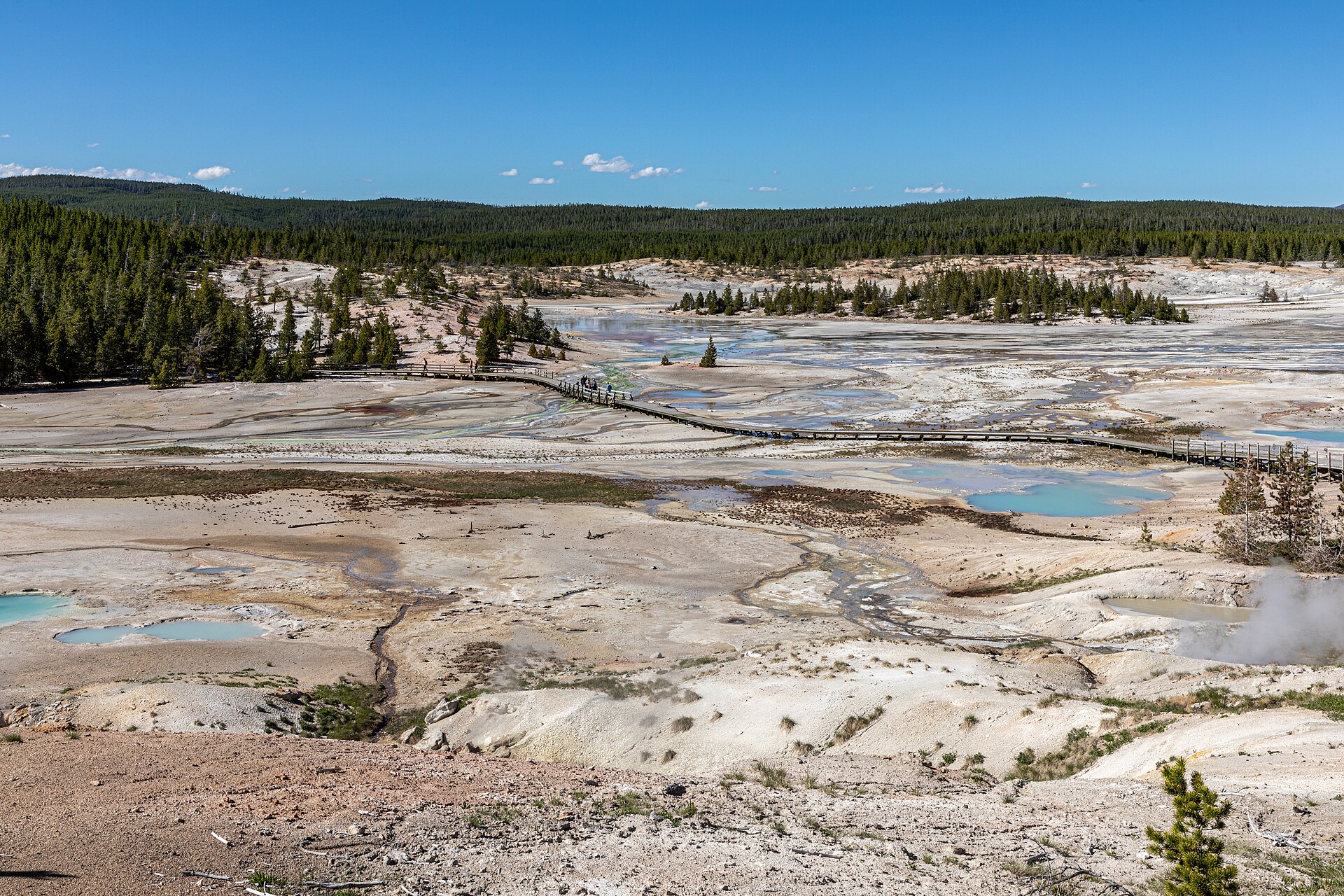
The resurfacing account of Colin Scott’s death is not a new Yellowstone incident. It is a stark, well-documented reminder of why visitors are told never to leave marked paths around the park’s boiling, acidic thermal features.
On June 7, 2016, Colin Nathaniel Scott, a 23-year-old Oregon man, dipped his finger into a Yellowstone hot spring near Norris Geyser Basin in Yellowstone National Park, Wyoming, before he accidentally fell into the hot spring and died. Officials later said the boiling, acidic water dissolved his remains so completely that they could not be recovered.
The story has resurfaced online under a dramatic headline, but it concerns a 2016 incident, not a newly reported death. Its lasting relevance is Yellowstone’s warning to visitors: thermal areas can be lethal, including beyond the marked boardwalks.
The fatal fall near Norris Basin
Scott visited Yellowstone with his sister, Sable Scott, according to a park incident report described by CNN and the BBC. The pair had left the defined boardwalk area in Norris Basin and were looking for a place to soak in a thermal feature, a prohibited activity commonly called “hot potting.”

Yellowstone deputy chief ranger Lorant Veress told local station KULR and later news outlets that they were in an unauthorized area specifically seeking a pool they could enter. Scott reached down to test a spring’s temperature, slipped and fell into the water, officials said.
The distinction matters. Yellowstone’s hydrothermal zones are not ordinary hot springs designed for recreation. The ground can be unstable, the water’s chemistry varies sharply from one feature to another, and a visitor may not be able to judge a pool’s danger from its appearance.
Why recovery was not possible
Searchers initially located Scott’s body in the spring, according to accounts of the incident report. A lightning storm prevented a recovery operation that day.
When rescuers returned the following day, no remains could be found beneath the pool’s churning water. Veress said there had been “a significant amount of dissolving” in a very short time.
That detail is often reduced online to a sensational claim. The more precise account is that park officials said the acidic, thermally heated feature had dissolved the remains before they could be retrieved. The original report did not turn the tragedy into a spectacle; it documented the extreme conditions in an area closed to public access.
Scott’s sister was recording on a cellphone when he fell, but the National Park Service did not release the video, according to CNN and the BBC. Keeping that material private was consistent with treating the event as a fatal accident rather than viral content.
Thermal pools are not swimming holes
Yellowstone is famous for geysers, colorful pools and steam vents because the park sits atop one of the world’s most active geothermal landscapes. Those same natural forces create serious hazards.
In reporting on Scott’s death, officials explained that the springs’ acidity is connected to thermal water rising from underground and interacting with sulfur compounds. Microorganisms also play a role in the chemistry of some thermal features.
The result is a landscape where bright colors and calm-looking water can mask dangerous conditions. There is no safe rule of thumb based on color, steam, depth or whether a pool looks shallow enough to approach.
- Boardwalks and marked trails are intended to keep visitors away from unstable ground and hazardous water.
- Area closures are safety boundaries, not suggestions for a more secluded experience.
- Putting a hand, foot or other object into a thermal feature can create risk even before someone gets close enough to fall.
- Swimming or soaking in Yellowstone’s thermal pools is prohibited.
The boardwalk rule has a purpose
Veress described Yellowstone as a “very unforgiving environment” after the incident. That is the key lesson behind the park’s repeated instructions to stay on designated trails.
Visitors sometimes see a boardwalk as a barrier between them and a better photograph or a more unusual experience. In a hydrothermal basin, it is closer to basic protective equipment. It keeps people off thin crusts that may conceal scalding water, mud or steam below.
That safety message is not limited to the most famous features. Risk can exist across geothermal areas, including places that seem quiet, remote or unoccupied. A closed zone may be harder to monitor, but it is not less hazardous.
There is also an environmental reason for respecting the route. Thermal features are fragile ecosystems, and stepping off a trail can damage formations and microbial communities that have developed over long periods.
An old story, a current warning
Readers encountering headlines about a man who “dissolved” in Yellowstone should know the basic timeline: Scott died on June 7, 2016, and details of the incident report became public later that year. The BBC reported that the information emerged after a freedom-of-information request by local television news.
That context does not make the event less tragic. It does prevent a recycled headline from implying that Yellowstone has just had another similar accident.
It also restores the central fact sometimes lost in retellings: Scott’s death occurred after he and his sister left the boardwalk in an attempt to find a place to hot pot. Officials’ account points to unauthorized access, a slip while checking the water and a rescue made impossible by both weather and the spring’s conditions.
What remains clear for visitors
There are limits to what public reporting can explain about the final moments, and the unreleased video should not be treated as evidence for online speculation. The official account is clear on the facts that matter for public safety.
Colin Scott’s death was a 2016 accident in an unauthorized Yellowstone thermal area. The park’s hot springs can be intensely hot and acidic, rescue may not be immediately possible, and remaining on boardwalks is the most direct way visitors can reduce a preventable risk.
Yellowstone’s thermal landscape is extraordinary precisely because it is active and largely natural. Seeing it safely means accepting the distance the park requires.
Leave a Reply