The law’s passage showed Trump’s grip on the GOP, but also exposed the tensions inside a narrow governing majority. Its size and scope will keep the political fight alive long after the signing ceremony.
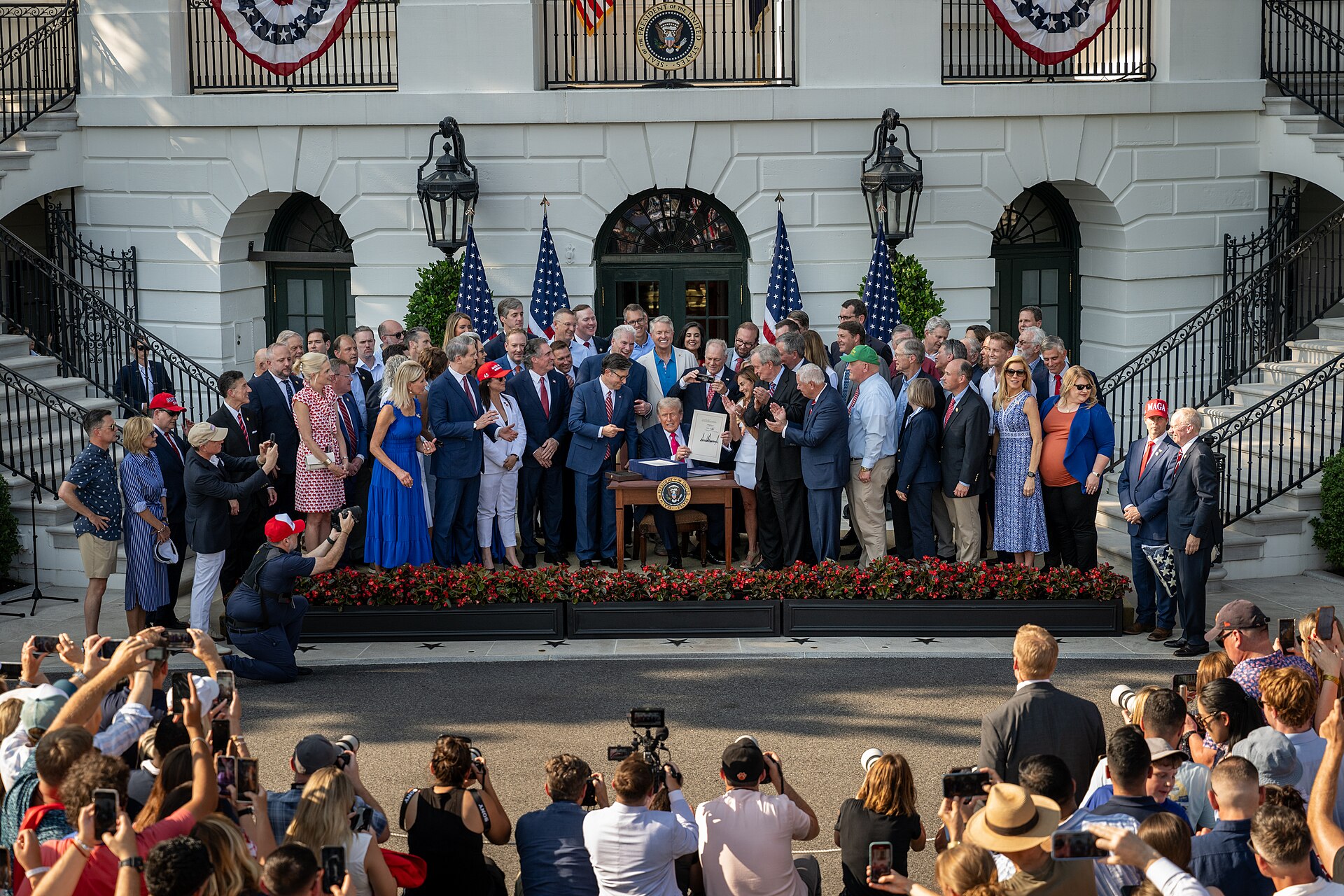
President Donald Trump signed the One Big Beautiful Bill Act into law after the bill became law following conflict with Republican lawmakers, turning a bruising internal GOP fight into a major legislative win for Trump.
The measure, identified in Congress.gov records as H.R. 1 and formally titled the One Big Beautiful Bill Act, became the signature legislative achievement of Trump’s second term, according to CNN’s description of the congressional passage and Reuters’ account of the signing.
A win built through pressure
The politics of the bill were always bigger than its title. Trump needed Congress to deliver a sweeping package that could prove his return to the White House had legislative force behind it, not just executive orders and campaign-style messaging.
Republican lawmakers, meanwhile, had to decide how much of Trump’s agenda they were willing to carry in one massive bill. Some wanted deeper spending cuts. Others worried about political blowback from changes to safety-net programs or the size of the overall package.
That tension is why the bill’s passage matters. It showed Trump could still force movement inside his party, even when GOP lawmakers were uneasy about parts of the product they were being asked to defend.
What the bill actually covers
The official Congress.gov text makes clear that the One Big Beautiful Bill Act was not a narrow tax measure. It was a reconciliation bill, a fast-track budget vehicle that allowed Republicans to package multiple priorities together and move them through Congress under special rules.
The table of contents in the House-passed text spans agriculture, nutrition programs, defense, education and workforce policy, among other areas. Reuters described the measure as a major tax-cut and spending bill, while CNN framed it as the first major legislative achievement of Trump’s second term.
That breadth was part of the strategy. A single large bill can unite different factions by giving each group something to claim. It can also create problems, because lawmakers who like one section may be forced to vote for another section that is harder to explain back home.
For Trump, the all-in-one approach had a political advantage: it turned scattered policy goals into one loyalty test for congressional Republicans.
Why GOP lawmakers resisted
The phrase “locked horns” captures the central drama without needing much embellishment. Trump and Republican lawmakers were not fighting over whether his agenda should advance. They were fighting over how far, how fast and at what political cost.
Fiscal conservatives often want large packages to cut more spending and reduce deficits. Members from competitive districts tend to worry about changes that Democrats can cast as harmful to working families, students, farmers or seniors. Leadership’s job is to keep those worries from becoming defections.
Reconciliation bills intensify those pressures because they are built to pass with narrow partisan support. That means every holdout can gain leverage, and every concession can anger another faction.
The result was a familiar Washington bargain: the president pushed for a visible victory, party leaders counted votes, and reluctant lawmakers had to choose between their objections and the cost of denying Trump his top legislative win.
The reconciliation route mattered
The One Big Beautiful Bill Act moved as H.R. 1, “to provide for reconciliation pursuant to title II of H. Con. Res. 14,” according to Congress.gov. That procedural language is dry, but it is central to how the bill became law.
Budget reconciliation is powerful because it can allow major tax and spending legislation to avoid the usual Senate filibuster threshold. In practice, that can let the majority party pass a major bill without needing broad bipartisan support.
That power comes with limits. Reconciliation measures must be tied to budgetary effects, and provisions can be challenged if they stray too far from taxes, spending or debt. The process rewards discipline, but it also creates a scramble to fit policy promises inside budget rules.
For readers, the takeaway is simple: the bill became law not only because Trump pressured Republicans, but because Republicans used the procedural tool best suited to pass a large partisan governing package.
Supporters see proof of control
Supporters of the law can point to the outcome and argue that the system worked for a party with unified control. Trump campaigned on a broad agenda, Republicans won enough power to act, and Congress delivered a bill carrying the president’s brand and priorities.
From that view, internal conflict was not a failure. It was the normal price of legislating. Big bills almost always require concessions, and lawmakers often protest loudly before voting yes.
The signing ceremony reported by Reuters underscored the image Trump wanted: a president surrounded by Republican congressional leaders and lawmakers, turning months of negotiation into a public victory.
That image matters in a second term. Presidents often struggle to keep Congress focused as political incentives begin shifting toward the next election. A major early win can define the governing agenda and pressure the party to stay aligned.
Critics see political risk
Critics see the same bill differently. A large partisan package can become an easy target because it bundles many controversial choices into one vote. Democrats can attack the whole law, or isolate specific provisions that poll poorly.
The official text’s range of subjects gives opponents plenty to scrutinize. Nutrition policy, education financing, defense spending and tax policy all affect different groups in different ways. That makes the law both sweeping and vulnerable.
There is also a governing risk for Republicans. Passing a bill is one thing; defending its consequences is another. Once agencies implement the law, voters may judge it less by Trump’s branding and more by what changes in household budgets, benefits, schools, farms, defense communities and local services.
That is where the fight shifts next. The law gave Trump the win he wanted, but it also gave both parties a concrete record to campaign on.
What remains unresolved
The biggest unanswered question is whether the One Big Beautiful Bill Act will be remembered as a governing breakthrough or as a partisan overreach. That will depend on implementation, economic conditions and how clearly each party can explain the law’s effects.
Trump’s immediate achievement is not in doubt: he signed the bill into law, and Republican lawmakers handed him a major legislative victory. The deeper story is that the win came through friction, not harmony.
That distinction matters. The law proves Trump can still bend the Republican Party toward his priorities. It also shows that his party’s governing coalition contains real fault lines over spending, taxes and the political risks of moving fast.
For now, the One Big Beautiful Bill Act stands as the clearest legislative marker of Trump’s second term: a massive victory, a test of GOP unity and a fight that did not end when the ink dried.
Leave a Reply