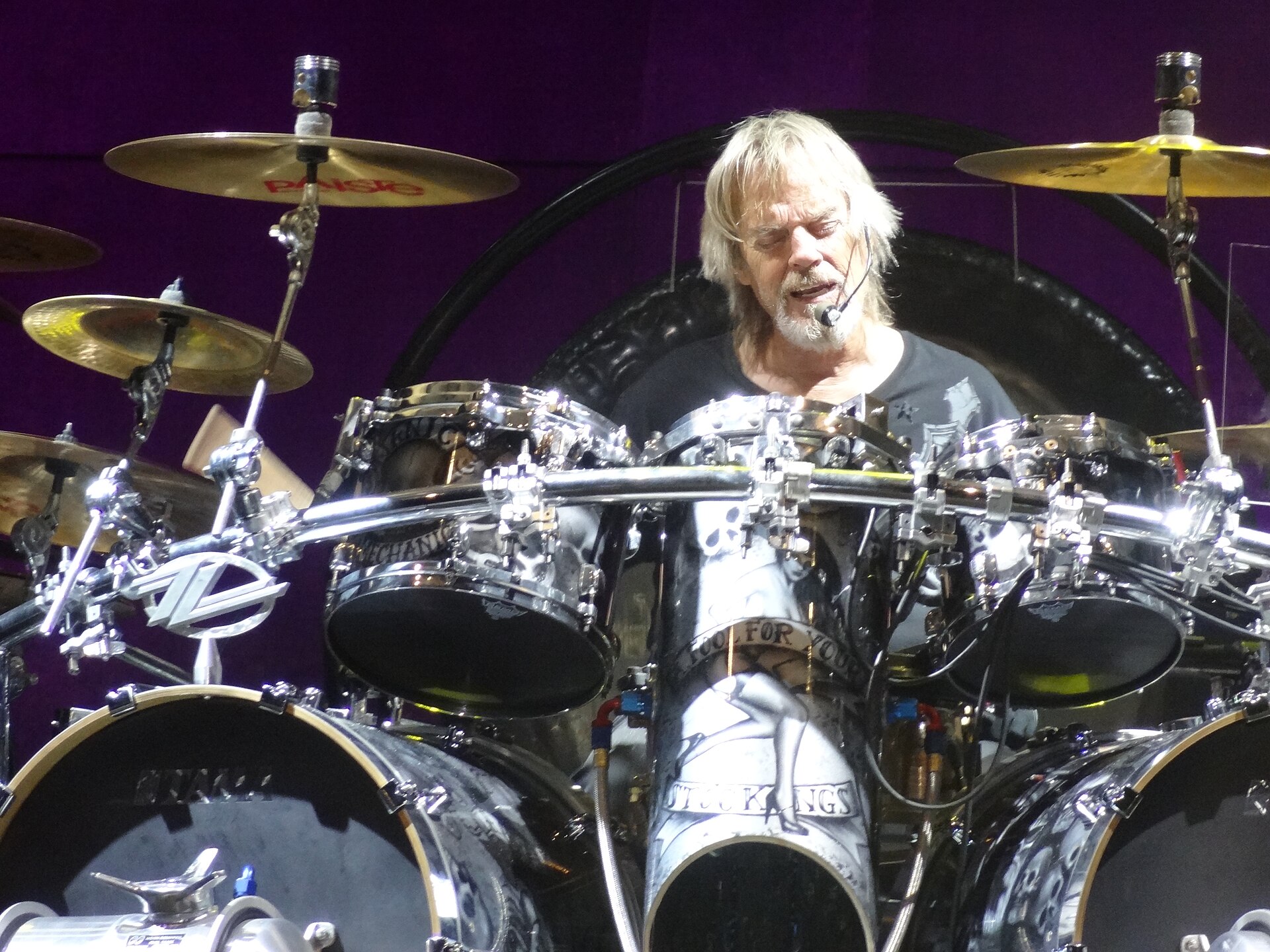
Frank Beard was the steady rhythmic force behind ZZ Top’s blues-rock sound, from early Texas club dates to the MTV era. His death marks another profound loss for a band whose core lineup stayed intact for decades.
Frank Beard died at age 77 on Aug. 17, 2026. The Grammy-nominated rocker was ZZ Top’s longtime drummer, playing with the Texas blues-rock band for 56 years and helping power songs including “La Grange,” “Tush” and “Sharp Dressed Man.”
Beard’s death leaves guitarist and singer Billy Gibbons as the sole surviving member of ZZ Top’s best-known lineup following bassist Dusty Hill’s death in 2021. For fans, the loss lands as the band had been on the road and preparing to resume dates on The Big One Tour.
A 56-year run behind ZZ Top
Beard joined ZZ Top shortly after the group formed, alongside Hill, a musician he had already played with in several earlier Texas bands. He appeared on the group’s 1971 debut, ZZ Top’s First Album, where he was credited as “Rube Beard.”
His tenure became one of the defining facts of ZZ Top’s story. Beard, Gibbons and Hill developed a durable three-piece chemistry that took them from blues-rooted bar-band grooves to arena rock, MTV saturation and eventual Rock and Roll Hall of Fame recognition.
That consistency matters because ZZ Top’s sound was never just the work of its frontman and famously bearded bassist. Gibbons’ guitar and Hill’s bass-and-vocal presence were instantly recognizable, but Beard supplied the compact, hard-driving pulse that held the band’s boogie-rock songs together.
In the 2019 documentary ZZ Top: That Little Ol’ Band from Texas, Beard recalled an early eight-hour rehearsal with Gibbons. Gibbons remembered the drummer as playing “fiercely” and with determination—qualities listeners could hear in the band’s lean, no-frills attack.
His death followed a tour absence
A representative for the band told USA Today that Beard died while in hospice care at his ranch in Richmond, Texas, with family members by his side. No further details about the cause of death were provided in the statement cited by the newspaper.
Earlier in August, Beard had stepped away from ZZ Top’s The Big One Tour because of health issues. Drummer Michael Monahan took his place for the scheduled performances.
Beard had also taken a temporary break from touring in 2025 for an undisclosed medical issue that reports linked to his foot and ankle. The recent absence gave fans an indication that he was facing health challenges, though the band did not publicly spell out the full nature of his condition.
ZZ Top said it would cancel shows scheduled for Aug. 18 and 19, then planned to return on Aug. 22 and 23 at ACL Live at the Moody Theater in Austin, Texas. The band described Austin as a city that had become a second home for Beard and called the venue one of his favorites.
The drummer without the famous beard
There was a long-running joke at the center of ZZ Top’s visual identity: the member named Beard was the only one in the classic trio who did not wear the group’s signature long facial hair. While Gibbons and Hill became pop-culture icons with their matching beards, sunglasses and hats, Beard generally wore a mustache and curly hair.
The contrast made him easy to overlook in a band whose videos often put flashy cars, sharply dressed characters and Gibbons’ guitar work front and center. Yet his playing was central to the precision beneath the spectacle.
ZZ Top’s early records drew from Texas blues, rock and boogie, producing staples such as “La Grange” and “Tush.” In the 1980s, the band broadened its reach without entirely shedding that grit, combining its guitar-driven sound with synthesizers, tightly made pop hooks and videos made for the MTV era.
“Gimme All Your Lovin’,” “Sharp Dressed Man,” “Legs” and “Rough Boy” turned ZZ Top into a far bigger commercial force. Beard’s role was rarely theatrical, but his disciplined drumming helped make those stylistic shifts feel connected rather than scattered.
A classic lineup already changed
Hill’s death at 72 in 2021 was the first major rupture in ZZ Top’s classic era. The band continued performing, honoring Hill’s reported wish that longtime guitar technician Elwood Francis take over on bass.
Beard’s death creates a different situation. He was not merely a substitute-era member or a sideman brought in for a single album cycle; he was part of the group’s working foundation for virtually its whole recording career.
Gibbons is now the only surviving member from the lineup associated with ZZ Top’s greatest commercial success. That reality will inevitably sharpen the debate around what continuation means for a legacy act: whether a band’s name represents its songs and its surviving founder, or whether it is inseparable from the particular people who created its defining sound.
There is no single answer that satisfies every fan. Some will see future concerts as a living continuation of a catalog built to be played loud. Others may view Beard’s passing as the point at which the original band’s long story should be treated as complete.
What remains uncertain for ZZ Top
At the time of the announcement, the immediate question was whether the scheduled Austin shows would go ahead after the two canceled dates. The band had said it intended to resume the tour, but it had not publicly detailed a longer-term plan following Beard’s death.
Monahan had already been filling in for Beard, which gives ZZ Top an experienced touring replacement if performances continue. Still, a practical lineup decision is not the same as settling the larger artistic question hanging over the group.
For now, Beard’s legacy is unusually clear. He was a Grammy-nominated rock musician, a Rock and Roll Hall of Fame band member, and the drummer whose economy and toughness helped ZZ Top turn regional Texas blues-rock into an international institution.
His death also returns attention to the rare durability of the Gibbons-Hill-Beard partnership. For decades, ZZ Top appeared to be built on an almost improbable permanence. With Beard gone, that defining trio belongs fully to the band’s history.
Leave a Reply