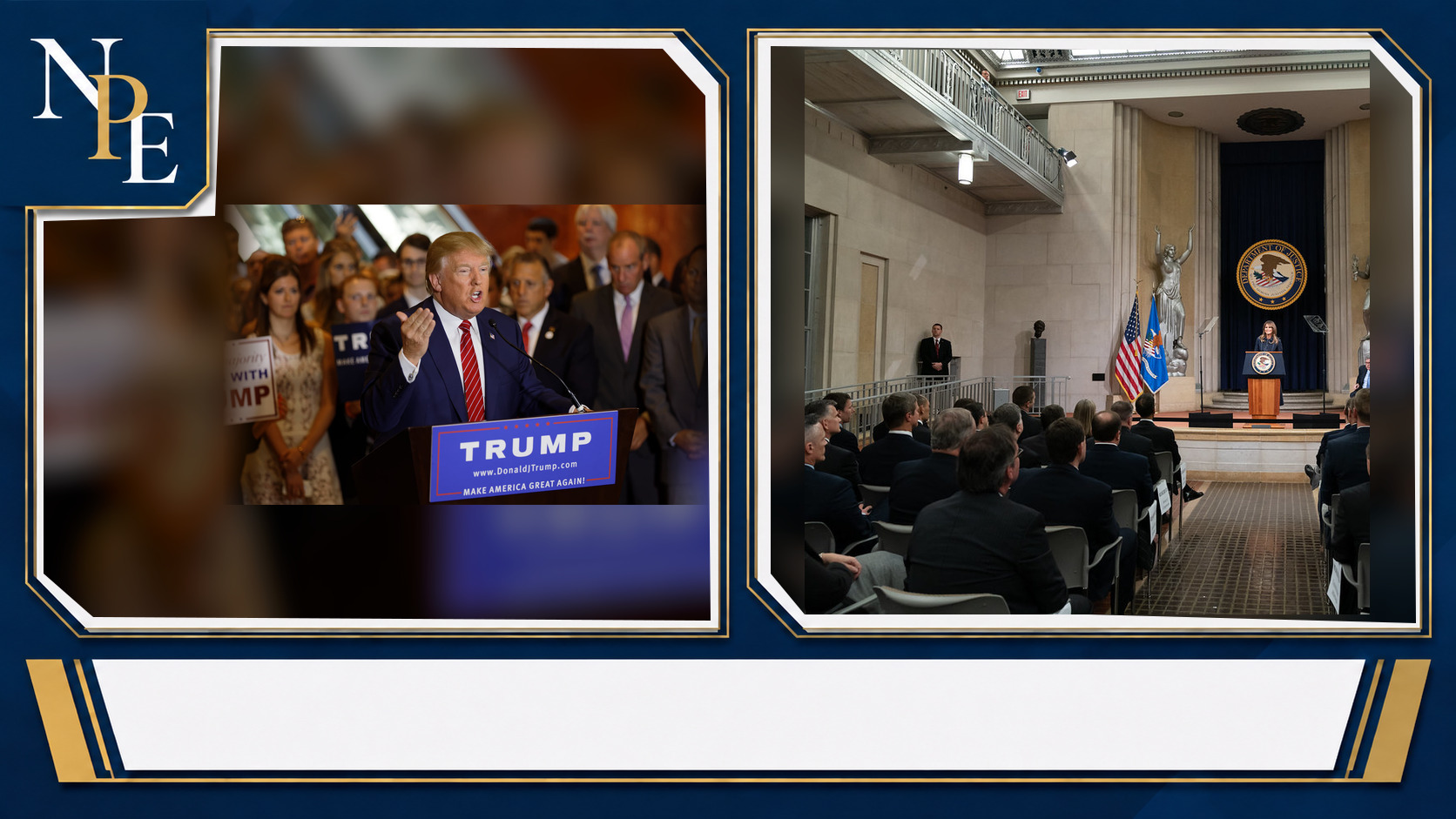
A White House construction dispute has shifted from design and event space to presidential authority and national security. The change in argument is now central to the legal fight over whether the project can proceed.
Donald Trump envisioned the White House ballroom in Washington, D.C., as a project for beauty and space. Now Trump’s ballroom is being presented as a national-security project — or, in Trump’s words, a “military complex” — as U.S. courts question his authority to build it and the Justice Department defends the administration’s position in the legal dispute.
The shift matters because the proposed ballroom is no longer being argued over only as an addition to the White House. It has become a test of how far a president can go in remaking a historic federal property, and whether a national-security rationale can change the legal calculation.
From event space to security claim
The Wall Street Journal reported that Trump’s vision for a White House ballroom stretches back more than a decade. When he announced the project last year and said part of the White House would be demolished to make room, the public rationale emphasized appearance and capacity.
A ballroom, in that framing, was meant to solve a practical hosting problem while giving the presidential complex a more expansive ceremonial space. The language was about aesthetics, convenience and scale — an idea familiar to a president whose public identity has long been tied to buildings and design.
That description has changed as the project moved into court. The Journal reported that Trump has called the ballroom “vital to our national security” and referred to it as a “desperately needed National Security structure for the people of the United States.”
Calling it a military complex is a striking escalation in the description of a project that began as a ballroom. It places the dispute in a different political and legal frame: not whether the White House should have a larger event venue, but whether the president needs this structure to carry out responsibilities connected to national defense.
The appeal raises the stakes
According to the Journal, the administration’s national-security argument culminated in an appeal to the Supreme Court on Friday. The immediate legal question is tied to whether construction can continue after lower courts raised doubts about Trump’s authority to move ahead.
The available reporting does not lay out every filing, lower-court ruling or Justice Department argument in detail. It does establish the central conflict: courts have questioned the president’s power to build the project, while the administration has answered with a much broader claim about security needs.
That creates two sharply different ways of viewing the same construction plan. Opponents can see a major alteration to a historic public building that must satisfy legal and preservation limits. Supporters of the administration’s position can argue that courts should give substantial weight to a president’s assessment of the operational needs of the White House.
The Supreme Court appeal does not itself settle those competing views. It signals, however, that the administration sees the dispute as important enough to seek rapid intervention from the nation’s highest court.
Why the White House is different
Construction at the White House is never a routine real-estate matter. The building is a working executive residence, a venue for diplomacy and ceremonies, a protected historic landmark, and a heavily secured federal site.
Those overlapping roles help explain why even a project described as an event space can quickly generate questions about security, authority and public stewardship. Changes may affect ceremonial functions, visitor access, protective planning and the physical character of one of the country’s most recognizable public buildings.
They also make the debate unusually difficult to separate into neat categories. A ballroom can have logistical implications for security and state events. At the same time, describing it as a national-security structure does not automatically answer the separate questions of legal authorization, process or institutional oversight.
The unresolved tension is whether the security rationale reflects an operational necessity or a litigation strategy — or some combination of both. The accessible reporting attributes the national-security language to Trump but does not provide a detailed public account of the specific security functions the proposed ballroom would perform.
A fight over presidential power
The legal dispute reaches beyond the fate of one ballroom. It concerns the limits on presidential control over the White House complex and the role courts can play when an administration seeks to alter it.
Presidents have broad responsibility for the executive branch and for the secure functioning of the presidency. But federal buildings, historic sites and public funds can also be governed by statutory requirements, appropriations rules, review processes and restrictions that do not disappear simply because a project is favored by an administration.
That is why the Justice Department’s role matters. Its task in the case is not merely to advocate for a building project; it is to make the legal case that the administration has authority to proceed, including under the circumstances it characterizes as involving national security.
Critics are likely to argue that attaching a security label to a contested project should not shield it from normal scrutiny. The administration’s likely counterpoint is that judges should be cautious before blocking a president’s judgment about the functional and security requirements of the White House.
What remains unclear
Several important facts remain unsettled in the public account available here. It is unclear what specific features make the ballroom an integrated military or national-security facility, how construction would be managed if the administration prevails, and what limits a court may ultimately place on the project.
It is also unclear whether the Supreme Court will take up the administration’s request, what immediate relief it may seek, or how quickly the dispute could be resolved. An appeal can focus on a narrow question about construction while leaving larger issues for later proceedings.
For now, the project’s evolution is the central story. Trump’s White House ballroom began publicly as a promise of more beauty and more room for events. In court, it is being defended in language normally reserved for the nation’s security infrastructure.
That reframing may help define the next stage of the fight. The outcome will determine more than whether a ballroom is built: it could clarify how much legal weight a president’s national-security justification carries when it is used to support changes to a historic seat of government.
Leave a Reply