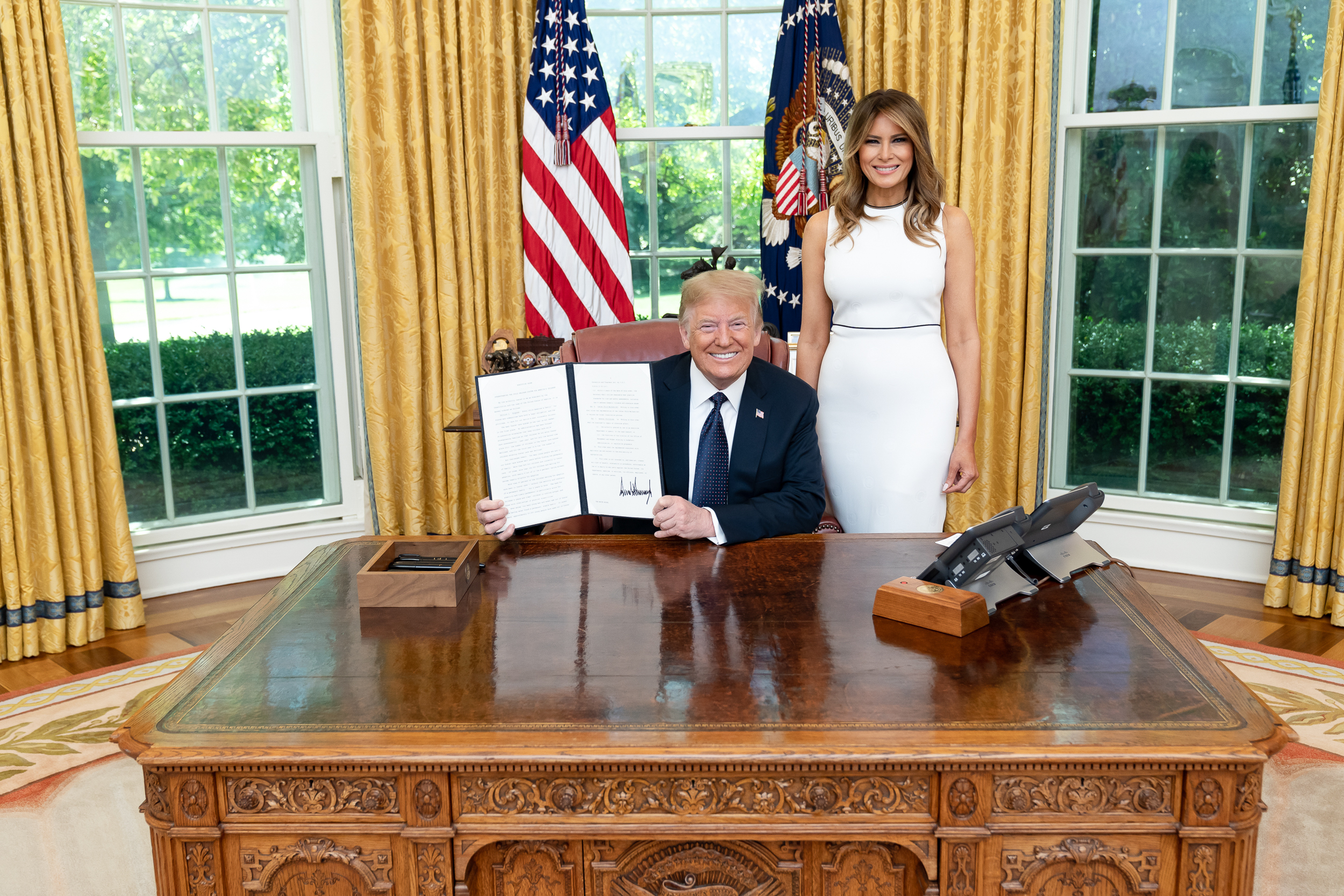
The fight is not just about Washington bureaucracy. Federal jobs are local paychecks, and cuts can land hardest in states whose leaders often campaign against big government.
Donald Trump’s executive order is linked to job losses in red states, with Republican-led states losing jobs as the United States government workforce is reshaped by his policy changes. This article explains the employment impact of Trump’s policy changes: roughly 8,000 jobs are at the center of the latest fight over whether a Trump executive order and related federal cuts are hitting communities that backed him.
The claim has gained traction because it scrambles an easy political story. Federal workforce reductions are often sold as a strike against Washington, but many federal workers do not live in Washington at all.
The order behind the fight
The policy at issue is not a simple layoff memo. A White House executive order titled Implementing Schedule Policy/Career in the Excepted Service, identified as Executive Order 14410, says certain policy-influencing federal jobs should be moved into a new category called Schedule Policy/Career.
The White House says the goal is accountability. The order argues that the president depends on executive-branch employees to carry out the priorities voters elected him to pursue, and that workers in policy-determining or policy-advocating roles should be easier to remove for poor performance or misconduct.
That language matters because federal civil service protections have long made many career jobs harder to politicize or quickly eliminate. Critics see the order as part of a broader push to weaken those protections and make it easier to purge or pressure career staff.
The reporting now circulating around the story puts about 8,000 jobs in the debate. The extracted material does not make clear whether that figure refers only to completed job losses, planned cuts, or a wider set of affected positions, which is why the number should be read as central to the dispute rather than a fully explained government tally.
Why red states are exposed
The phrase “red states bleeding jobs” lands because it points to a geographic irony. Republican-led states often send politicians to Washington who promise to shrink the federal government. Yet those same states can rely heavily on federal paychecks, federal facilities, military installations, public-land agencies, veterans’ services, and regional offices.
A federal job cut does not stay inside an agency chart. It can mean fewer salaries spent at local grocery stores, fewer families paying rent or mortgages, and less demand for restaurants, repair shops, child care, and other services.
That is why the employment impact can be bigger than the number of positions on paper. A lost federal job can also weaken contractor work, state and local partnerships, and the private businesses that serve federal employees.
For smaller communities, even a modest federal workforce reduction can be visible. In a large metro area, dozens of lost positions may disappear into the churn of the labor market. In a rural county or mid-sized city, the same cut can feel like a plant closing.
The White House argument
The White House order frames the change as a management reform, not a punishment of workers or states. It says Schedule Policy/Career positions are to be filled based on merit and not political affiliation.
The order also says existing adverse-action procedures make removals so difficult that many supervisors believe they cannot effectively remove employees who engage in serious misconduct or underperform. In that telling, the problem is a federal system that protects failure and slows an elected president’s agenda.
Supporters of Trump’s approach argue that elections should have consequences inside the executive branch. If voters choose a president who promises to change policy, they say, senior or policy-influencing employees should not be able to slow-walk that agenda from career posts.
That argument has political force, especially among voters who view the federal bureaucracy as insulated from accountability. It also helps explain why a workforce order can be presented as reform even when critics describe the same policy as a threat to civil service independence.
The critics’ core concern
The sharpest criticism is that “accountability” can become a polite word for political control. Career civil servants are not supposed to be elected officials, but they are also not supposed to be replaced wholesale because they are seen as insufficiently loyal.
Critics of the order and the wider government-cutting effort argue that weakening job protections creates a chilling effect. Employees may become less willing to give candid advice, enforce rules against powerful interests, or preserve institutional knowledge that outlasts any one administration.
There is also a practical concern: the federal government does not only write regulations. It processes benefits, inspects workplaces, manages public lands, staffs weather and emergency systems, supports veterans, handles research, and coordinates with state governments.
If cuts remove experienced employees faster than agencies can adapt, the result may be slower service rather than leaner service. That is the line between government reform and government breakdown.
The politics of local pain
The red-state angle is politically uncomfortable for both parties. Democrats can point to job losses in Republican-led states as evidence that anti-government rhetoric has real costs. Republicans can counter that a bloated federal payroll should not be preserved simply because it is spread across friendly territory.
For governors and members of Congress, the calculation is trickier. It is easy to campaign against “Washington bureaucracy” in the abstract. It is harder when the bureaucracy is a federal office in a home district, a national park gateway town, a veterans’ facility, or a defense-adjacent employer.
That tension has appeared in many budget fights over the years. Lawmakers may denounce federal spending broadly while defending specific facilities, contracts, grants, and jobs in their own states.
The current fight follows that familiar pattern but adds a Trump-specific twist: an executive order aimed at reshaping the career workforce could deliver economic consequences in places where Trump’s political coalition is strongest.
What still needs proving
The strongest version of the claim is that Trump’s executive order and related cuts are directly causing job losses in red states. The weaker, but still important, version is that the order is part of a broader policy environment that makes those losses more likely.
Those are not the same thing. A job can disappear because of an executive order, an agency reorganization, a budget reduction, a hiring freeze, a buyout, a contract change, or a separate decision by political appointees. Untangling those causes requires more detailed agency-by-agency data than the extracted source material provides.
That uncertainty does not make the story meaningless. It means the most honest reading is narrower: Trump’s workforce policy is being blamed for thousands of affected jobs, and the backlash is growing because the pain is being described in red-state terms.
The takeaway is simple. Cutting the federal workforce is not just a Washington story. If the jobs are spread across the United States, the consequences will be spread across the United States too — including in the Republican-led states where shrinking government remains a powerful political promise.
Leave a Reply