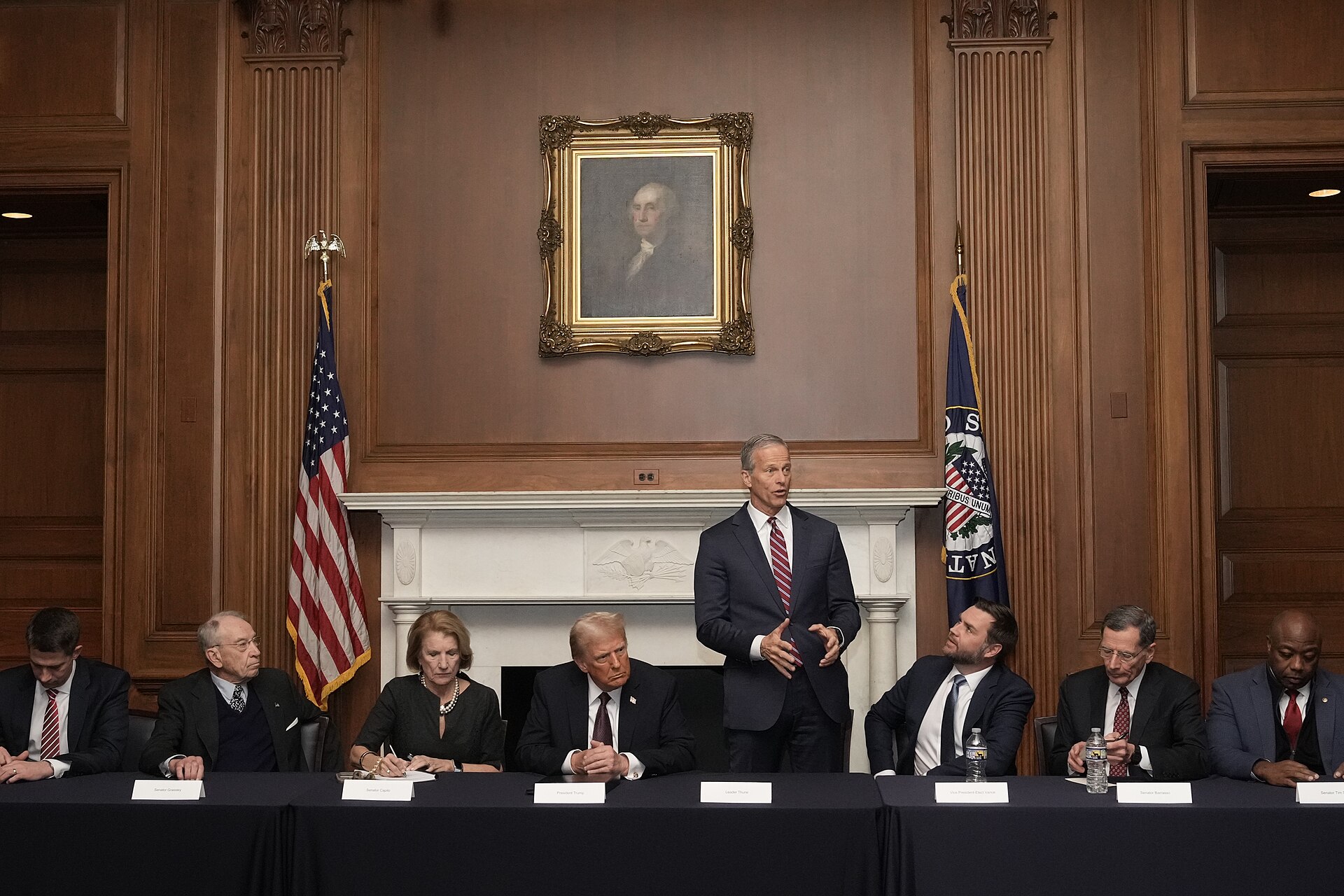
The fight is less about the Senate calendar than the limits of a 53-seat majority trying to pass a voting bill that needs 60 votes. It also tests how much pressure Trump can put on Republican leaders before the midterms.
Donald Trump is demanding that Senate Majority Leader John Thune keep the Senate in session in Washington after Monday’s escalation rather than let the chamber begin the Senate’s upcoming August break, until the SAVE America Act passes. The SAVE America Act is a strict proof-of-citizenship voting bill, but Republicans hold a 53-47 majority in the 100-member Senate and face a 60-vote threshold for most legislation.
Trump’s demand now puts a scheduling fight, a voting-rules clash and Thune’s leadership math in the same spotlight: cancel the August break to force a vote, or acknowledge that Republicans still cannot advance the bill.
Trump targets the Senate calendar
According to an Associated Press report published by PBS, Trump called on Thune not to allow senators to leave town until they pass the SAVE America Act. He also renewed his push for Republicans to eliminate the legislative filibuster, the Senate rule that effectively requires 60 votes to move most bills forward.

That demand lands at an awkward time for Thune. The Senate’s August break is scheduled to begin Aug. 7, giving the majority leader only a narrow window to manage a packed agenda and a restless Republican base.
Trump later told reporters that he has a good relationship with Thune, while also saying the majority leader has “got to get his job done,” according to the AP account. The message was friendly in tone but blunt in substance: Trump wants movement, not procedural explanations.
Thune’s problem is arithmetic
The central obstacle is not whether Thune can keep senators physically in Washington. It is whether he can find votes that do not currently appear to exist.
Republicans control the Senate 53-47. That gives them a governing majority, but not enough to break a filibuster on most legislation without Democratic support. Thune has repeatedly said Republicans lack the votes both to pass the bill under current rules and to change the rules to get around the filibuster.
Trump’s preferred answer is to terminate the filibuster or find a workaround. Thune’s answer has been more cautious: if senators do not have the votes, more floor time alone will not solve the problem.
That gap between political pressure and Senate procedure is the heart of the dispute. Trump is treating the SAVE America Act as a must-pass priority. Thune is treating it as a bill trapped by the same Senate math that has blocked many majority-party wish lists.
What the SAVE bill would do
The SAVE America Act, short for Safeguard American Voter Eligibility, would create new national requirements for voter registration and voting. The AP report says it would require Americans to prove citizenship when registering to vote, largely through documents such as a valid U.S. passport or birth certificate.
It would also require valid photo identification before voters cast ballots, a rule that already exists in some states but not as a uniform federal standard.
Supporters frame the bill as an election-integrity measure and argue that federal elections need tougher safeguards. Trump has made the bill a major legislative priority and has claimed it is necessary to prevent election cheating.
Critics and voting-rights experts warn the measure could block eligible voters who do not have easy access to documents such as birth certificates or passports. The AP report cited experts who said about 20 million Americans could be affected because they lack such paperwork readily available.
A workaround is also stuck
House Republicans have tried to open another route through the budget reconciliation process, which can allow some measures tied to taxes and spending to pass the Senate with a simple majority rather than 60 votes.
That path is narrower than a standard bill. The AP report says the House last week approved a budget framework that included $10 billion for voting-related changes aligned with the SAVE America Act.
Even there, Thune has said Republicans do not currently have the votes. That matters because reconciliation is not a magic button; provisions must fit budget rules, and senators still have to agree on the strategy.
For Trump and conservative activists, the workaround may look like proof that leadership has options. For Thune, it appears to be another version of the same problem: Republicans are close enough to control the chamber, but not aligned enough to force the bill through.
GOP pressure is building
The fight has become bigger than one voting bill. It is now a test of how Senate Republicans respond when Trump and the party base demand aggressive tactics from leadership.
Utah Sen. Mike Lee, who has pushed hard for the bill, warned late last week that how Republicans handle the SAVE America Act could affect not only the midterm elections but also Senate GOP leadership elections, according to the AP report.
That is a direct pressure point for Thune. He has generally retained support inside the Republican conference, but this issue gives critics a way to argue that leadership is moving too slowly or accepting defeat too early.
Thune has pushed back by urging Trump, Lee and others to help him find the votes. Trump said Friday he would be willing to call senators, according to the AP account. That offer may help rally Republicans, but it does not answer the bigger question of whether any Democrats would join them or whether enough Republicans would vote to weaken the filibuster.
Why the timing matters
The August break is not just vacation time. It is when senators return home, hold events, meet voters and prepare for the next political season. With midterm elections ahead, that time is valuable, especially for members facing competitive races.
The AP report noted that Republicans such as Maine Sen. Susan Collins, Ohio Sen. Jon Husted and Alaska Sen. Dan Sullivan are among those facing competitive races. Keeping senators in Washington could satisfy Trump’s demand for urgency, but it could also disrupt campaign planning and local visibility.
Thune also has other Senate priorities competing for floor time, including government funding, cryptocurrency legislation and sanctions on Russia. A prolonged standoff over the SAVE America Act could crowd out those items without guaranteeing a voting-bill victory.
That is the political risk for both sides. If Thune lets senators leave, Trump allies can accuse leadership of walking away from a signature election bill. If Thune keeps senators in session and the bill still fails, the party’s internal divisions become harder to hide.
What remains unresolved
The immediate question is whether Thune changes the Senate schedule before the Aug. 7 break. The deeper question is whether Trump’s pressure can alter the vote count, the filibuster fight or both.
For now, the SAVE America Act sits at the intersection of three Republican priorities: tightening voting rules, showing loyalty to Trump’s agenda and proving the Senate majority can deliver. The problem is that each priority runs into the same institutional wall.
Trump can demand that senators stay in Washington. Thune can keep the chamber open. But unless Republicans find 60 votes, change the rules or settle on a viable reconciliation strategy, the bill remains stalled.
That makes the August break fight a revealing one. It shows how much power Trump still has to set the Republican agenda — and how limited that power can be inside a Senate where a 53-seat majority is not always enough.
Leave a Reply